
Smart Thermostat Installation: Costs, Benefits, Compatibility
Explore smart thermostat installation costs, benefits, and compatibility to see if this energy-saving upgrade is right for your home.

By Joshua Benson
Learn more about Thermostat Installation or Repair for guides, costs, and what to expect.
Compare Thermostat Installation or Repair Pros Near You

Enter your ZIP code to compare top-rated local professionals and request free quotes.
Imagine adjusting your home's temperature from your phone while you are still at work, or having your heating system automatically lower itself when you leave for vacation. This is the everyday reality for homeowners who upgrade to a smart thermostat. Yet, the decision to install one often raises two immediate questions: what will it cost, and will it actually work with my existing HVAC system? This guide unpacks smart thermostat installation costs, benefits, and compatibility, giving you the clarity you need to make a confident, budget-smart choice for your home.
Breaking Down Smart Thermostat Installation Costs
The total cost of adding a smart thermostat involves two main components: the price of the device itself and the cost of professional installation. While the device price can range from $80 for a basic model to over $300 for a premium unit with advanced sensors, the installation fee is where many homeowners encounter surprises. On average, professional installation runs between $100 and $250, depending on your location, the complexity of your wiring, and the contractor's hourly rate.
One of the most attractive aspects of a smart thermostat upgrade is that many utility companies and local energy programs offer rebates or incentives that can significantly offset the upfront cost. In some regions, you can receive a rebate of $50 to $100 simply for purchasing a qualifying ENERGY STAR certified model. Additionally, some HVAC contractors offer promotional pricing that includes installation at no extra charge when you buy the thermostat through them. To maximize your savings, always ask your chosen contractor about current rebates and package deals before you commit.
Here is a quick breakdown of the typical cost range you can expect:
- Basic smart thermostat (device only): $80 to $150. These include Wi-Fi connectivity and basic scheduling features.
- Mid-range smart thermostat (device only): $150 to $250. These often feature geofencing, voice control, and energy usage reports.
- Premium smart thermostat (device only): $250 to $350. These add remote sensors, advanced algorithms, and higher-resolution displays.
- Professional installation (labor): $100 to $250. This includes wiring verification, mounting, and setup of the device and its app.
If you are replacing an older, non-programmable thermostat, the installation is usually straightforward. However, if your home has a high-voltage (line-voltage) heating system, such as baseboard heaters, or if you lack a common wire (C-wire), the installation may require additional work. Running a new C-wire or adding a power adapter can add $50 to $150 to your total cost. In these cases, hiring a professional ensures your new thermostat is powered safely and correctly, preventing potential damage to your HVAC system.
The Key Benefits That Justify the Investment
While the upfront cost is a consideration, the long-term benefits of a smart thermostat are substantial. The most immediate advantage is energy savings. According to the U.S. Department of Energy, a smart thermostat can save homeowners between 8% and 15% on their annual heating and cooling bills, primarily through automatic temperature adjustments and occupancy detection. Over the course of a year, these savings often amount to more than the installation fee, meaning the device pays for itself within a couple of seasons.
Beyond dollar savings, smart thermostats offer an unprecedented level of convenience and control. Imagine being able to adjust your home's temperature from your smartphone while you are lying in bed, or when you are away on a business trip and want to ensure your pipes do not freeze. Many models also provide detailed energy usage reports, showing you exactly when your HVAC system runs the most. This data empowers you to make small behavioral changes, such as lowering the temperature during peak hours, that lead to even greater efficiency.
Another benefit that is often overlooked is the positive impact on your HVAC system's health. By reducing unnecessary runtimes and maintaining a more consistent temperature, a smart thermostat can reduce wear and tear on your furnace or air conditioner. This can extend the lifespan of your equipment and decrease the frequency of costly repairs. Additionally, many smart thermostats send maintenance reminders, such as when to change your air filter, helping you stay on top of routine care that keeps your system running efficiently.
Compatibility: The Critical First Step Before You Buy
Before you purchase a smart thermostat, you must verify that it is compatible with your home's heating and cooling system. Not all thermostats work with all HVAC configurations. The most common systems, such as forced-air furnaces and central air conditioners, are usually compatible with most smart thermostats. However, heat pumps, multi-stage systems, and systems with electric auxiliary heat may require specific models or an additional accessory, such as an O/B wire adapter.
The most important technical factor is the presence of a C-wire, or common wire. This wire provides a continuous 24-volt power supply to the thermostat, which is essential for its Wi-Fi connectivity and backlit display. If your current thermostat has no C-wire, you have a few options. Some smart thermostats are designed to draw power from the existing wires (power stealing), but this can occasionally cause issues with older systems. The most reliable solution is to have a professional run a new C-wire from your HVAC system to the thermostat location, or to install a plug-in power adapter near the thermostat.
To determine your system's compatibility, start by turning off the power to your HVAC system at the circuit breaker and removing the faceplate of your current thermostat. Note the letters on the terminals where the wires are connected. A system with a C-wire will show a terminal labeled 'C'. If you see only R, W, G, and Y wires, you likely need a professional to add a C-wire. For line-voltage systems (typical in some apartments and older homes), you will need a specialized smart thermostat designed for 120V or 240V circuits, which is a different product category entirely.
If you are unsure about any of these steps, or if you simply want the peace of mind that comes with a guaranteed, safe installation, hiring a licensed HVAC professional is the best course of action. A qualified technician can quickly assess your system, recommend a compatible model, and handle the installation, saving you time and preventing potential electrical issues.
Estimating Your Return on Investment
To decide if a smart thermostat is a worthwhile purchase for you, calculate your potential payback period. Start by reviewing your annual energy bills for heating and cooling. Then, apply a conservatively estimated savings rate of 10%. For example, if you spend $1,800 annually on heating and cooling, a 10% savings equals $180 per year. If your total installation cost is $300, your payback period would be less than two years. After that, the savings go directly into your pocket.
It is important to note that your actual savings will vary based on your climate, the size of your home, your daily schedule, and how consistently you use the thermostat's energy-saving features. For instance, a household that is empty during the workday will see greater savings than one with people home all day. Similarly, those who take advantage of geofencing, which uses your phone's location to adjust the temperature when you leave and return, will maximize their efficiency gains.
Navigating Installation: DIY vs. Professional
If your system has a C-wire and you are comfortable working with basic electrical components, a DIY installation is feasible for many homeowners. The process typically involves removing your old thermostat, labeling the wires, and connecting them to the corresponding terminals on the new device. Most smart thermostat manufacturers include detailed instructions and even offer augmented reality tools to help you through the process. However, if you encounter any wires that do not match the standard labeling, or if you are uncertain about any step, it is best to stop and call a professional.
For most people, professional installation is worth the cost for several reasons. First, it guarantees that the wiring is correct, which is crucial for both the thermostat's operation and the safety of your HVAC system. A miswired thermostat can cause short cycling, which forces your furnace or AC to turn on and off rapidly, leading to increased energy use and potential damage. Second, a professional can also verify that your HVAC system is functioning correctly before connecting the new device. Finally, many smart thermostat manufacturers require professional installation for the full warranty to remain valid.
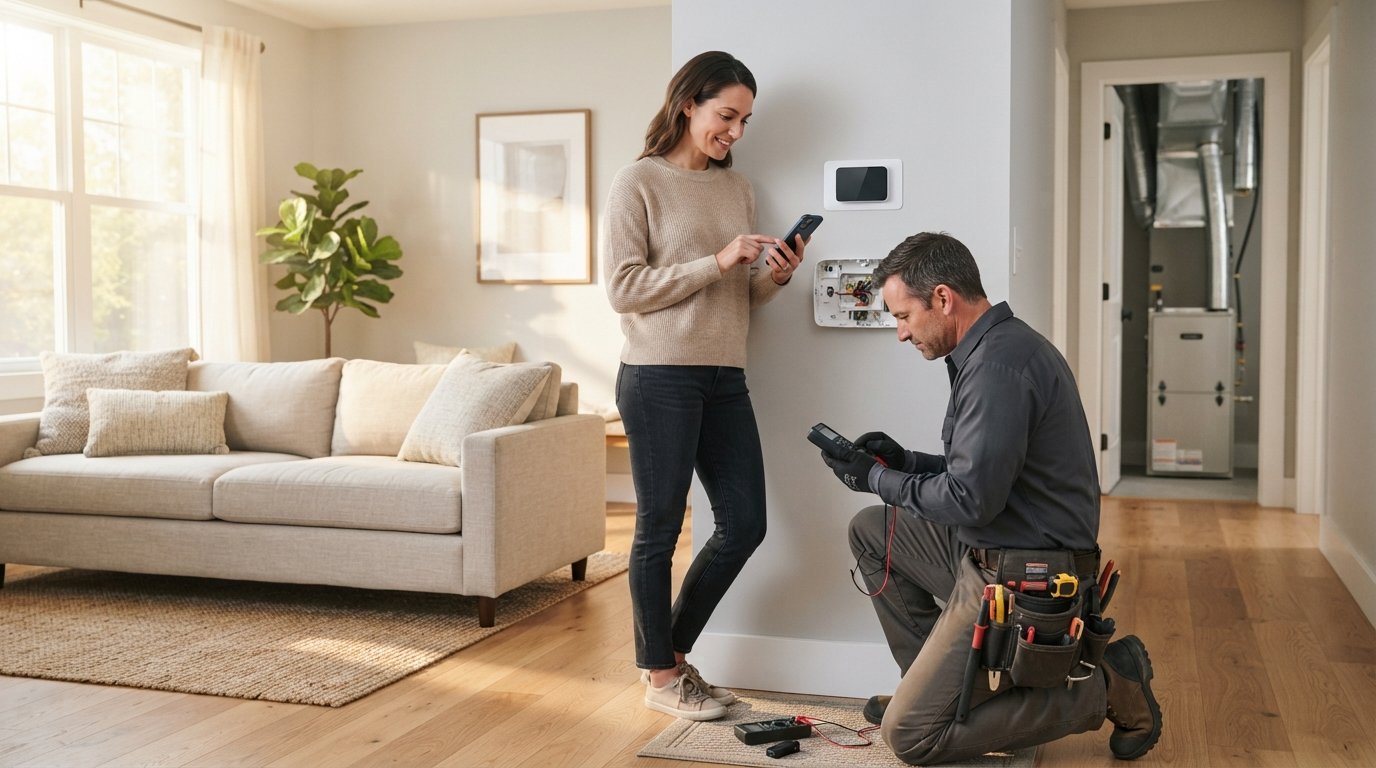
When you hire a professional, they will typically handle every step, from mounting the thermostat base to connecting the wires and configuring the Wi-Fi and app settings. They will also walk you through the basic features and answer any questions you have. To get the best value, request quotes from multiple contractors. For a project like this, you can easily compare pricing and expertise online. Many homeowners find that using a platform like FreeQuotes.Contractors is a smart way to connect with pre-vetted local HVAC professionals who can provide detailed, no-obligation estimates. This approach not only saves time but also gives you confidence that you are getting a fair price from a qualified technician.
Smart Features That Enhance Comfort and Efficiency
Modern smart thermostats are more than just remote controls for your HVAC system. They are sophisticated learning devices that can adapt to your lifestyle. For example, some models use occupancy sensors to detect when you are home and adjust the temperature accordingly, a feature known as home/away assistance. Others can learn your preferred temperature schedule after just a few days of manual adjustments, creating a personalized program that maximizes comfort and efficiency.
Voice control is another popular feature. Most smart thermostats are compatible with major voice assistants, such as Amazon Alexa, Google Assistant, and Apple HomeKit. This allows you to change the temperature with simple voice commands, such as 'Alexa, set the thermostat to 72 degrees.' This hands-free control is especially useful when you are cooking, carrying groceries, or simply relaxing on the couch.
Energy reporting is a feature that offers tangible, long-term value. Instead of receiving a vague monthly bill, you can see a daily and weekly breakdown of your HVAC run times, energy consumption, and estimated costs. Some devices even compare your usage to that of similar homes in your area, giving you a benchmark for your performance. These insights can help you identify inefficient periods, such as when the temperature is set high while the house is empty, and make adjustments to save more.
How to Choose the Right Smart Thermostat for Your Home
With so many models on the market, selecting the right smart thermostat can feel overwhelming. The best place to start is by identifying your specific needs. If you want a simple, reliable device that learns your schedule, a popular option is the Google Nest Learning Thermostat. If you are deeply integrated into the Apple ecosystem, an Ecobee thermostat with HomeKit support might be a better fit. Consider the following factors to help narrow down your choices:
- Compatibility: Confirm that the thermostat supports your HVAC system type (single-stage, multi-stage, heat pump, etc.) and that you have a C-wire or a viable solution to add one.
- Features: Decide which features are essential for you. Do you need remote sensors for multi-room comfort? Is voice control a must-have? Are you interested in energy reports?
- Budget: Set a clear budget that includes installation. Remember that a higher upfront cost may be offset by greater energy savings over time.
- Brand ecosystem: If you have other smart home devices, such as smart speakers or lighting, choose a thermostat that integrates seamlessly with your existing ecosystem.
Once you have a shortlist of models, read reviews from other homeowners to learn about real-world performance and reliability. Pay attention to comments about the mobile app's user-friendliness, the accuracy of the temperature sensors, and the responsiveness of customer support.
After you make your selection, the next step is to schedule the installation. Whether you choose a DIY approach or hire a professional, ensure that you have the necessary tools and a clear understanding of the process. If you hire a pro, obtain estimates from at least three contractors. This not only helps you find the best price but also gives you the opportunity to ask questions about their experience with smart thermostat installations and their recommendations for your specific system.
Conclusion: The Smart Move for Your Home
A smart thermostat is an investment in your home's comfort, efficiency, and long-term value. While the smart thermostat installation costs and compatibility questions are important, they are manageable with the right information and professional guidance. By calculating your potential savings, verifying your system's compatibility, and choosing a qualified installer, you can enjoy the convenience, control, and energy savings that smart technology provides. Start by getting quotes from trusted professionals in your area, and take the first step toward a more intelligent and cost-effective home climate system today.