
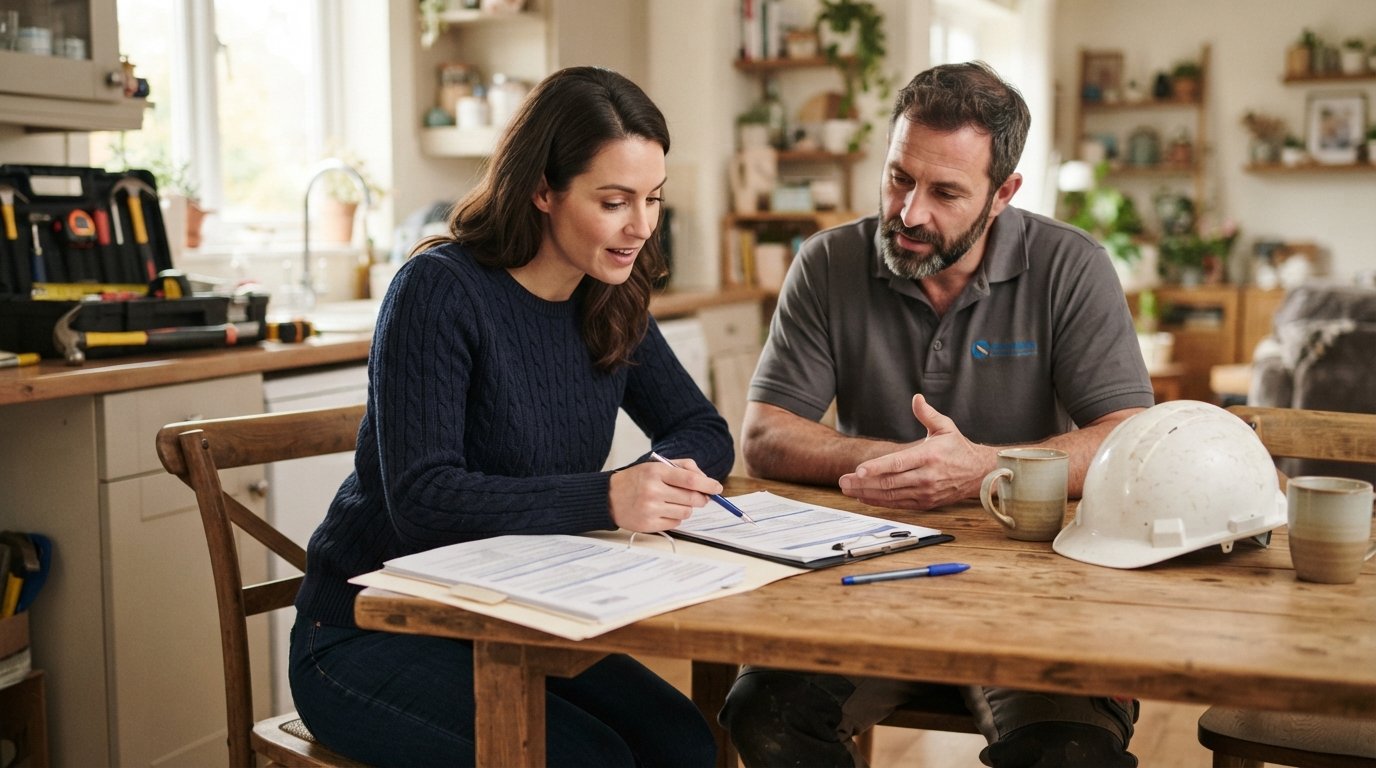
7 Types of Contractor Insurance Homeowners Must Verify
Verify contractor insurance before hiring to avoid liability. Call (833)-365-8755 for expert guidance on types of contractor insurance homeowners should verify.

By Jessica Reis
Learn more about General Contracting for guides, costs, and what to expect.
Compare General Contracting Pros Near You

Enter your ZIP code to compare top-rated local professionals and request free quotes.
Hiring a contractor for a home improvement or repair project is a significant investment, and the last thing you want is to be held financially responsible for an accident or defect. Yet many homeowners skip a critical step: verifying that the contractor carries adequate insurance. Without proper coverage, you could be on the hook for medical bills, property damage, or legal fees if something goes wrong. In this guide, we break down the types of contractor insurance homeowners should verify before signing a contract, so you can protect yourself and your property.
Why Contractor Insurance Matters to Homeowners
When a contractor works on your property, their actions can affect you financially. If an uninsured worker is injured on your property, you might be liable for their medical expenses. If a contractor accidentally damages your neighbor's property, you could be sued. And if a contractor's work is defective, you might have to pay for repairs out of pocket. Contractor insurance is designed to protect both the contractor and you, the homeowner, from these risks.
Unfortunately, not all contractors carry sufficient insurance, and some may misrepresent their coverage. That is why it is essential to verify the types of contractor insurance homeowners should verify. Doing so ensures that if an accident occurs, you are not left holding the bag. It also gives you peace of mind that the contractor is professional and financially responsible.
In this article, we cover seven key types of insurance and bonding that you should confirm before any work begins. We also explain how to request and verify certificates of insurance and what can happen if you skip this step.
1. General Liability Insurance
General liability insurance is the foundation of contractor coverage. It protects against third-party claims of bodily injury or property damage that occur during the contractor's work. For example, if a contractor accidentally knocks over a ladder that hits a passerby, or if their equipment damages your neighbor's fence, general liability insurance would cover the resulting costs.
As a homeowner, you should verify that the contractor's general liability policy has adequate limits. Most standard policies have limits of $1 million per occurrence and $2 million aggregate, but the right amount depends on the project size. For larger projects, you may want to see higher limits or an umbrella policy (see below).
To verify coverage, ask for a certificate of insurance (COI) that lists the policy limits, effective dates, and the insurer's name. You can also call the insurer directly to confirm the policy is active. Do not rely solely on a paper certificate, as it can be altered.
2. Workers' Compensation Insurance
Workers' compensation insurance covers medical expenses and lost wages for employees who are injured on the job. In most states, contractors with employees are required by law to carry workers' comp. If a contractor does not have this coverage and a worker is injured on your property, you could be sued for the injury.
Homeowners often assume that the contractor's general liability policy covers worker injuries, but it does not. General liability excludes injuries to the contractor's own employees. That is why workers' comp is a separate and crucial coverage.
When verifying workers' comp, check that the policy is in the contractor's business name and that it covers all employees who will be on your site. If the contractor is a sole proprietor with no employees, they may be exempt from workers' comp in some states, but you should still confirm this in writing.
3. Umbrella Insurance
Umbrella insurance provides additional liability coverage beyond the limits of general liability and workers' comp policies. It kicks in when a claim exceeds the underlying policy limits. For example, if a contractor's general liability policy has a $1 million limit and a claim is settled for $1.5 million, the umbrella policy would cover the remaining $500,000.
Homeowners should request umbrella coverage for large or high-risk projects, such as roof replacements, structural work, or projects involving heavy machinery. Even for smaller projects, an umbrella policy indicates that the contractor is well-insured and serious about risk management.
Ask for the umbrella policy's limits and confirm that it applies to the type of work being done. As with other policies, verify the coverage directly with the insurer.
4. Commercial Auto Insurance
If the contractor uses vehicles for business purposes, such as transporting materials or equipment to your site, they should have commercial auto insurance. Personal auto policies often exclude business use, so if a contractor causes an accident while driving for your project, their personal policy might not cover it.
Commercial auto insurance covers liability and physical damage for vehicles used in the business. While this may seem less critical for homeowners, it is part of a comprehensive insurance check. If a contractor's truck damages your driveway or garage door, commercial auto coverage would respond.
Verify this coverage by checking the contractor's certificate of insurance for commercial auto liability limits.
5. Surety Bonds
Surety bonds are not insurance, but they provide similar financial protection. A surety bond is a three-party agreement between the contractor (principal), the bonding company (surety), and the project owner (obligee). If the contractor fails to perform according to the contract, the surety company compensates the owner up to the bond amount.
There are different types of bonds, including license bonds, performance bonds, and payment bonds. License bonds are often required for contractors to obtain a license and protect consumers from fraudulent practices. Performance bonds guarantee that the contractor will complete the project according to the contract terms. Payment bonds ensure that subcontractors and suppliers are paid, preventing liens on your property.
Homeowners should verify that the contractor has the required bonds for their license and, for larger projects, a performance bond. You can check with your state or local licensing board to confirm bond requirements and verify that the contractor's bond is active.
6. Professional Liability Insurance (Errors and Omissions)
Professional liability insurance, also known as errors and omissions (E&O) insurance, covers claims of negligence or mistakes in professional services. For contractors, this might include design errors, faulty workmanship that causes financial loss, or failure to deliver services as promised.
While general liability covers bodily injury and property damage, professional liability covers financial losses due to errors. For example, if a contractor designs a home addition that later requires costly structural repairs due to a design flaw, professional liability could cover the cost.
Not all contractors carry this coverage, but it is particularly important for design-build firms and contractors who provide architectural or engineering services. Ask if the contractor has E&O coverage and verify the limits.
7. Builder's Risk Insurance
Builder's risk insurance covers structures under construction or renovation. It protects against damage from fire, wind, theft, and other perils during the project. While this is typically the responsibility of the contractor or the property owner, homeowners should confirm who is carrying this coverage.
If you are financing a major renovation, your lender may require builder's risk insurance. Even if not required, it is a good idea to ensure that the project is covered during construction. Ask the contractor if they carry builder's risk insurance or if you need to purchase it separately.
How to Request and Verify Certificates of Insurance
Verifying contractor insurance is a straightforward process if you know what to ask for. Follow these steps to ensure you are protected:
- Request a certificate of insurance (COI): Ask the contractor to provide a COI for each policy (general liability, workers' comp, commercial auto, and umbrella). The COI should list the policyholder's name, policy numbers, limits, and effective dates.
- Check the business name: Ensure the COI is in the name of the contracting business you are hiring, not an individual or a different company.
- Verify with the insurer: Call the insurance company listed on the COI to confirm the policy is active and the limits are accurate. Do not rely solely on the certificate.
- Confirm additional insured status: For larger projects, ask to be listed as an additional insured on the contractor's general liability policy. This gives you direct protection under their policy.
- Check bond status: Contact your state or local licensing board to verify the contractor's bond is active and in the correct amount.
It is also wise to keep copies of all insurance documents for your records. If a dispute arises, you will have proof that you exercised due diligence.
What Happens When a Contractor Is Underinsured
If you hire a contractor without verifying insurance, you expose yourself to significant financial risk. For example, if an uninsured worker falls from a ladder and breaks a leg, you could be responsible for their medical bills and lost wages. If the contractor damages your home or a neighbor's property, you might have to pay for repairs. And if the contractor's work is defective, you may have to cover the cost of fixing it.
Even if the contractor has some insurance, low limits can leave you underprotected. That is why it is important to verify not just the existence of coverage but also the limits. For large projects, consider requiring higher limits or additional insured status.
Finally, hiring an uninsured contractor can void your homeowner's insurance policy if the insurer determines that you failed to exercise reasonable care. That could leave you without coverage for a major loss.
Additional Tips for Homeowners
Beyond verifying insurance, take these steps to protect yourself when hiring a contractor:
- Get multiple quotes: Comparing bids helps you gauge fair pricing and spot red flags. For guidance on typical project costs, see our article on average remodeling project cost.
- Check licenses: Verify the contractor's license with your state or local licensing board.
- Ask for references: Speak with past clients about their experience.
- Use a written contract: Ensure the contract details the scope, timeline, payment schedule, and insurance requirements.
- Consider a platform: Services like Repairmen connect homeowners with vetted, licensed professionals, which can simplify the verification process.
By taking these steps, you can hire with confidence and avoid costly surprises.
Verifying contractor insurance is not just a formality; it is a critical part of protecting your home and finances. Make it a standard part of your hiring process for every project, big or small. When you know the types of contractor insurance homeowners should verify, you can ask the right questions and demand proof before work begins. That diligence pays off in peace of mind and financial security.
Learn more about General Contracting for guides, costs, and what to expect.
Compare General Contracting Pros Near You
Enter your ZIP code to compare top-rated local professionals and request free quotes.