
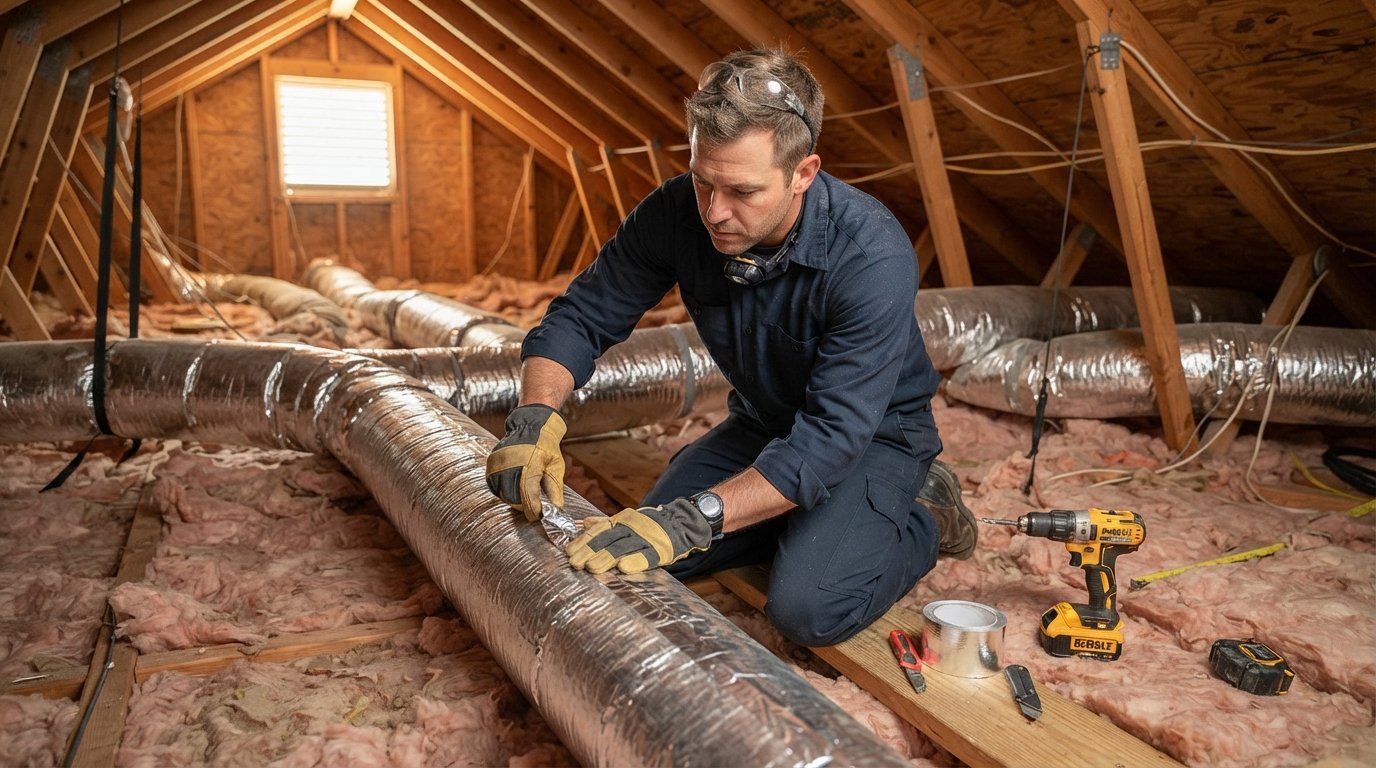
Ductwork Replacement Cost and Efficiency Gains: A Homeowner's Guide
Ductwork replacement cost and efficiency gains explained, including energy savings and payback. Call (833)-365-8755 for expert guidance.

By Jessica Reis
Learn more about Duct and Vent Installation or Removal for guides, costs, and what to expect.
Compare Duct and Vent Installation or Removal Pros Near You

Enter your ZIP code to compare top-rated local professionals and request free quotes.
Your HVAC system is only as good as the network of ducts that delivers conditioned air throughout your home. If you have noticed rising energy bills, uneven room temperatures, or excessive dust, your ductwork may be the culprit. Replacing aging, leaky ducts is a significant investment, but it can also unlock substantial efficiency gains and long-term savings. This guide breaks down the real costs of ductwork replacement, the efficiency improvements you can expect, and how to decide whether to seal or replace. We will also explore how combining ductwork with a furnace or heat pump upgrade can maximize your return on investment. Whether you are planning a major renovation or simply want to stop wasting energy, understanding the numbers is the first step toward a smarter, more comfortable home.
Understanding the True Cost of Ductwork Replacement
The cost of replacing ductwork varies widely based on your home's size, layout, and the complexity of the existing system. For a typical single-family home, whole-house duct replacement ranges from $2,500 to $8,000, with most homeowners spending around $4,500. However, larger homes with multiple zones or difficult access points (such as attics or crawl spaces) can push costs to $10,000 or more. Per linear foot, expect to pay between $15 and $55 for materials and labor, depending on the duct type and insulation R-value.
Several factors influence the final price. Accessibility is a major one: ducts buried in walls or ceilings are harder to reach and may require drywall repair. The type of duct material also matters. Flexible ductwork is generally cheaper to install than rigid metal ductwork, but it can be less durable and may restrict airflow if not properly sized. Insulation levels (R-value) add to the cost but improve efficiency. Finally, labor rates vary by region, with urban areas typically commanding higher prices.
To get a clearer picture, here is a breakdown of common cost components:
- Materials: $5 to $15 per linear foot for standard galvanized steel or flexible duct; higher for insulated or specialized ducts.
- Labor: $50 to $100 per hour, depending on local rates and job complexity.
- Permits and inspections: $100 to $500, required in many jurisdictions for HVAC modifications.
- Additional work: Sealing, insulation, or rerouting can add $500 to $2,000.
Keep in mind that these figures are national averages. For an accurate estimate tailored to your home, it is wise to obtain multiple quotes from licensed HVAC contractors. A professional assessment will also reveal whether partial replacement or sealing might suffice, potentially saving you thousands.
Signs You Need Duct Sealing Versus Full Replacement
Not all duct problems require a complete overhaul. Sometimes, sealing leaks and improving insulation can restore efficiency at a fraction of the cost. So how do you know which path is right for you? Start by looking for these warning signs:
- High energy bills: A sudden spike without a corresponding increase in usage often points to duct leaks.
- Uneven temperatures: Rooms that are consistently too hot or too cold suggest air is escaping before reaching its destination.
- Excessive dust: Leaky ducts can pull in dust and debris from unconditioned spaces like attics or crawl spaces.
- Visible damage: Torn flexible duct, disconnected joints, or crushed sections are clear indicators of problems.
If your ducts are relatively new (less than 15 years old) and made of rigid metal, sealing may be sufficient. Professional duct sealing involves applying mastic or specialized tape to all joints, seams, and connections. This can reduce leakage by 10 to 30 percent, according to the U.S. Department of Energy. However, if your ducts are old, made of flexible material that has deteriorated, or are undersized for your system, replacement is likely the better long-term solution. A qualified contractor can perform a duct leakage test to quantify the problem and recommend the most cost-effective approach.
It is also worth noting that some older homes have ductwork that was never properly designed for modern HVAC systems. In such cases, sealing may not address underlying issues like inadequate airflow or poor insulation. A full replacement allows for a redesigned layout that optimizes performance and comfort.
How Duct Design, Sizing, and R-Value Affect HVAC Performance
Ductwork is not just a series of pipes; it is an engineered system that must be carefully designed to deliver the right amount of air to each room. Incorrect sizing is a common problem. Ducts that are too small restrict airflow, forcing your blower motor to work harder and increasing energy consumption. Ducts that are too large can lead to poor air distribution and higher noise levels. Proper sizing, based on a room-by-room load calculation (Manual J), ensures that each space receives the correct CFM (cubic feet per minute) of air.
Insulation R-value is another critical factor. Ducts running through unconditioned spaces (attics, crawl spaces, garages) are subject to significant temperature loss. In a hot attic, uninsulated ducts can lose up to 30 percent of their cooling capacity. Insulating ducts to at least R-8 (for attics) or R-6 (for other unconditioned spaces) can dramatically reduce these losses. When replacing ductwork, always insist on properly insulated ducts that meet or exceed local energy code requirements.
Design also matters. A well-designed duct system minimizes bends and turns, uses smooth inner surfaces (like rigid metal) to reduce friction, and ensures balanced airflow. Flexible duct, while easier to install, can sag and create resistance if not supported properly. A professional contractor will use industry-standard software to design a duct system that matches your HVAC equipment and home layout, maximizing efficiency and comfort.
For homeowners considering a larger renovation, it may be helpful to consult resources on material selection and cost trade-offs. For example, our guide on the best material for a front door replacement illustrates how choosing the right materials can impact both upfront costs and long-term performance, a principle that applies equally to ductwork.
Combining Duct Replacement with a Furnace or Heat Pump Upgrade
If your furnace or air conditioner is nearing the end of its life (typically 15 to 20 years), replacing ductwork at the same time can be a smart move. A new high-efficiency furnace or heat pump will only perform at its rated efficiency if the duct system is in good condition. Leaky or undersized ducts can rob a new system of 20 to 30 percent of its efficiency, undermining your investment. By upgrading both together, you ensure that the equipment and the delivery system are matched for optimal performance.
Moreover, many utilities and government programs offer rebates for high-efficiency HVAC upgrades, and some require a duct leakage test as part of the qualification. Combining projects can streamline the process and potentially increase your rebate amount. From a practical standpoint, doing both at once minimizes disruption: the contractor can access ducts while the old equipment is removed, and you avoid paying for two separate mobilizations.
When considering a combined upgrade, think about the type of system you want. Heat pumps are increasingly popular for their efficiency in both heating and cooling, but they require properly sized and insulated ducts to deliver comfortable air without drafts. A qualified HVAC contractor can help you evaluate whether your existing ductwork can be adapted or should be replaced. They can also advise on the right SEER or AFUE ratings for your climate, ensuring you maximize energy savings.
Energy Savings and Payback Expectations by Climate
The financial return on duct replacement depends heavily on where you live and how much you run your HVAC system. In general, homes with leaky ducts in extreme climates see the highest savings. According to Energy Star, sealing and insulating ducts can improve heating and cooling efficiency by up to 20 percent, and in some cases, even more. Replacing old, leaky ducts can yield similar or greater improvements, especially when combined with a new high-efficiency HVAC system.
To estimate payback, consider your annual energy bills. If you spend $2,000 per year on heating and cooling and reduce consumption by 20 percent, you save $400 annually. A $5,000 duct replacement would then have a simple payback of about 12.5 years. However, in climates with long, hot summers or cold winters, savings can be higher, shortening the payback period. Conversely, in mild climates, the payback may be longer, but comfort improvements (like even temperatures and reduced dust) still add value.
It is also important to factor in potential utility rebates and tax credits. Many states and utilities offer incentives for duct sealing and insulation, and the federal government occasionally offers tax credits for high-efficiency HVAC upgrades. These can significantly reduce your net cost and improve the return on investment. Your contractor can help you identify available incentives.
For a more detailed analysis, you can use our cost estimation tools to model different scenarios based on your home's size and location. And when you are ready to find a qualified professional, Homes.Contractors offers a comprehensive directory of pre-vetted contractors across the United States, making it easy to compare quotes and choose the right expert for your project.
Making the Decision: Seal, Replace, or Upgrade
Deciding whether to seal, replace, or combine ductwork with an HVAC upgrade requires weighing costs, efficiency gains, and your long-term plans for your home. If your ducts are relatively new and the leaks are minor, sealing is a cost-effective first step. If your ducts are old, damaged, or poorly designed, replacement is likely the better investment, especially if you plan to stay in your home for several years. And if your HVAC equipment is also aging, a combined upgrade can deliver the best comfort and efficiency, often with the shortest payback.
Before committing, always get at least three quotes from licensed contractors. Ask each to perform a duct leakage test and a load calculation, and to explain their proposed design and materials. A trustworthy contractor will welcome your questions and provide transparent pricing. You can also check our guide on how to vet contractors to ensure you are working with a reliable professional.
Remember that ductwork replacement is not just an expense; it is an investment in your home's comfort, energy efficiency, and indoor air quality. By understanding the costs and efficiency gains, you can make an informed decision that pays off for years to come. Homes.Contractors