
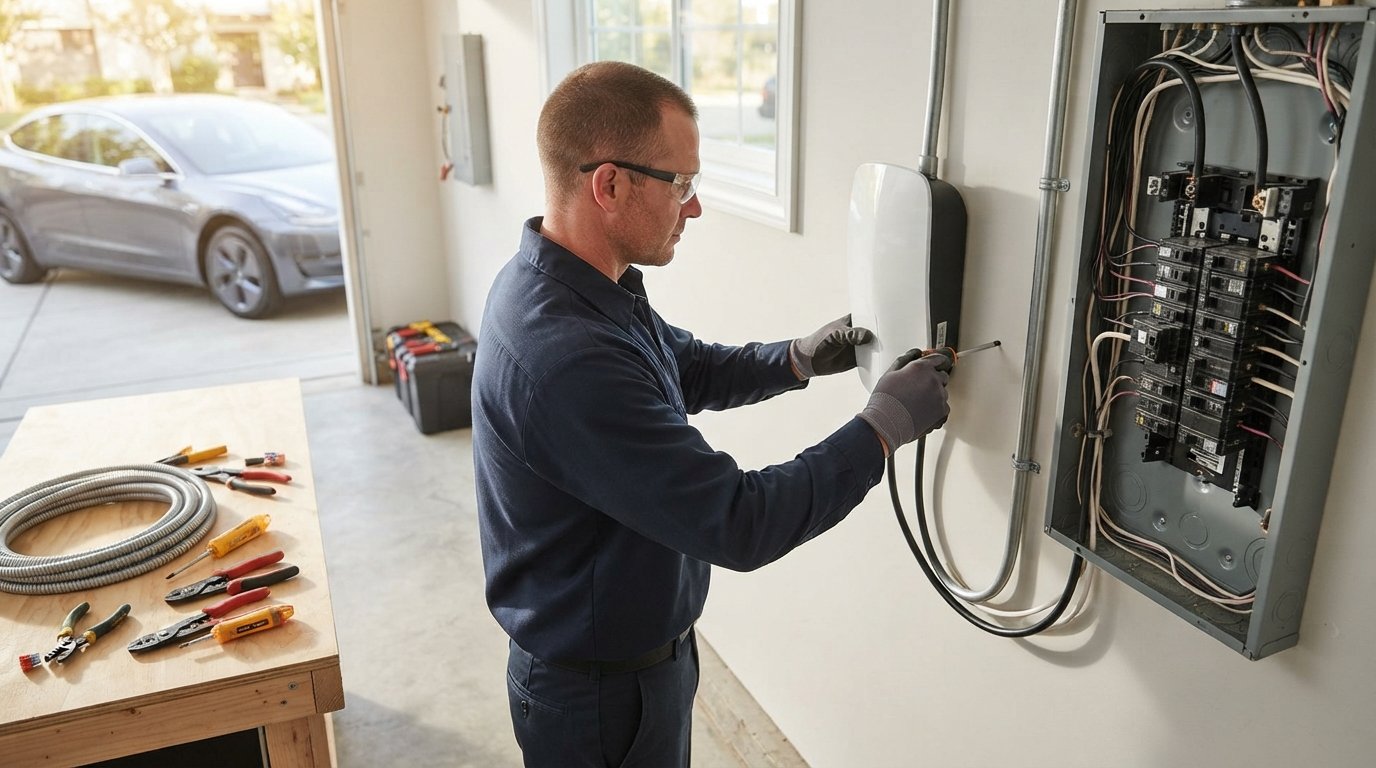
Cost to Install EV Charger at Home Electrical Panel
Get a clear breakdown of the cost to install an EV charger at home electrical panel, including panel upgrades and rebates. Call (833)-365-8755 for expert help.

By Jessica Reis
Learn more about Wiring Installation for guides, costs, and what to expect.
Compare Wiring Installation Pros Near You

Enter your ZIP code to compare top-rated local professionals and request free quotes.
You have priced out a new electric vehicle and now face the next big question: what will it actually take to charge it conveniently at home? The answer depends heavily on your existing electrical service, the distance from your panel to your parking spot, and the local permitting rules. For most homeowners, the cost to install an EV charger at home electrical panel becomes the single largest line item in the project, often rivaling or exceeding the price of the charging unit itself. Understanding how electricians build that number, and where you can trim costs, is the difference between a smooth upgrade and a surprise bill.
What Drives the Cost to Install an EV Charger at Your Electrical Panel
Home EV charging projects are not one-size-fits-all. A simple garage installation on a newer home might require only a short dedicated circuit, while an older property with a 100-amp service and a detached carport could demand a full panel replacement and a long conduit run. Electricians price these jobs by combining three main components: the charging equipment, the labor and materials to wire it safely, and the permits and inspections required by your municipality.
National averages for a Level 2 (240-volt) charger installation land between $1,200 and $2,500 when no major panel work is needed. Once you add a service upgrade or a long, difficult wire run, that figure can climb to $4,000 or more. The table below shows the typical ranges you will encounter, though local labor rates and code requirements will shift these numbers up or down.
- Charger unit: $400 to $800 for a standard 32- to 48-amp Level 2 unit; smart or dual-port models can exceed $1,200.
- Electrician labor and wiring: $600 to $1,800 for a dedicated 240-volt circuit, including conduit, breaker, and mounting hardware.
- Permit and inspection fees: $100 to $400, varying widely by jurisdiction.
- Panel upgrade (if required): $1,500 to $4,000 for a 200-amp service replacement, separate from the charger circuit.
- Subpanel or long-run conduit: $500 to $1,500 when the parking spot is far from the main service.
These ranges assume a straightforward installation on a home with adequate service capacity. The moment an electrician opens your panel and finds a crowded bus bar, undersized service conductors, or no available breaker spaces, the project scope changes. That is why reputable contractors insist on an on-site assessment before quoting a firm price, and why you should be skeptical of any bid given over the phone without seeing the panel.
Level 1 vs. Level 2: Why the Panel Matters
A Level 1 charger plugs into a standard 120-volt household outlet and adds only three to five miles of range per hour. It requires no electrical panel work at all, which makes it the cheapest option upfront (often just the cost of the cord that comes with the vehicle). However, for most drivers commuting 30 or more miles per day, Level 1 charging cannot replenish the battery overnight. That pushes homeowners toward Level 2, which operates on a 240-volt circuit and can add 20 to 40 miles of range per hour depending on the amperage.
Level 2 is where the electrical panel enters the conversation. A dedicated 240-volt circuit must be run from the panel to the charger location, protected by an appropriately sized double-pole breaker. Common configurations include a 40-amp circuit for a 32-amp charger or a 60-amp circuit for a 48-amp charger. The breaker size, wire gauge, and conduit requirements are dictated by the National Electrical Code and your local amendments, so the exact materials cost varies by region.
Before committing to Level 2, ask your electrician to perform a load calculation. This assessment determines whether your existing service can handle the added demand alongside your oven, dryer, air conditioner, and other major appliances. If the calculation shows the service is maxed out, you face one of two paths: upgrade the panel or install energy management hardware that pauses charging when household demand spikes. The latter is often cheaper but less future-proof.
When a Panel Upgrade or Dedicated Circuit Is Required
Many older homes were built with 60-amp or 100-amp service, sized for a far less electrified lifestyle. Adding a 40- to 60-amp EV circuit to a panel that is already near capacity is unsafe and usually prohibited by code. Electricians look for several warning signs that a service upgrade is unavoidable: no spare breaker slots, a panel brand known for failure (such as certain Federal Pacific or Zinsco models), rust or overheating evidence, or a main breaker that cannot accommodate the additional load.
Even when the panel has capacity, code requires the EV charger to be on its own dedicated circuit. You cannot legally share a circuit with a dryer, range, or general-purpose outlets. This means the electrician must install a new breaker, run new conductors, and often add a disconnect or GFCI protection depending on the charger model and local rules. For a detailed walkthrough of how these variables affect your quote, see our guide on understanding electrical panel upgrade quotes for your home, which explains how contractors itemize service replacements and what questions to ask before signing.
If your parking area is detached or far from the main panel, the wire run itself becomes a major cost driver. Trenching, conduit, and conductor pricing for a 50- to 100-foot run can add $800 to $2,000. In these cases, some homeowners choose a subpanel in the garage or outbuilding to shorten the charger circuit and provide future capacity for other equipment. Your electrician can compare the cost of a long direct run versus a subpanel feed and recommend the more economical path.
Federal, State, and Utility Rebates That Offset the Cost
The sticker price of EV charger installation is rarely the final number you pay. A patchwork of federal tax credits, state programs, and utility incentives can significantly reduce your out-of-pocket expense. The federal government offers a tax credit covering 30 percent of the cost of qualified EV charging equipment and installation, up to $1,000 for residential projects, though you should confirm current eligibility rules with a tax professional since program details evolve.
Many states and local air quality districts add their own rebates, often targeting lower-income households or specific geographic areas. Electric utilities frequently offer bill credits or upfront rebates for customers who install a smart charger or agree to charge during off-peak hours. These programs vary wildly: some cover $200, others cover half the project cost up to $1,500. The best strategy is to check your utility's website and your state energy office before you request quotes, so you can tell contractors which equipment qualifies.
For homeowners who are also considering solar to offset the added electricity demand, pairing an EV charger with a residential solar system can improve the financial case for both. Resources like FreeSolarPowerQuotes help homeowners compare solar options and understand available incentives, which is a natural complement to an EV charging upgrade. Just be sure to coordinate the timing: installing solar and an EV charger in the same project can sometimes reduce trenching and labor costs, but only if the electrical panel has enough capacity for both.
Keep in mind that rebates usually require proof of a permitted, inspected installation. Hiring a licensed electrician who pulls the correct permits is not just a safety measure; it is often a prerequisite for collecting incentive money. Skipping the permit to save a few hundred dollars can disqualify you from a rebate worth far more.
How to Compare Quotes from Licensed Electricians
Once you understand the cost drivers, the next step is gathering multiple bids. The goal is not simply to find the lowest number but to compare scope, equipment quality, and warranty terms on an apples-to-apples basis. A bid that looks cheap may exclude the permit, the disconnect, or the GFCI breaker, leaving you to pay for those items later. A bid that looks expensive may include a longer warranty, a higher-quality charger, or a panel upgrade you actually need.
When you request estimates, ask each electrician to itemize the following: the charger make and model, the circuit amperage, the wire gauge and run length, whether a permit is included, whether drywall repair or trenching is included, and the warranty on labor. Also ask whether they performed a load calculation and what the result was. A contractor who cannot explain the load calculation in plain language is a red flag. For a deeper dive into evaluating bids and avoiding common pitfalls, our resources on contractor selection can help you screen for licenses, insurance, and references before you sign.
- Verify licensing and insurance: Ask for the license number and call your state or local licensing board to confirm it is active. Request a certificate of insurance showing general liability and workers' compensation coverage.
- Request a written, itemized scope: The quote should list equipment, labor, permit fees, and any optional add-ons separately so you can compare line by line.
- Confirm permit responsibility: The electrician should pull the permit in their name and schedule the inspection. If they ask you to pull the permit as the homeowner, understand that you may bear liability for code compliance.
- Ask about rebate documentation: A good contractor will provide the invoices and inspection records you need to claim utility or state incentives.
- Check warranties and service terms: Confirm the labor warranty period and whether the contractor offers ongoing support for the charger or panel work.
After you have two or three itemized bids, compare the total cost of ownership rather than the headline price. A slightly higher bid that includes a permit, a quality charger, and a clear warranty often saves money over the life of the installation. If one bid is dramatically lower than the others, ask what is missing. In electrical work, cutting corners on materials or permits creates fire and liability risks that far outweigh the savings.
The cost to install an EV charger at home electrical panel is ultimately an investment in convenience and safety. By understanding the components, checking your panel capacity early, and pursuing every available rebate, you can keep the project within budget while ensuring the work meets code. Start by requesting free, no-obligation quotes from licensed local electricians, and use those estimates to make an informed decision that fits your home and your driving habits.