
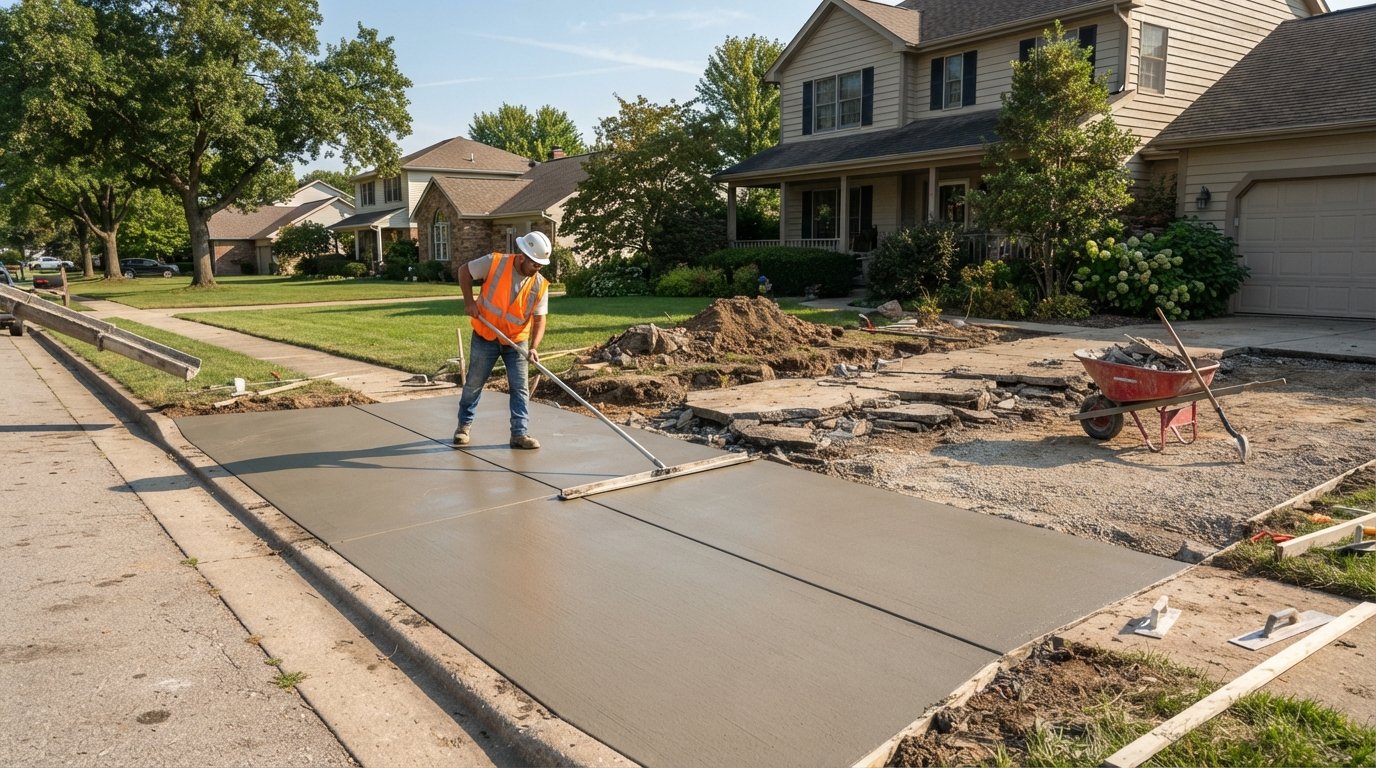
Concrete Driveway Replacement Cost and Options for 2026
Plan your project with clear concrete driveway replacement cost and options, from per-square-foot pricing to decorative finishes. Call (833)-365-8755 for vetted local pros.

By Justin Blake
Learn more about Concrete Installation for guides, costs, and what to expect.
Compare Concrete Installation Pros Near You

Enter your ZIP code to compare top-rated local professionals and request free quotes.
Your driveway is more than a parking pad: it is a daily first impression, a structural surface that shrugs off weather and traffic, and a significant line item in your home's exterior budget. When cracks spread, settling creates trip hazards, or the surface simply looks tired, the question of replacement versus repair quickly turns into a numbers game. Understanding concrete driveway replacement cost and options before you call a contractor puts you in control, helping you compare bids apples to apples and avoid overpaying for extras you do not need.
In 2026, most homeowners pay between $6 and $12 per square foot for a full remove and replace job, with a typical two-car driveway (roughly 600 square feet) landing between $3,600 and $7,200. That range widens once you add decorative finishes, thicker slabs for heavy vehicles, or challenging site conditions. This guide breaks down the real numbers, the upgrade upcharges, the repair versus replace decision, and the contractor checks that protect your investment.
Concrete Driveway Replacement Cost per Square Foot
The cost per square foot is the foundation of any driveway estimate. For a basic remove and replace, contractors typically quote $6 to $12 per square foot. That figure bundles demolition, hauling, site prep, gravel base, reinforcement, and a standard 4-inch pour of 4,000 psi concrete. A simple single-car driveway of 300 square feet might run $1,800 to $3,600, while a long 1,000 square foot driveway can reach $6,000 to $12,000 or more.
What drives the spread? Labor rates vary by region, disposal fees fluctuate, and access matters. A driveway that a skid steer can reach is cheaper to demolish than one hemmed in by landscaping or a tight gate. Thicker slabs, wire mesh or rebar, and upgraded mix designs add cost but pay back in durability. Here is how the typical line items break down for a standard 600 square foot replacement:
- Demolition and hauling: $1 to $2 per square foot, including dumpster rental and disposal fees.
- Grading and base prep: $1 to $2 per square foot for excavation, compaction, and a 4 to 6 inch gravel base.
- Concrete material and pour: $3 to $5 per square foot for a 4-inch slab with reinforcement.
- Finishing and curing: $1 to $2 per square foot for broom finish, control joints, and curing compound.
- Permits and inspections: $50 to $300 flat, depending on your municipality.
Those line items explain why two bids for the same driveway can differ by thousands of dollars. One contractor may skimp on base depth or skip rebar; another may include thicker edges, better drainage, and a written warranty. When you compare estimates, ask each bidder to itemize these categories so you can see exactly where the money goes. For a broader look at how material and labor costs interact across exterior projects, our guide on ductwork replacement cost and efficiency gains illustrates the same principle: transparent line items make it easier to spot value and avoid surprise bills.
Decorative Upgrades: Stamped, Stained, and Exposed Aggregate
A plain gray slab is the budget baseline, but many homeowners want a driveway that complements their home's architecture. Decorative finishes add $2 to $8 per square foot on top of the base cost, and some premium options push higher. These upcharges reflect additional labor, materials, and skill, not just aesthetics. Stamped concrete, for example, requires a skilled crew to press molds into the surface at the right moment, and mistakes are expensive to fix.
Stamped concrete is the most popular upgrade, mimicking stone, brick, or slate for an upcharge of $3 to $8 per square foot. Stained concrete uses acid or water-based dyes to add color and depth, costing $2 to $5 per square foot, and it can be combined with stamping for a richer look. Exposed aggregate, created by washing away the top layer of cement to reveal pebbles, runs $2 to $6 per square foot and offers excellent slip resistance. Broom finish remains the standard, cost-effective choice at no extra charge, while a smooth trowel finish is best avoided outdoors because it becomes slippery when wet.
Beyond the finish, structural upgrades affect both cost and longevity. A 5 or 6 inch slab instead of 4 inches adds $1 to $2 per square foot but handles heavier vehicles and reduces cracking risk. Rebar or wire mesh reinforcement is often included but should be confirmed in writing. Proper control joints, spaced every 8 to 12 feet, cost little but prevent random cracking. Sealing, typically $1 to $2 per square foot, protects against freeze-thaw damage, deicing salts, and stains, and it should be reapplied every few years.
Repair or Replace: Making the Right Call
Not every cracked driveway needs replacement. Hairline cracks, surface scaling, and minor settling can often be repaired for a fraction of the cost. Resurfacing, also called overlaying, adds a new layer of concrete or a polymer-modified topping over the existing slab, typically for $3 to $7 per square foot. Mudjacking or foam injection can lift settled slabs for $500 to $1,500 per project. These options make sense when the underlying slab is structurally sound and the damage is cosmetic or localized.
Replacement becomes the smarter investment when the damage is widespread or structural. Consider these decision factors:
- Crack severity: Cracks wider than 1/4 inch, multiple intersecting cracks, or cracks that have vertical displacement usually signal a failing slab.
- Settling and heaving: Trip hazards, ponding water, or slabs that have shifted more than an inch often cannot be reliably leveled.
- Age and history: A driveway over 25 years old with repeated repairs is a candidate for replacement rather than another patch.
- Drainage problems: Poor grading that sends water toward the house or foundation needs correction at the slab level, not just a surface patch.
- Cost ratio: If repairs exceed 30 to 40 percent of replacement cost, replacement delivers better long-term value.
Repair is also a stopgap. A resurfaced driveway may last 8 to 15 years with good maintenance, while a new slab properly installed can last 30 years or more. If you plan to sell within a few years, a clean, functional driveway improves curb appeal and can support your asking price. If you plan to stay, replacement usually wins on life-cycle cost.
Hiring a Concrete Contractor: What to Verify
Concrete work is unforgiving. A poorly poured slab can crack within a season, and fixing it means paying twice. The contractor you choose matters more than the finish you pick. Start by verifying licensing and insurance: most states require concrete contractors to hold a license, and general liability and workers' compensation coverage protect you if someone is injured on your property. Ask for the policy numbers and call the insurer to confirm the coverage is active.
Next, request at least three local references from driveways completed in the past two years, and visit one in person if possible. Look for uniform color, tight control joints, proper slope away from the house, and no ponding. Ask those homeowners whether the crew showed up on time, cleaned up, and honored the warranty. A written contract should spell out the scope, slab thickness, reinforcement, finish, cure time, payment schedule, and warranty terms. Never pay more than a modest deposit upfront; progress payments tied to milestones protect you both.
Finally, compare bids on equal terms. A low bid that omits base prep or reinforcement is not a bargain. Ask each contractor to explain what is included and what would trigger extra charges, such as rock excavation, hauling distance, or permit fees. If you are also considering energy upgrades around your home, resources like NewSolarQuotes can help you evaluate renewable options and incentives, though your driveway project should stay focused on concrete scope and site work. For a faster start, you can request free, no-obligation quotes from licensed local concrete contractors through ContractorHomeQuotes and compare itemized bids side by side.
Budgeting Beyond the Pour: Permits, Drainage, and Timing
Smart budgeting accounts for the costs that surround the pour. Permits are often required for driveway replacement, especially if the apron meets a public sidewalk or the slope changes. Fees range from $50 to $300, but the inspection process also adds time. Drainage corrections, such as regrading, adding a channel drain, or installing a dry well, can add $500 to $3,000 depending on scope. If your driveway is shared or crosses a utility easement, coordinate early to avoid delays.
Timing affects price and quality. Concrete cures best in moderate weather, so late spring and early fall are ideal in most regions. Peak season bids may run 10 to 20 percent higher, and extreme heat or cold can compromise the pour. Ask your contractor how they will protect the slab from rapid drying or freezing, and insist on a proper cure period (typically 7 days before light traffic, 28 days for full strength). Keep vehicles off the new driveway for at least a week, and avoid deicing salts for the first winter.
Financing is another lever. Many homeowners pay cash, but if the project strains your budget, ask contractors about financing or consider a home equity line of credit. Be wary of door-to-door offers or pressure to sign immediately. A reputable contractor will give you time to compare bids and will never demand full payment upfront.
Frequently Asked Questions
How long does a concrete driveway replacement take?
Most residential driveways are demolished, poured, and finished within 2 to 4 days, weather permitting. Curing adds time before you can park on it: typically 7 days for light foot traffic and vehicles after 7 to 10 days, with full strength at 28 days. Complex decorative work or poor weather can extend the schedule.
Is it cheaper to overlay or replace a concrete driveway?
Overlays cost $3 to $7 per square foot versus $6 to $12 for replacement, so they are cheaper upfront. However, overlays only work on sound slabs and may last 8 to 15 years. If the base is failing, replacement is the better long-term value.
Does a new concrete driveway increase home value?
A well-installed driveway improves curb appeal and can support resale value, though it is not typically a high-ROI renovation like a kitchen update. Buyers notice cracked, uneven driveways, so a clean replacement removes a negotiating point.
What is the best time of year to replace a concrete driveway?
Late spring through early fall is ideal in most climates, when temperatures stay between 50 and 80 degrees Fahrenheit. Hot, windy, or freezing conditions require special precautions and can increase cost or risk of defects.
Replacing a concrete driveway is a major exterior investment, but it is also one of the most visible upgrades you can make. By understanding the per-square-foot cost, the upcharges for decorative finishes, the repair versus replace threshold, and the contractor checks that matter, you can move forward with confidence. Get multiple itemized bids, verify licensing and insurance, and plan for curing time and drainage. Do that, and your new driveway will serve your home for decades.