
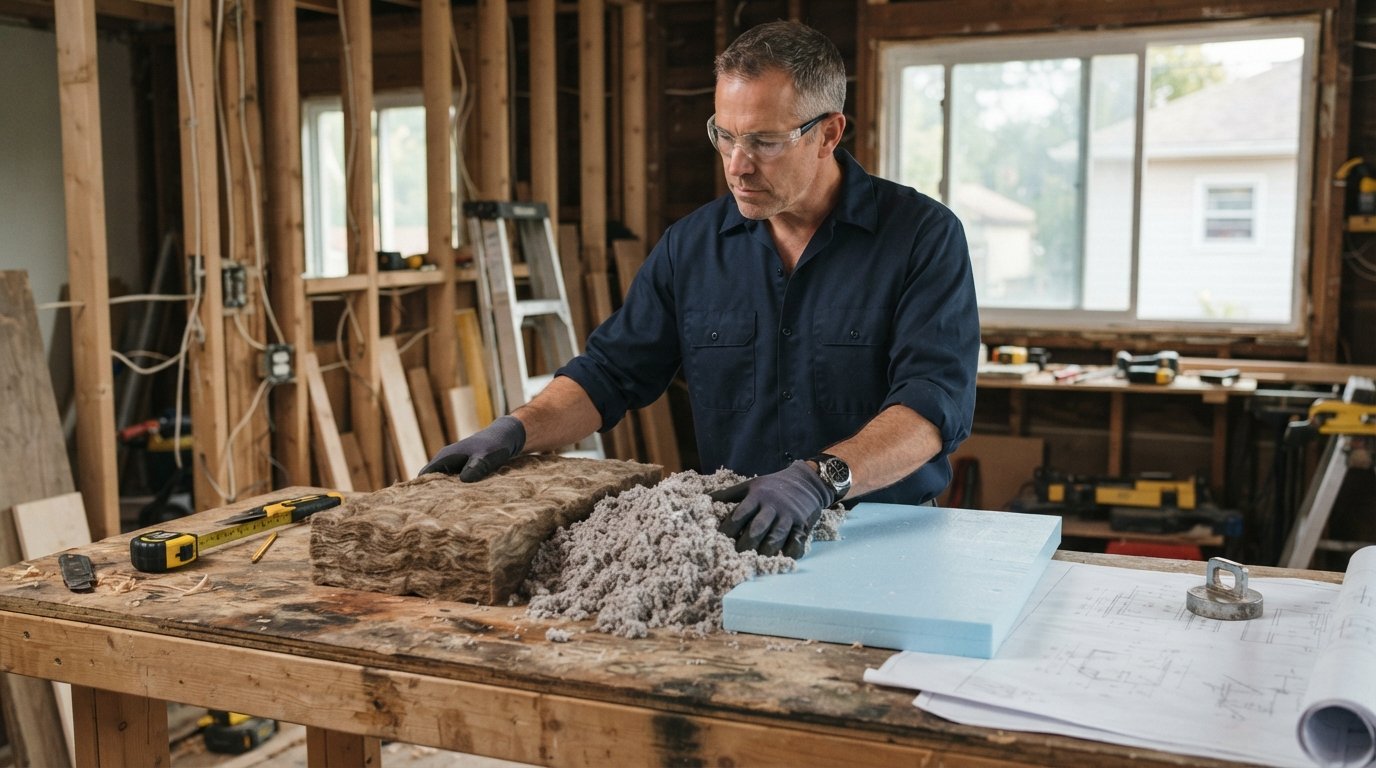
Mineral Wool vs Cellulose vs Rigid Foam: Best Insulation
Compare mineral wool, cellulose, and rigid foam for your home. Call 8333658755 for expert advice on advanced insulation options.

By Chelsea Kris
Learn more about Insulation Installation or Upgrade for guides, costs, and what to expect.
Compare Insulation Installation or Upgrade Pros Near You

Enter your ZIP code to compare top-rated local professionals and request free quotes.
Choosing the right insulation for your home is one of the most impactful decisions you can make for energy efficiency, comfort, and long-term savings. With so many advanced insulation options available, from mineral wool to cellulose to rigid foam, it is easy to feel overwhelmed. Each material has distinct advantages, installation requirements, and cost profiles. Understanding how they compare helps you select the best fit for your project, whether you are finishing a basement, upgrading an attic, or building a new home. This guide breaks down the key differences so you can make an informed choice and avoid common pitfalls.
Why Advanced Insulation Matters for Modern Homes
Insulation is not just about staying warm in winter or cool in summer. It affects your monthly energy bills, indoor air quality, moisture control, and even the structural integrity of your home. Modern building codes increasingly demand higher R-values and better performance, pushing homeowners to look beyond traditional fiberglass batts. Advanced materials like mineral wool, cellulose, and rigid foam offer superior thermal resistance, fire resistance, and moisture management. They also come with varying environmental footprints and installation complexities.
When planning a project, it helps to consider your climate zone, the area you are insulating (walls, attic, basement, crawlspace), and your budget. For example, a basement remodel in a cold climate may benefit from rigid foam because it adds a vapor barrier and reduces thermal bridging. An attic retrofit might favor cellulose for its ability to fill irregular cavities. Mineral wool shines in areas requiring fire resistance and soundproofing. The right choice often depends on balancing these factors. To get accurate cost estimates for your specific project, you can use resources that provide transparent pricing data and connect you with local professionals.
Mineral Wool: Fire-Resistant and Durable
Mineral wool, also known as rock wool or slag wool, is made from molten rock or industrial slag spun into fibers. It is naturally fire-resistant, able to withstand temperatures above 1,000 degrees Celsius, and does not melt or release toxic smoke. This makes it a top choice for homes in wildfire-prone areas or for insulating around chimneys and furnaces. Mineral wool is also excellent at sound absorption, making it ideal for interior walls, ceilings, and floors where noise reduction is a priority.
In terms of thermal performance, mineral wool typically has an R-value of 3.0 to 3.3 per inch, similar to fiberglass. It is available in batts, rolls, and loose-fill form. Batts are easy to cut and install in standard wall cavities, while loose-fill works well for attics and irregular spaces. Mineral wool is denser than fiberglass, so it resists settling and maintains its R-value over time. It is also hydrophobic, meaning it repels water and does not support mold growth. However, it is heavier and more expensive than fiberglass, and installation requires protective gear because the fibers can irritate skin and lungs.
For homeowners prioritizing safety and longevity, mineral wool is a strong contender. It is particularly beneficial in basements and crawlspaces where moisture can be an issue, as it will not degrade when exposed to dampness. It also pairs well with rigid foam for a hybrid approach that maximizes both fire resistance and thermal breaks.
Cellulose: Eco-Friendly and Cost-Effective
Cellulose insulation is made from recycled paper, typically newspaper, treated with fire retardants such as borax or ammonium sulfate. It is one of the most environmentally friendly options, diverting waste from landfills and requiring less energy to produce than mineral wool or foam. Cellulose is available as loose-fill, which is blown into attics, walls, and floors, or as damp-sprayed for new construction. Its R-value is around 3.2 to 3.8 per inch, depending on density and application.
One of cellulose's biggest advantages is its ability to fill gaps, voids, and irregular cavities, creating a seamless thermal envelope. This reduces air leakage and improves overall efficiency. It also has good sound-dampening properties. However, cellulose can settle over time, potentially reducing its R-value by 15 to 20 percent if not installed at the correct density. It is also susceptible to moisture; if it gets wet, it can compact and lose effectiveness, and the fire retardants can leach out. Proper installation with a vapor barrier and good ventilation is crucial.
Cost-wise, cellulose is generally cheaper than mineral wool and rigid foam, making it attractive for budget-conscious homeowners. It is a popular choice for attic insulation and retrofits because it can be blown into existing spaces with minimal disruption. For DIYers, cellulose is relatively easy to handle, though blowing equipment is required for large areas. It is not recommended for areas with high moisture, such as below-grade basements, unless combined with a vapor barrier.
Rigid Foam: High R-Value and Moisture Control
Rigid foam insulation, including polyisocyanurate, extruded polystyrene (XPS), and expanded polystyrene (EPS), offers the highest R-value per inch of the three materials. Polyiso has an R-value of 6.5 to 7 per inch, XPS around 5, and EPS around 4. This makes rigid foam ideal for space-constrained areas like exterior walls, cathedral ceilings, and foundations. It also acts as a vapor barrier and reduces thermal bridging when installed as continuous sheathing.
Rigid foam is available in boards of various thicknesses and can be cut to fit. It is lightweight and easy to install with adhesives or mechanical fasteners. However, it is more expensive than cellulose and mineral wool, and it must be covered with a fire-rated barrier (such as drywall) in interior applications because it is combustible and releases toxic smoke when burned. Polyiso has the added benefit of a foil facing that reflects heat, but its R-value decreases in very cold temperatures.
For basements, rigid foam is often the best choice because it insulates and prevents moisture migration. It can be installed directly against concrete walls, followed by framing and drywall. In exterior applications, rigid foam sheathing reduces thermal bridging through studs, significantly improving whole-wall R-value. While the upfront cost is higher, the energy savings and durability can justify the investment, especially in extreme climates.
Comparing Performance: R-Value, Moisture, Fire, and Cost
To make a smart decision, compare these materials across key performance metrics. The table below summarizes the differences, but keep in mind that actual performance depends on installation quality and climate.
- R-value per inch: Rigid foam (4-7), Cellulose (3.2-3.8), Mineral wool (3.0-3.3).
- Moisture resistance: Rigid foam (excellent), Mineral wool (good, hydrophobic), Cellulose (poor, requires vapor barrier).
- Fire resistance: Mineral wool (excellent, non-combustible), Cellulose (good, treated with retardants), Rigid foam (poor, combustible).
- Cost: Cellulose (lowest), Mineral wool (moderate), Rigid foam (highest).
- Environmental impact: Cellulose (recycled content), Mineral wool (recycled slag), Rigid foam (petroleum-based, some blowing agents have high global warming potential).
Beyond these metrics, consider installation requirements. Mineral wool and cellulose can be DIY-friendly for attics, but rigid foam demands precise cutting and sealing. For complex retrofits, such as insulating a basement or crawlspace, a combination of materials often works best. For example, you might use rigid foam against the foundation wall, then fill the framed cavity with mineral wool or cellulose for added R-value and fire protection.
Another factor is long-term performance. Mineral wool and rigid foam resist settling and degradation better than cellulose. Cellulose can settle, but proper installation mitigates this. Rigid foam can off-gas and lose R-value over time, though modern formulations have improved. Always check product specifications and warranties.
When comparing costs, look beyond the material price to include labor, equipment, and potential savings. For a typical attic project, cellulose might cost $1,500 to $3,000 installed, mineral wool $2,000 to $4,000, and rigid foam $3,000 to $6,000. These are rough estimates; actual quotes vary by region and project complexity. To get precise numbers for your home, it is wise to request multiple quotes from licensed contractors. If you are also considering spray foam, which is another advanced option, you can read our comparison of spray foam vs fiberglass insulation cost and R-value to understand how it stacks up.
Installation and Safety Considerations
Proper installation is critical for any insulation to perform as expected. Mineral wool and cellulose can be installed by homeowners for simple attic jobs, but rigid foam often requires professional installation to ensure airtight seams and proper coverage. Safety is paramount: mineral wool fibers irritate skin and lungs, so wear protective clothing, goggles, and a respirator. Cellulose dust can also be irritating, and blowing insulation requires equipment and careful setup to avoid over- or under-dense areas. Rigid foam must be cut with a sharp knife and sealed with tape or foam, and it should always be covered with a fire barrier indoors.
For basements and crawlspaces, moisture management is key. Rigid foam acts as a vapor barrier, but it can trap moisture if not installed correctly. In humid climates, a combination of closed-cell spray foam and rigid foam may be necessary. Always consult a building science professional or a licensed contractor to ensure your insulation strategy aligns with local codes and your home's specific needs.
If you are planning a larger renovation, such as a basement remodel or an addition, integrating insulation with other systems (HVAC, electrical) is essential. This is where a qualified contractor can add value. Platforms like FreeQuotes.Contractors connect homeowners with pre-vetted local professionals who can handle insulation and related projects, ensuring everything is done to code and with quality materials.
Making the Right Choice for Your Project
There is no one-size-fits-all answer when comparing mineral wool, cellulose, and rigid foam. The best choice depends on your priorities: budget, fire safety, moisture control, environmental impact, and available space. For attics, cellulose offers excellent value and eco-friendliness. For basements and exterior walls, rigid foam provides superior moisture control and thermal breaks. For interior walls and soundproofing, mineral wool is hard to beat. In many cases, a hybrid approach delivers the best performance.
Before you commit, assess your climate, building code requirements, and long-term energy goals. Obtain multiple quotes from licensed contractors to compare not just material costs but also installation quality and warranty terms. A reputable contractor can help you weigh the options and avoid common mistakes like inadequate ventilation or improper vapor barriers. With the right insulation, you can enjoy a more comfortable, energy-efficient home for years to come.