
Laminate Flooring Installation Cost: DIY vs Professional
Compare laminate flooring installation cost and DIY vs professional options. Call (833)-365-8755 for help finding local providers and save on your project.
By Adnan Nazir
Learn more about Floor Installation or Replacement for guides, costs, and what to expect.
Compare Floor Installation or Replacement Pros Near You

Enter your ZIP code to compare independent local professionals and request free quotes.
Laminate flooring is one of the most popular budget-friendly options for homeowners who want the look of hardwood without the high price tag. But before you load up your cart with boxes of planks, you need a clear picture of what laminate flooring installation costs and whether you should tackle the job yourself or hire a professional. The answers depend on material quality, subfloor conditions, and your comfort with power tools. This guide breaks down the real numbers, compares DIY versus professional installation, and helps you decide which path protects your time, money, and warranty.
Laminate Flooring Installation Cost Breakdown
The total cost of a laminate flooring project has several moving parts: the planks themselves, underlayment, trim and transition pieces, tools, and labor if you hire out. Material prices vary widely based on thickness, wear layer, and brand. On average, laminate flooring materials range from $1 to $5 per square foot, while professional installation adds another $2 to $4 per square foot. For a typical 300-square-foot room, you can expect to spend between $900 and $2,700 for a fully installed job, depending on your choices.
Here is a closer look at the cost components you will encounter:
- Laminate planks: $1 to $5 per square foot. Thicker planks (10mm to 12mm) cost more but feel more solid underfoot and often carry better warranties. Entry-level 7mm to 8mm planks are fine for low-traffic areas but may flex or sound hollow.
- Underlayment: $0.20 to $1.50 per square foot. Some laminates come with attached padding, which saves time and money. Otherwise, you will need a separate foam, cork, or acoustic underlayment. Moisture barrier underlayment is essential over concrete.
- Trim and transitions: $2 to $10 per linear foot. Baseboards, quarter round, T-moldings, reducers, and stair nose pieces add up quickly. Budget $100 to $300 for a typical room.
- Tools: $50 to $200 if you do not already own a tapping block, pull bar, spacers, and a laminate cutter. A miter saw or jigsaw may also be needed for door casings and odd angles.
- Labor (professional): $2 to $4 per square foot, or $40 to $80 per hour. Complex layouts, stairs, and furniture moving increase the price.
Keep in mind that these are national averages. Prices vary by region and by the specific products you select. For a more precise estimate tailored to your project, you can compare quotes from independent local providers in your area. Many homeowners find that getting three bids helps them spot outliers and understand what a fair price looks like for their zip code.
Subfloor Preparation: The Hidden Cost Driver
No laminate floor will perform well over an uneven or damp subfloor. Manufacturers typically require flatness within 3/16 inch over a 10-foot span. If your subfloor fails that test, you will need to level it with a self-leveling compound or patching material, which adds $0.50 to $2 per square foot in materials and potentially more if you hire help. Moisture is another critical factor. Concrete subfloors must be tested for moisture vapor emission, and wood subfloors should be checked with a moisture meter. If levels are too high, you may need a specialized moisture barrier or even a sump pump or drainage correction before installation.
These preparatory steps are often where DIYers get tripped up. A floor that looks flat to the naked eye can still have dips and humps that cause clicking, squeaking, or premature wear. Professional installers include subfloor inspection and basic prep in their quotes, and they know how to identify red flags quickly. If you skip this step, you risk voiding your warranty and wasting the money you spent on materials.
DIY Laminate Installation: When It Makes Sense
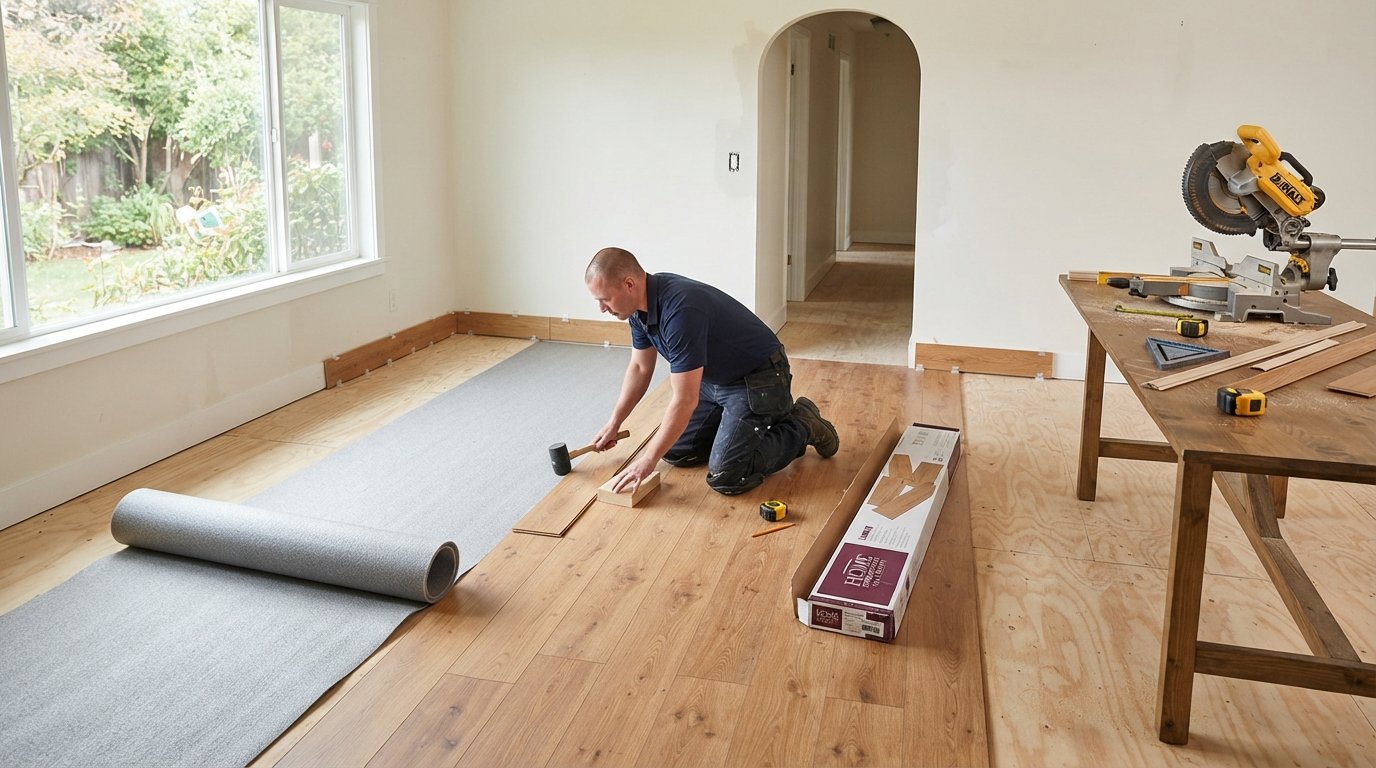
Laminate is one of the more DIY-friendly flooring options. Most products use a click-lock system that requires no glue or nails, and the planks can be cut with a basic laminate cutter or a miter saw. If you have a rectangular room with a sound, flat subfloor and you are comfortable using hand tools, you can realistically install laminate yourself over a weekend. Doing so saves the $2 to $4 per square foot labor charge, which for a 300-square-foot room means $600 to $1,200 in savings.
That said, DIY is not for everyone. Consider the following factors before you commit:
- Time and patience: A first-time installer might spend 20 to 30 hours on a 300-square-foot room, including prep and trim work. Professionals can finish in a day or two.
- Tool access: You will need a tapping block, pull bar, spacers, a saw, and knee pads. Renting tools adds cost.
- Complexity of the layout: Rooms with lots of angles, doorways, or stairs are much harder to DIY. Stair installation in particular requires precise cuts and special nose pieces.
- Warranty requirements: Some manufacturers require professional installation to validate their wear and moisture warranties. Check the fine print before you decide.
If you decide to go the DIY route, plan carefully. Watch manufacturer videos, read the installation guide thoroughly, and buy 10 percent extra material for waste and future repairs. And do not skip the subfloor prep; it is the foundation of a lasting floor.
Professional Installation: When It Is Worth the Cost
Hiring a professional makes sense in several scenarios. If your subfloor needs significant leveling, if you have stairs or a complicated layout, or if the warranty requires pro installation, the extra cost is often justified. Professionals also carry insurance and can handle unexpected issues like discovering a water leak or asbestos-containing flooring underneath. They typically complete the job faster and with fewer mistakes, and they can often source materials at a discount.
When comparing professional bids, look beyond the bottom line. Ask for a written estimate that details the scope of work, including subfloor prep, furniture moving, and disposal of old flooring. Verify that the contractor holds the necessary licenses and insurance for your project, and ask for references. Be wary of quotes that seem too low; they may exclude critical steps or use inferior underlayment. For larger renovation projects that include flooring alongside other trades, a service like USremodel can help you connect with independent local providers for remodeling and repair work. USremodel is a free matching and referral service that does not perform the work itself, but it can simplify the process of finding multiple quotes.
If you are also considering hardwood in other areas of your home, our guide on hardwood flooring installation pro secrets explains how professional techniques differ and why some homeowners choose to mix flooring types.
Comparing Laminate to Vinyl Plank and Engineered Wood
Laminate is not the only option in the budget-friendly flooring category. Luxury vinyl plank (LVP) and engineered wood are two common alternatives, each with distinct pros and cons. Understanding these differences can help you decide if laminate is truly the right fit for your home and your installation budget.
Laminate vs Vinyl Plank: Laminate has a rigid core made of high-density fiberboard and a photographic layer that mimics wood or stone. It is durable and resists scratches, but it is not waterproof; standing water can seep into seams and cause swelling. Vinyl plank is entirely waterproof, making it a better choice for bathrooms, kitchens, and basements. LVP is also generally softer underfoot and quieter. However, laminate often looks more realistic and can be less expensive for the same thickness. Installation costs are similar for both, though LVP can sometimes be installed over slightly less perfect subfloors.
Laminate vs Engineered Wood: Engineered wood has a real wood veneer top layer over a plywood core. It looks and feels like solid hardwood and can be refinished once or twice. It costs more than laminate, typically $4 to $10 per square foot for materials, and professional installation is often recommended to ensure proper acclimation and fastening. Laminate is more resistant to scratches and moisture (though not waterproof), and it is easier to install as a DIY project. If you want the authentic look of wood and are willing to pay more, engineered wood may be worth it. If you want maximum durability for a busy household on a budget, laminate is a solid choice.
When weighing these options, consider the room's use, your tolerance for maintenance, and your long-term plans. Laminate is a practical, cost-effective solution for many homeowners, but it is not the best fit for every space.
Making the Decision: DIY or Professional?
The choice between DIY and professional laminate installation comes down to a few key questions. How flat and dry is your subfloor? How complex is the room layout? Does the warranty require professional installation? And how much is your time worth? If you have a simple, rectangular room with a sound subfloor and you enjoy hands-on projects, DIY can save you hundreds of dollars. If any of those factors are uncertain, hiring a professional is the safer bet.
Whichever route you choose, get written quotes from multiple sources. For professional installation, compare at least three bids that itemize labor, materials, and prep work. For DIY, price out all the materials and tools you will need, and add a 10 percent contingency for surprises. And remember that ContractorHomeQuotes is a free matching service that can connect you with independent local providers for flooring and other home improvement projects. We do not perform the work ourselves, but we can help you gather no-obligation quotes from providers in your area.
Laminate flooring can transform a room without breaking the bank, but the installation method you choose affects both your upfront cost and your floor's longevity. Take the time to assess your subfloor, read the warranty, and honestly evaluate your DIY skills. With the right preparation, you will end up with a beautiful, durable floor that fits your budget.