
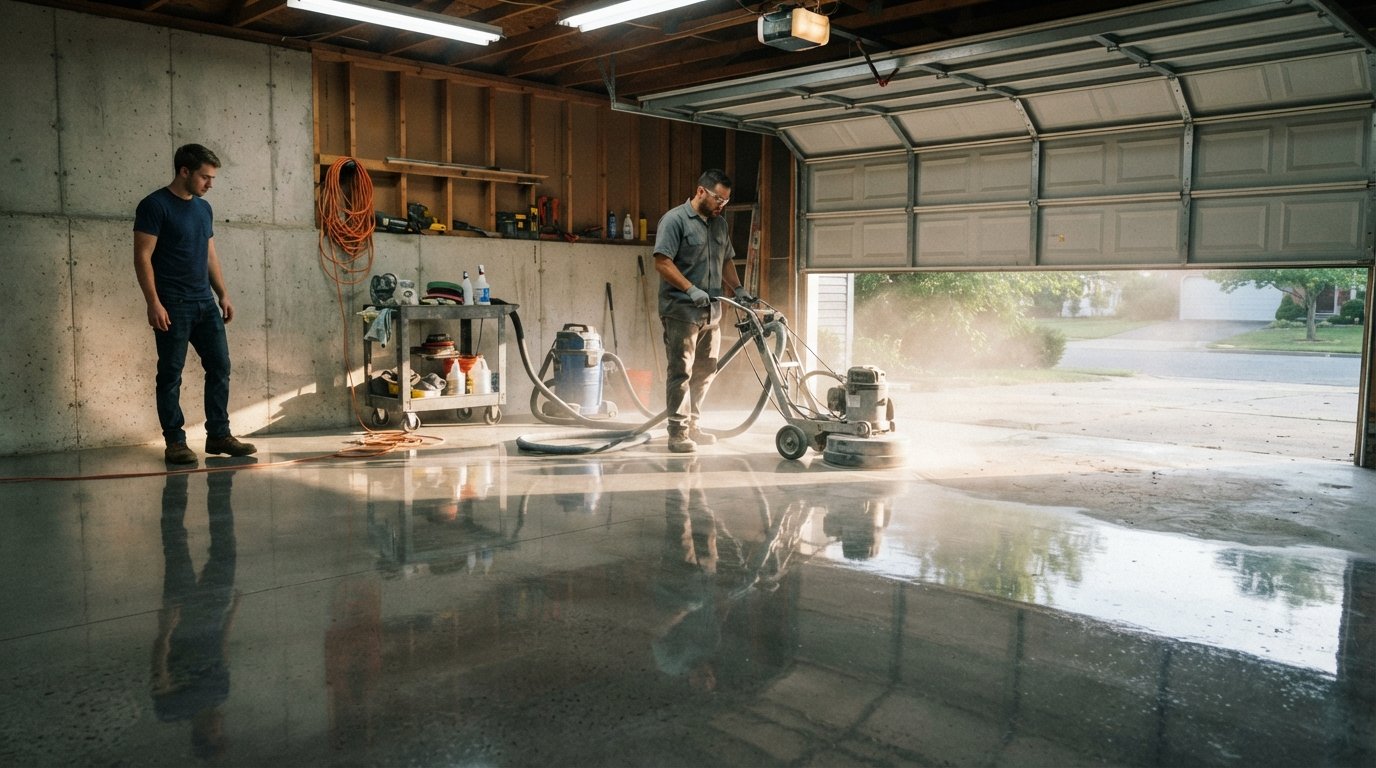
Polished Concrete Floor Cost For Basements And Garages
Polished concrete floor cost for basements and garages ranges from $3 to $12 per square foot. Call (833)-365-8755 for expert guidance.

By Eric Andrew
Learn more about Floor Polishing for guides, costs, and what to expect.
Compare Floor Polishing Pros Near You

Enter your ZIP code to compare top-rated local professionals and request free quotes.
Polished concrete floors have become a popular choice for basements and garages, offering a sleek, industrial look with exceptional durability. But how much should you expect to pay? The cost of polished concrete varies widely depending on the level of finish, the condition of the existing slab, and your geographic location. In this guide, we break down the polished concrete floor cost for basements and garages, so you can budget accurately and make an informed decision.
What Determines Polished Concrete Floor Cost?
Several factors influence the final price of a polished concrete floor. The most significant is the level of polishing, which ranges from a matte finish to a high-gloss sheen. The process involves grinding the concrete with progressively finer diamond abrasives, and each additional step adds labor and material costs. Another key factor is the condition of the existing slab: cracks, stains, and moisture issues must be addressed before polishing, which can drive up the price. Additionally, the size of the area, accessibility, and local labor rates all play a role. Understanding these variables will help you interpret quotes and compare options effectively.
For basements and garages, moisture is often the biggest wildcard. Concrete slabs in these areas are more prone to dampness, which can interfere with polishing and sealing. A contractor may need to apply a moisture mitigation system or repair cracks before the polishing begins. These prep steps are essential for a long-lasting floor but can add to the overall cost. It is also worth noting that polished concrete is not a DIY-friendly project; it requires specialized equipment and expertise, so professional installation is strongly recommended.
Cost Per Square Foot For Polished Concrete
The cost of polished concrete typically ranges from $3 to $12 per square foot, depending on the complexity of the job and the desired finish. For a basic grind and seal (often called a "polished" finish but with a topical sealer), you might pay $3 to $5 per square foot. A true mechanically polished floor with a medium gloss runs $5 to $8 per square foot. For a high-gloss, mirror-like finish with densifiers and guard, expect $8 to $12 per square foot or more. Staining or dyeing the concrete adds $2 to $4 per square foot. These prices include labor and materials, but not major repairs.
For basements, which are often smaller and may have lower ceilings or limited access, the per-square-foot cost can be slightly higher due to mobilization and setup. Garages, on the other hand, are typically larger and more straightforward, so the cost per square foot may be on the lower end. However, garages often have oil stains and cracks that require extra attention. It is wise to get multiple quotes to compare pricing and ensure you are getting a fair deal. You can also use our flooring Columbia SC guide to see how regional pricing works for other flooring types.
Grinding And Polishing Levels
Polished concrete is classified by the level of aggregate exposure and gloss. A "cream" polish leaves the aggregate hidden and produces a smooth, matte surface. A "salt and pepper" finish exposes fine aggregate for a speckled look. "Full aggregate" exposure reveals the larger stones for a terrazzo-like appearance. Each level requires more grinding steps and time, increasing the cost. For basements and garages, a salt and pepper or cream polish is often sufficient, as it provides durability without the premium price of full aggregate exposure.
Staining And Dyeing
If you want to add color, staining or dyeing the concrete can transform the look. Acid stains react with the concrete to create mottled, earthy tones, while water-based dyes offer more vibrant, consistent colors. Staining typically adds $2 to $4 per square foot. Keep in mind that the final color can vary based on the concrete's age and composition, so a test patch is recommended. For garages, a darker stain can help hide oil and dirt, while basements might benefit from lighter, warmer tones to brighten the space.
Suitability For Basements, Garages, And Living Spaces
Polished concrete is an excellent choice for basements and garages due to its durability and low maintenance. In basements, it can turn a damp, unfinished space into a usable living area. However, moisture is a critical concern: if the slab is prone to dampness, a moisture barrier or mitigation system may be necessary before polishing. In garages, polished concrete resists oil stains, tire marks, and abrasion, making it ideal for parking and workshop use. It also reflects light, improving visibility. For living spaces, polished concrete offers a modern, minimalist aesthetic and can be warmed up with rugs and area lighting.
One of the biggest advantages of polished concrete is its longevity. With proper maintenance, it can last decades without needing replacement. It is also resistant to dust and allergens, making it a good choice for allergy sufferers. However, it can be slippery when wet, so consider a non-slip additive or a matte finish in areas prone to moisture. Additionally, polished concrete is hard and cold underfoot, which may not be ideal for all living spaces, but area rugs and radiant heating can mitigate this.
Crack Repair And Moisture Issues
Before polishing, any cracks or spalls must be repaired. Small cracks can be filled with epoxy or polyurea, while larger cracks may require routing and filling. Crack repair typically costs $2 to $5 per linear foot, but extensive damage can add significantly to the project. Moisture is another major factor: if the concrete has a high moisture vapor emission rate, a moisture mitigation system (such as a vapor barrier or epoxy coating) may be needed. This can add $2 to $6 per square foot. Ignoring moisture issues can lead to delamination of the polish or sealer, so it is essential to address them upfront.
For basements, proper drainage and waterproofing are also important. If the basement has a history of water intrusion, fixing those issues before polishing is crucial. A contractor should perform a moisture test (such as the calcium chloride test or relative humidity test) to determine if mitigation is needed. In garages, oil stains should be removed before polishing, as they can prevent the densifier from penetrating. These prep steps ensure a successful and long-lasting floor.
Maintenance, Sealing, And Longevity Versus Other Flooring
Polished concrete is relatively low maintenance. Regular sweeping and occasional damp mopping with a pH-neutral cleaner are usually sufficient. Unlike waxed floors, polished concrete does not require stripping and re-waxing. However, if a topical sealer is used (as in a grind-and-seal finish), it may need to be reapplied every few years. A true mechanically polished floor with a densifier and guard is more durable and may only need occasional re-polishing. When comparing to other flooring options, polished concrete often has a lower lifecycle cost. For example, carpet needs regular cleaning and replacement every 10-15 years, while tile can crack and requires grout maintenance. Polished concrete, on the other hand, can last the life of the building with minimal upkeep.
In terms of upfront cost, polished concrete is comparable to mid-range flooring like laminate or vinyl plank, but it outperforms them in durability. It is also more resistant to moisture than hardwood or carpet, making it ideal for basements and garages. However, it can be noisy and hard, so acoustic underlayment or area rugs may be desired in living spaces. Overall, polished concrete offers a compelling combination of aesthetics, durability, and low maintenance, making it a smart investment for many homeowners.
How To Get Accurate Quotes
To get an accurate quote for your polished concrete project, start by contacting at least three local contractors. Be prepared to provide details about the size of the area, the current condition of the concrete, and your desired finish. A reputable contractor will visit the site to assess the slab and perform moisture tests. When comparing quotes, make sure they include all prep work, such as crack repair and moisture mitigation, as these can be significant add-ons. Also, ask about the polishing levels and the type of sealer or guard used. For additional guidance on hiring professionals for home projects, you can visit Repairmen for a directory of vetted service pros.
It is also helpful to ask for references and to view examples of their previous work. Polished concrete is a specialized trade, so choose a contractor with specific experience in concrete polishing. Ask about warranties and maintenance requirements. Finally, ensure the quote is detailed and in writing, including the scope of work, timeline, and payment schedule. With careful planning and comparison, you can find a qualified contractor who delivers a beautiful, durable polished concrete floor at a fair price.