
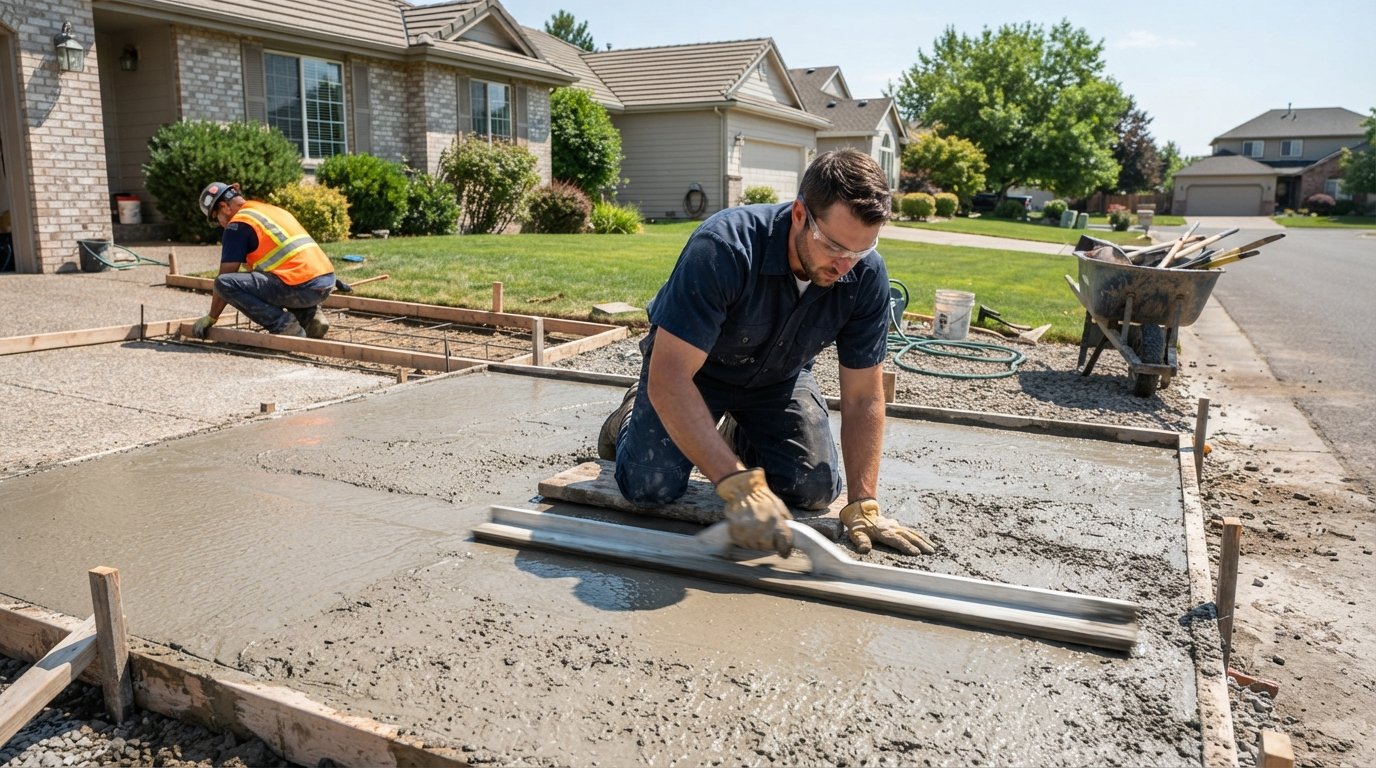
How to Vet Concrete Contractors for Driveway and Patio
Learn how to vet concrete contractors for driveway and patio projects by checking licenses, comparing bids, and asking the right technical questions.

By Justin Blake
Learn more about Concrete Installation for guides, costs, and what to expect.
Compare Concrete Installation Pros Near You

Enter your ZIP code to compare top-rated local professionals and request free quotes.
Your driveway and patio are two of the most visible and heavily used surfaces on your property. They endure vehicle traffic, freeze-thaw cycles, scorching sun, and foot traffic year after year. When either surface begins to crack, settle, or simply looks worn out, hiring a concrete contractor becomes a high-stakes decision. A poor installation can lead to premature cracking, drainage problems, and repair bills that dwarf the original project cost. A skilled contractor, on the other hand, delivers a surface that lasts decades with minimal maintenance.
The challenge is that concrete work attracts a wide range of professionals, from seasoned specialists with decades of experience to fly-by-night operators who disappear after the first rain. Learning how to vet concrete contractors for driveway and patio projects is not just about comparing prices. It is about verifying credentials, understanding the technical details of concrete work, and knowing which questions separate true craftsmen from pretenders. This guide walks you through every step of that vetting process so you can hire with confidence.
Start With Licensing, Insurance, and Business Legitimacy
Before you discuss design ideas or request a bid, confirm that the contractor is legally operating in your state. Concrete contractors typically need a specific license or registration depending on your jurisdiction. Some states require a general contractor license for any project above a certain dollar amount, while others have a dedicated concrete specialty license. You can verify a license number through your state contractor licensing board website or by calling the board directly. If a contractor hesitates to provide a license number, that is an immediate red flag.
Insurance is equally critical. Concrete work involves heavy equipment, potential property damage, and the risk of worker injury. A legitimate contractor carries general liability insurance and workers compensation coverage. Ask for a certificate of insurance and then call the insurance company to confirm the policy is active and covers the scope of your project. If a worker is injured on your property and the contractor lacks workers comp, you could be held liable for medical bills and lost wages.
Beyond licensing and insurance, verify the business itself. Check that the company has a physical address, a working phone number, and a professional website. Look up the business registration with your state secretary of state office to confirm it is in good standing. A contractor who operates only through a mobile phone and a magnetic sign on a truck may be difficult to hold accountable if problems arise later.
Evaluate Experience With Driveways and Patios Specifically
Not all concrete contractors are equal. A company that excels at foundation walls or decorative interior floors may not have the same expertise in outdoor flatwork. Driveways and patios present unique challenges: proper slope for drainage, resistance to freeze-thaw cycles, soil compaction, and joint spacing to control cracking. You need a contractor who has completed many similar projects in your climate and soil conditions.
Ask how many driveway and patio projects the contractor has completed in the past two years. Request addresses or photos of recent work, and if possible, visit a job site that is at least three to five years old. That is enough time for settlement or cracking issues to appear. A contractor who proudly shows you work from a decade ago and can explain how it has held up is demonstrating real confidence. If they only have photos of fresh concrete, you cannot judge long-term performance.
Experience with your specific climate matters as well. In cold regions, contractors must use air-entrained concrete and proper curing methods to resist freeze-thaw damage. In hot, dry climates, they need to manage rapid moisture loss to prevent plastic shrinkage cracks. A contractor who has only worked in one region may not understand the demands of your local environment. Ask directly: "What admixtures or curing practices do you use for outdoor concrete in this area?" A knowledgeable contractor will have a clear answer.
Request and Compare Multiple Detailed Bids
Getting at least three written bids is one of the most effective ways to vet concrete contractors for driveway and patio work. A single bid gives you no context for pricing or scope. Three bids reveal the market range and highlight differences in what each contractor includes. However, comparing bids requires more than looking at the bottom line. You need to compare the scope of work, materials, thickness, reinforcement, and site preparation.
Here are the key elements every concrete bid should specify:
- Excavation and grading: How much soil will be removed, and how will the subgrade be compacted?
- Base material: What type and depth of gravel or crushed stone will be used under the slab?
- Concrete thickness: Driveways typically require 4 to 6 inches, patios 4 inches, but heavy vehicles may demand more.
- Reinforcement: Will the slab include rebar, wire mesh, or fiber mesh? Where will it be placed?
- Joint spacing and type: How far apart will control joints be, and will expansion joints be installed against existing structures?
- Finishing and curing: What finish (broom, exposed aggregate, stamped) and what curing method will be used?
- Drainage plan: What slope will be created to direct water away from your home and driveway?
A bid that simply says "pour 4-inch concrete driveway" without these details is incomplete. Ask each contractor to clarify anything missing. A professional will appreciate your thoroughness and provide the information. A contractor who becomes defensive or vague is likely cutting corners.
Be cautious of bids that are dramatically lower than the others. A price that is 30 to 50 percent below the average often means thinner concrete, no reinforcement, inadequate base preparation, or unlicensed labor. The cheapest bid is rarely the best value when it comes to concrete. For more guidance on comparing contractor quotes and understanding cost drivers, you can explore the resources at FreeQuotes.Contractors, which connects homeowners with pre-vetted local professionals and offers educational tools for project planning.
Check References and Online Reputation Thoroughly
References are one of the most powerful vetting tools available, but only if you actually call them. Ask each contractor for three to five references from projects completed in the last two years. When you call, ask specific questions: Did the contractor show up on time? Was the crew professional and respectful? Did the final cost match the bid? Would you hire them again? Have you noticed any cracking or settling?
Online reviews provide another layer of insight, but you need to read them critically. A handful of glowing reviews could be written by friends or family. Look for patterns across multiple platforms: Google, Yelp, the Better Business Bureau, and industry-specific sites. Pay attention to how the contractor responds to negative reviews. A professional response that acknowledges the issue and explains how it was resolved is a good sign. Defensive or hostile replies are a warning.
Also check for complaints with your state attorney general office and the Better Business Bureau. A contractor with a pattern of unresolved complaints or legal judgments is not worth the risk, no matter how attractive the price. Cross-reference the business name, owner name, and license number to catch any history of operating under different names.
Ask Technical Questions to Gauge Expertise
You do not need to be a concrete expert, but asking a few technical questions will quickly reveal whether a contractor truly understands outdoor flatwork. Here are some questions to pose during your interview:
- "What is the minimum concrete thickness you recommend for a driveway that will hold a pickup truck?" (Answer: 5 to 6 inches with proper reinforcement.)
- "How do you prevent cracking in a patio?" (Answer: proper base compaction, control joints spaced 8 to 12 feet apart, and adequate curing.)
- "Do you use air-entrained concrete for outdoor pours in freezing climates?" (Answer: yes, for freeze-thaw resistance.)
- "How will you ensure water drains away from my foundation?" (Answer: specific slope percentages and grading plan.)
- "What is your curing process, and how long before I can drive on the surface?" (Answer: typically 7 days for light vehicles, 28 days for full strength.)
A contractor who answers these questions confidently and with specific details is likely experienced. If the answers are vague or contradictory, keep looking. You can also ask for the mix design or PSI rating of the concrete they plan to use. Standard driveway concrete is typically 4,000 to 4,500 PSI, while patios may use 3,500 to 4,000 PSI. A contractor who does not know the PSI of their mix is not paying attention to quality.
Review the Contract and Payment Terms Carefully
Before signing anything, read the contract line by line. A solid concrete contract should include the full scope of work, materials specifications, timeline, payment schedule, warranty terms, and a clause explaining how disputes will be handled. It should also state who is responsible for permits and disposal of excavated material.
Payment terms deserve special scrutiny. A common rule of thumb is to pay 10 to 30 percent as a deposit, with the remainder due upon completion and your approval. Never pay the full amount upfront. A contractor who demands 50 percent or more before starting is either undercapitalized or planning to disappear. Also be wary of contracts that require cash payments only or refuse to provide a written agreement. These are classic signs of a scam.
The warranty is another critical element. Ask how long the workmanship warranty lasts and what it covers. A one-year warranty is standard, but some contractors offer two to five years on workmanship. Get the warranty in writing, and make sure it covers both materials and labor. If the contractor offers a manufacturer warranty on the concrete mix, ask for documentation.
Watch for Red Flags During the Vetting Process
Certain behaviors should immediately disqualify a contractor from consideration. Be on the lookout for these warning signs:
- Door-to-door solicitation with pressure to sign today for a discount.
- No physical business address or only a P.O. box.
- Refusal to provide a written estimate or contract.
- Requests for full payment upfront or large cash deposits.
- No license number on business cards or vehicles.
- Evasive answers about insurance or references.
- High-pressure sales tactics or claims that a special price expires immediately.
- No local presence or a history of operating under multiple business names.
Any one of these red flags is reason enough to walk away. There are plenty of reputable concrete contractors who will treat you fairly and do quality work. You do not need to take a risk on someone who shows even one of these warning behaviors. Trust your instincts: if something feels off, it probably is.
Plan for Long-Term Maintenance From the Start
Vetting a contractor is not just about the installation. It is also about setting your driveway and patio up for long-term success. Ask the contractor about recommended maintenance after the pour. Most concrete should be sealed after 28 days to protect against moisture, stains, and freeze-thaw damage. Some contractors include sealing in their bid, while others charge extra. Knowing the maintenance plan upfront helps you budget for future care.
For driveways in particular, sealing every two to three years can significantly extend the life of the concrete. If you want to learn more about why sealing matters and how it protects your investment, a useful resource is this guide on driveway sealing for longevity, which explains the benefits and timing in detail. A contractor who educates you on maintenance is likely one who takes pride in their work and wants it to last.
Finally, consider the overall relationship. A good concrete contractor will answer your questions patiently, provide clear documentation, and communicate openly throughout the project. They will not rush you into a decision or dismiss your concerns. The vetting process is as much about finding someone you trust as it is about checking credentials. When you find a contractor who meets all these criteria, you can move forward with confidence, knowing your driveway and patio are in capable hands.