
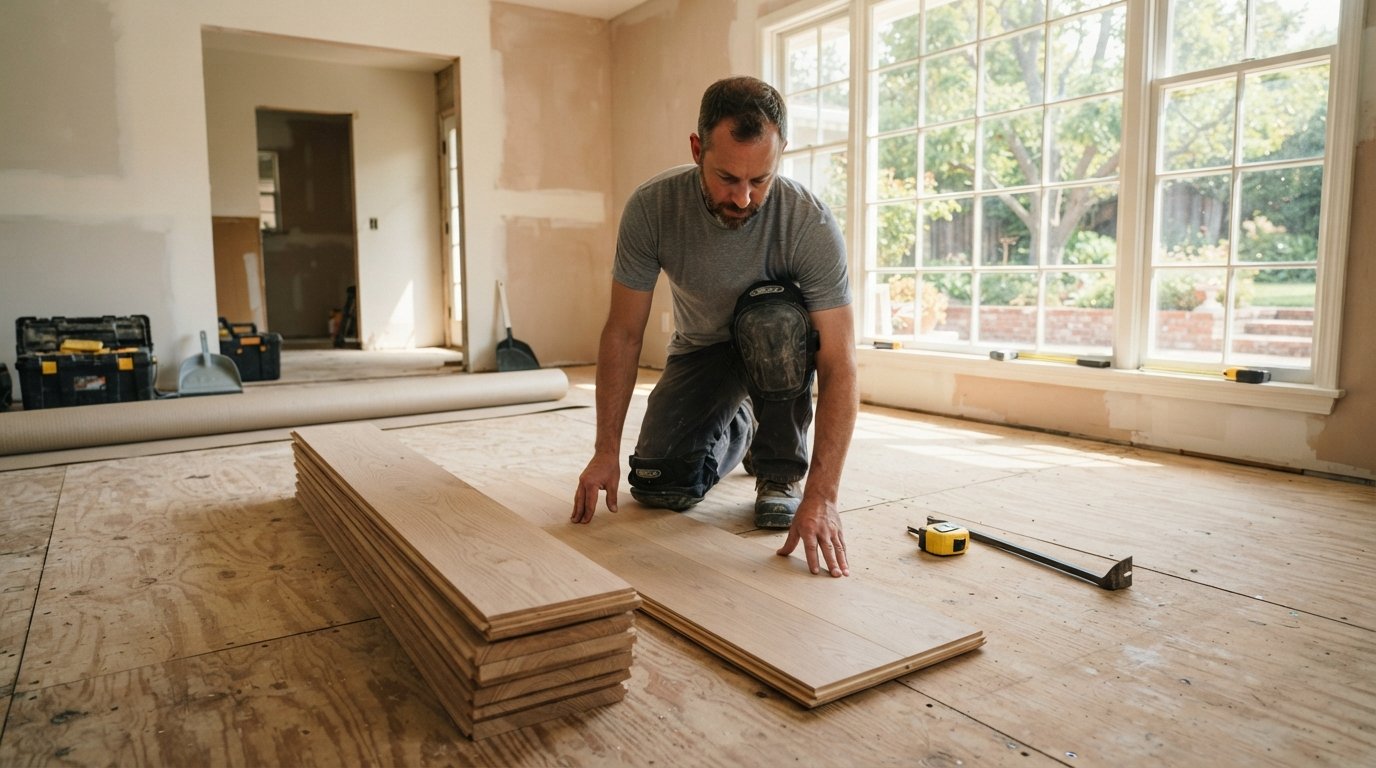
Hardwood vs Engineered Wood Flooring: Cost and Durability
Compare hardwood vs engineered wood flooring cost and durability, including installed prices and refinishing limits. Call (833)-365-8755 for expert help.

By Alexia Mabel
Learn more about Floor Installation or Replacement for guides, costs, and what to expect.
Compare Floor Installation or Replacement Pros Near You

Enter your ZIP code to compare top-rated local professionals and request free quotes.
Choosing between hardwood and engineered wood flooring is one of the most consequential decisions in a home renovation. Both options deliver the warm, natural look that homeowners love, but they differ dramatically in cost, durability, installation requirements, and long-term performance. Understanding these differences before you commit can save you thousands of dollars and prevent costly mistakes, especially if your home has a concrete slab, a basement, or rooms with high humidity. This guide breaks down the real numbers and practical trade-offs so you can make an informed choice for your project.
Material and Installed Cost: What to Expect per Square Foot
The first question most homeowners ask is simple: how much will it cost? The answer depends on species, grade, finish, and location, but national averages provide a reliable starting point. Solid hardwood typically ranges from $4 to $12 per square foot for the material alone, while engineered wood runs from $3 to $10 per square foot. Those ranges overlap, but the installed cost tells a clearer story.
Installation labor adds $3 to $8 per square foot for solid hardwood, depending on whether you choose nail-down or glue-down methods and whether subfloor prep is required. Engineered wood installation is often slightly cheaper, at $3 to $7 per square foot, because floating installations can be faster and some products come pre-finished. When you combine materials and labor, solid hardwood generally lands between $8 and $20 per square foot installed, while engineered wood falls between $6 and $17 per square foot installed.
These figures are national averages. Regional labor rates, the complexity of your room layout, and the condition of your subfloor can push costs higher. For a more localized estimate, you can explore wood flooring in OKC to see how pricing shifts by market. Always obtain multiple quotes from licensed flooring contractors to get a precise figure for your home.
It is also worth noting that the cheapest engineered products (often 1/4-inch thick with a thin veneer) may not last as long as a mid-range solid hardwood. Paying a little more upfront for a thicker wear layer or a higher-grade solid plank often delivers better long-term value. The table below summarizes the typical cost ranges:
- Solid hardwood material: $4 to $12 per square foot
- Engineered wood material: $3 to $10 per square foot
- Solid hardwood installed: $8 to $20 per square foot
- Engineered wood installed: $6 to $17 per square foot
- Typical refinishing cost (solid): $3 to $5 per square foot
Keep in mind that these numbers are guidelines, not guarantees. Your actual quote will depend on the specific product you choose, the contractor's rates, and whether any subfloor repairs or moisture mitigation are needed. For a broader look at flooring costs and contractor selection, ContractorHomeQuotes offers detailed resources to help you plan your budget.
Durability and Refinishing Limits: How Many Times Can You Sand?
Durability is where the two flooring types diverge most sharply. Solid hardwood planks are typically 3/4 inch thick, which means they can be sanded and refinished multiple times, usually three to five times over their lifespan. That translates to 30 to 100 years of service if the floor is properly maintained. Each refinishing removes a thin layer of wood, but the thickness of solid planks provides ample material for repeated restoration.
Engineered wood, by contrast, has a real wood veneer on top of a plywood or high-density fiberboard core. The veneer thickness ranges from 1/16 inch to 1/4 inch. Thin veneers (1/16 to 3/32 inch) can typically be sanded only once, and some cannot be refinished at all. Thicker veneers (1/8 inch or more) may allow two or three sandings, but the risk of sanding through the veneer is real. Once the veneer is compromised, the floor cannot be repaired and must be replaced.
This does not mean engineered wood is fragile. High-quality engineered products with a thick wear layer can last 20 to 40 years in normal residential settings. The key is to choose a product with a veneer thick enough for your long-term plans. If you plan to stay in your home for decades and want the option to refresh the floor multiple times, solid hardwood is the safer bet. If you are renovating a rental property or planning to move within 10 to 15 years, a quality engineered floor can deliver excellent value.
It is also important to consider the finish. Factory-finished engineered and solid products come with durable aluminum oxide or polyurethane coatings that resist scratches and wear. Site-finished solid hardwood offers a custom look but requires more time and labor. In either case, proper maintenance, including felt pads under furniture and regular cleaning, extends the life of any wood floor.
Moisture and Humidity Tolerance: Basements and Slab Foundations
Moisture is the enemy of solid hardwood. Because solid planks expand and contract with changes in humidity, they are not recommended for basements, rooms over crawl spaces with high moisture, or any area where relative humidity fluctuates widely. Installing solid hardwood over a concrete slab is particularly risky; the slab can transmit moisture vapor, causing the wood to cup, crown, or gap. Most manufacturers require a vapor barrier and a dry slab, and even then, solid hardwood is often not warrantied for below-grade installations.
Engineered wood is engineered for stability. Its cross-ply construction counteracts the natural movement of wood, making it far more resistant to humidity swings. Many engineered products are approved for installation on concrete slabs, in basements, and even over radiant heating systems. That flexibility is a major advantage for homeowners with slab-on-grade homes or finished basements. However, engineered wood is not waterproof. Standing water or prolonged dampness can still damage the core, so it should not be used in bathrooms or laundry rooms.
If your project involves a basement or a concrete slab, engineered wood is usually the practical choice. If you have a wood subfloor and can maintain stable indoor humidity (typically 35 to 55 percent), solid hardwood will perform beautifully. In both cases, acclimate the flooring to the room before installation and follow the manufacturer's guidelines for moisture testing.
Installation Methods: Nail-Down, Glue-Down, and Floating
The installation method affects both cost and performance. Solid hardwood is typically installed with a nail-down method over a wood subfloor. The planks are fastened to the subfloor with cleats or staples, which allows the floor to move slightly as it expands and contracts. Nail-down installation requires a suitable subfloor and is not an option over concrete slabs without a plywood overlay.
Engineered wood offers more flexibility. It can be nailed, glued, or floated. Glue-down installation is common over concrete slabs, where a moisture-cured adhesive acts as both a bond and a vapor barrier. Floating installations, where planks click together and rest on an underlayment, are fast and can be DIY-friendly, though professional installation is still recommended for a flawless result. Some engineered products are approved for all three methods, giving you options based on your subfloor and budget.
Installation costs vary by method. Nail-down and glue-down installations require more labor and surface preparation, while floating floors can be installed more quickly. However, floating floors may sound hollow underfoot and can feel less solid than glued or nailed floors. Discuss the best method for your home with your contractor, and make sure the product you choose is warrantied for that installation type.
Resale Value and Buyer Perception
Real wood flooring, whether solid or engineered, is a strong selling point. Buyers perceive wood floors as warm, durable, and premium. According to real estate professionals, hardwood floors can increase a home's resale value and speed up the sale process. The difference in buyer perception between solid and engineered wood is often minimal, especially when the engineered product looks and feels like real wood.
That said, some buyers and home inspectors may place a higher value on solid hardwood because of its refinishing potential and longevity. In higher-end markets, solid hardwood may be expected. In markets where slab foundations are common, engineered wood is the norm and is widely accepted. The key is to choose a product that matches the expectations of your local market and the architectural style of your home.
If you are planning a renovation and want to maximize your return on investment, consider the overall design and durability of the floor. A well-installed, high-quality engineered floor can look just as impressive as solid hardwood and may be more practical for your lifestyle. For homeowners in Atlanta and across Georgia, local market preferences and humidity levels often favor engineered wood for its stability. You can find more regional guidance in our contractor marketplace resources.
Making the Decision: A Practical Framework
To choose between hardwood and engineered wood, start by assessing your home's environment and your long-term plans. Ask yourself these questions:
- What is my subfloor? Concrete slab or basement? Engineered wood is the safer choice. Wood subfloor with stable humidity? Solid hardwood is viable.
- How long do I plan to stay? If you plan to stay 20 years or more, solid hardwood's refinishing potential may be worth the higher upfront cost. If you plan to move sooner, engineered wood offers excellent value.
- What is my budget? Engineered wood typically costs less installed, but high-end engineered products can approach solid hardwood prices. Compare quotes for the specific products you like.
- Do I need to install over radiant heat? Engineered wood is often approved for radiant heating; solid hardwood may not be.
- What are local buyer expectations? In some markets, solid hardwood is a premium feature; in others, engineered wood is standard and fully accepted.
Once you have answers, request quotes from at least three licensed flooring contractors. Ask each contractor about product warranties, installation methods, and moisture testing. A reputable contractor will help you weigh the trade-offs and choose a floor that fits your home and budget. For a free, no-obligation quote from pre-screened professionals, visit our partner network.
Whichever option you choose, remember that proper installation and maintenance are just as important as the material itself. A well-installed engineered floor will outperform a poorly installed solid floor every time. Invest in quality materials and hire a qualified professional to protect your investment.
Hardwood and engineered wood both offer beauty and value, but they serve different needs. Solid hardwood wins on refinishing potential and long-term durability, while engineered wood wins on moisture tolerance, installation flexibility, and upfront cost. By understanding the cost per square foot, refinishing limits, moisture considerations, and resale implications, you can make a confident decision that enhances your home for years to come.