
Crawl Space Encapsulation vs Vented Crawl Space
Compare crawl space encapsulation vs vented crawl space, including costs, moisture control, and energy savings, to choose the best option for your home.
By Scott Thompson
Learn more about Home Waterproofing for guides, costs, and what to expect.
Compare Home Waterproofing Pros Near You

Enter your ZIP code to compare top-rated local professionals and request free quotes.
A crawl space sits beneath thousands of American homes, quietly shaping indoor air quality, energy bills, and structural longevity. Yet most homeowners never think about it until something goes wrong: sagging floors, musty odors, high humidity, or a pest infestation. When that moment arrives, one question dominates the conversation among contractors and building scientists: should you seal the crawl space completely through encapsulation, or keep it vented to the outside air? The crawl space encapsulation vs vented crawl space debate has shifted dramatically over the past two decades, and the answer you choose affects everything from your monthly utility costs to the resale value of your property.
This guide breaks down how each approach works, what the research says, what it costs, and how to decide which method fits your home, your climate, and your budget. You will also learn how to plan the project properly and find qualified local professionals who can get the job done right.
How Vented Crawl Spaces Work and Why They Were Standard
For most of the twentieth century, building codes across North America required crawl spaces to have foundation vents, typically one square foot of vent opening for every 150 square feet of floor area. The logic seemed sound at the time: let outside air circulate underneath the house to dry out moisture and prevent wood rot. Builders installed screened vents along the foundation walls, and homeowners were told to keep them open year round.
The problem is that this logic fails in most real-world conditions. During humid summers, the outside air carries far more moisture than the cooler crawl space air. When that warm, moist air enters through the vents, it condenses on cool joists, insulation, and ductwork, exactly the surfaces you want to keep dry. In winter, vents allow freezing air to chill water pipes and HVAC equipment. In wildfire-prone regions, vents pull smoke and embers underneath the home. In flood zones, they invite water in rather than keeping it out.
Building researchers, including teams at advanced building science centers, began documenting these failures in the 1990s and 2000s. Their findings were consistent: vented crawl spaces frequently suffer from high relative humidity, mold growth, wood decay, and elevated radon levels. What was once considered best practice is now recognized in many jurisdictions as an outdated approach that creates more problems than it solves.
What Crawl Space Encapsulation Actually Involves
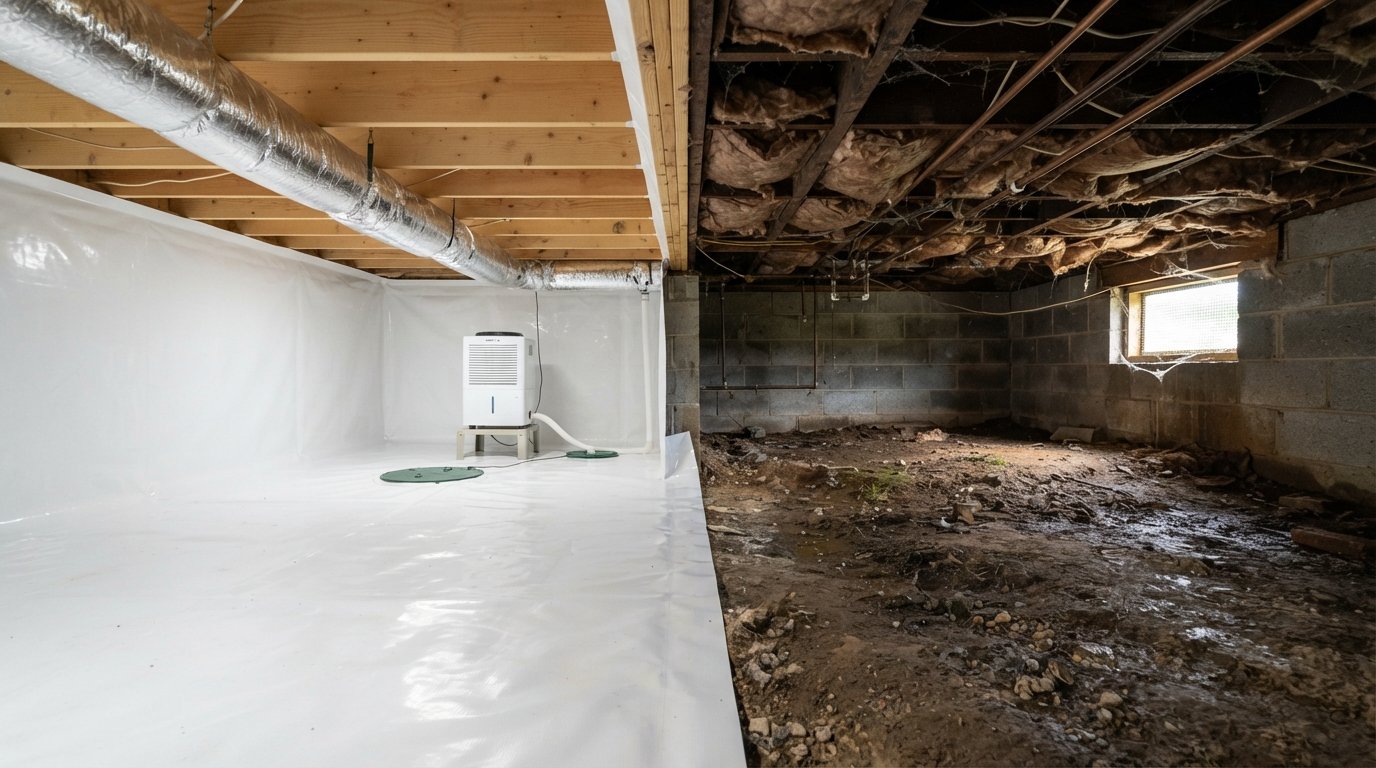
Encapsulation takes the opposite approach. Instead of trying to dry the crawl space with outside air, encapsulation seals it off from the ground and the exterior environment entirely. A heavy-duty polyethylene liner, typically 10 to 20 mil thick, covers the floor and often extends up the walls and piers. The seams are taped and sealed, foundation vents are closed or removed, and the space is treated as a conditioned or semi-conditioned zone of the home.
A complete encapsulation system usually includes several components working together:
- A reinforced vapor barrier liner on the floor and walls, sealed at all seams and penetrations
- Closed-cell spray foam or rigid foam insulation on the walls and rim joists
- A crawl space dehumidifier sized to the volume of the space
- A sump pump or drainage system if groundwater is a concern
- Sealed vents and a sealed access door
Once installed, the crawl space stays dry, clean, and within a stable temperature range. Because the space is no longer exposed to outdoor humidity, the wood framing stays dry, mold cannot thrive, and the HVAC system does not have to work as hard to condition the home. Many homeowners find they can even use the encapsulated space for limited storage, something that was never advisable in a vented crawl space.
The cost of encapsulation varies widely by region, home size, and the condition of the existing crawl space. According to our guide on crawl space repair costs, homeowners should expect to pay more for full encapsulation than for simple vent sealing, but the long-term savings on energy and repairs often justify the investment. A typical encapsulation project ranges from a few thousand dollars for a small, simple crawl space to well over ten thousand for a large home with significant moisture issues.
Head-to-Head Comparison: Encapsulation vs Vented
To make a smart decision, you need to compare the two approaches across the factors that matter most: moisture control, energy efficiency, indoor air quality, pest resistance, and long-term maintenance. The table below summarizes the key differences, followed by a deeper look at each factor.
Moisture control is the single biggest differentiator. A vented crawl space depends on outdoor air to dry itself, but as explained earlier, that air often makes things worse. Encapsulation eliminates the moisture source by blocking ground vapor and sealing out humid air. The result is a dry space with relative humidity typically below 60 percent, the threshold at which mold and dust mites struggle to survive.
Energy efficiency follows directly from moisture control. A vented crawl space acts as an open window under your floor, pulling conditioned air out of the house and replacing it with outside air that must then be heated or cooled. Encapsulated crawl spaces reduce this stack effect, and many homeowners report lower heating and cooling bills after the project. The exact savings depend on climate, home design, and how well the rest of the house is sealed, but the direction of the effect is consistent.
Indoor air quality is another major consideration. In a vented crawl space, air from the soil and outside moves upward into the living space, carrying mold spores, dust, radon, and pests. Encapsulation creates a barrier that keeps these contaminants out of your home. For families with allergies or respiratory issues, this improvement alone can justify the cost.
Pest resistance is a secondary but meaningful benefit. Vented crawl spaces offer easy access to termites, rodents, and insects. Encapsulation, combined with sealed vents and a tight liner, makes the space far less inviting. It does not replace a pest control program, but it reduces the likelihood of infestation.
Maintenance requirements differ as well. Vented crawl spaces require periodic inspection for moisture, pest activity, and insulation damage. Encapsulated spaces need occasional checks of the dehumidifier and liner, but they are generally lower maintenance once installed.
When a Vented Crawl Space Might Still Make Sense
Despite the strong case for encapsulation, there are situations where a vented crawl space can be acceptable. In very dry climates with low humidity year round, such as parts of the desert Southwest, venting may not cause the moisture problems seen elsewhere. Similarly, some older homes with no existing moisture issues and limited budgets may choose to keep the current vented configuration and focus on targeted improvements like better drainage or a partial vapor barrier.
However, even in these cases, building scientists generally recommend at least a ground vapor barrier and careful monitoring. The trend in building codes and industry best practices is clearly moving toward sealed, encapsulated crawl spaces. If you are building new construction or planning a major renovation, encapsulation is the forward-looking choice.
Cost Factors and Long-Term Value
Understanding the cost difference between encapsulation and vented crawl space maintenance is essential for budgeting. A vented crawl space is cheaper upfront because it requires no liner, no dehumidifier, and no sealing work. But those savings often disappear over time through higher energy bills, repeated moisture repairs, pest control, and eventually the cost of fixing rot or mold.
Encapsulation carries a higher initial price, but it is a one-time investment that can last decades. When you factor in energy savings, improved air quality, and avoided repairs, the return on investment can be substantial. To get accurate numbers for your specific home, request multiple quotes from licensed crawl space contractors. You can use a service like FreeQuotes.Contractors to compare bids and find a qualified professional in your area.
Financing options are also available for homeowners who want to spread the cost over time. Many contractors offer payment plans, and some energy efficiency upgrades may qualify for tax credits or rebates. Be sure to ask about these possibilities when you request quotes.
How to Plan Your Crawl Space Project
Whether you choose encapsulation or decide to improve a vented crawl space, proper planning is critical. Start by having a qualified contractor inspect the space for moisture sources, structural issues, and existing damage. The inspection should cover the foundation walls, floor joists, insulation, plumbing, and any signs of pest activity.
Next, define your goals. Are you trying to solve a specific problem like musty odors or high humidity? Do you want to improve energy efficiency? Are you preparing to sell the home? Your goals will shape the scope of work and help you compare bids fairly.
Then, gather at least three written estimates. Each estimate should detail the materials to be used, the scope of work, the timeline, and the warranty. Avoid contractors who give vague verbal quotes or pressure you to decide immediately. A reputable professional will be happy to answer your questions and provide references.
Finally, schedule the work during a dry season if possible, and plan for the crawl space to be inaccessible for a few days. After installation, follow the contractor's maintenance recommendations to keep the system in good condition.
Finding the Right Contractor for the Job
Crawl space work is specialized, and not every general contractor has the training or equipment to do it well. Look for companies that specialize in crawl space encapsulation, waterproofing, or foundation repair. Check licenses, insurance, and online reviews. Ask for photos of past projects and contact information for recent customers.
A good contractor will perform a thorough inspection, explain your options clearly, and provide a detailed written estimate. They will also be familiar with local building codes and any permits required. If a contractor suggests simply sealing a few vents without addressing ground moisture or insulation, consider getting a second opinion.
Remember that the lowest bid is not always the best choice. Quality materials and proper installation matter enormously in crawl space work. A poorly installed vapor barrier can fail within a few years, leaving you with the same problems you started with.
For homeowners who want to compare multiple quotes quickly and easily, online platforms can streamline the process. ContractorHomeQuotes connects you with pre-screened local professionals who can assess your crawl space and provide free, no-obligation estimates. This saves time and helps you make an informed decision.
Common Misconceptions About Crawl Spaces
One persistent myth is that a little ventilation is always good. As we have seen, in most climates, ventilation introduces more moisture than it removes. Another misconception is that encapsulation is only for old homes. In reality, new construction can benefit just as much, and many builders now include encapsulated crawl spaces as a standard feature.
Some homeowners worry that sealing the crawl space will trap radon or other gases. In fact, a proper encapsulation system includes a radon mitigation component if needed, and sealing the space prevents soil gases from entering the home. A qualified contractor can test for radon and design a system that addresses it.
Finally, there is the belief that encapsulation is too expensive to consider. While it is a significant investment, the long-term savings and health benefits often outweigh the upfront cost. When you compare the price of encapsulation to the cumulative cost of energy waste, repairs, and potential health issues, the value proposition becomes clear.
Making the Decision: A Step-by-Step Framework
To choose between encapsulation and venting, follow this simple framework:
- Assess your climate: humid climates strongly favor encapsulation.
- Inspect the current crawl space for moisture, mold, pests, and structural damage.
- Define your goals: comfort, energy savings, health, or resale value.
- Get quotes for both approaches if venting is even viable in your area.
- Compare long-term costs, not just upfront prices.
- Choose a licensed, experienced contractor with strong references.
After completing these steps, you will have a clear picture of which option makes sense for your home. In most cases, encapsulation emerges as the superior choice for durability, comfort, and indoor air quality.
Whichever path you choose, remember that the crawl space is not a space to ignore. It affects your home's performance every day. By taking the time to understand your options and work with a qualified professional, you can protect your investment and enjoy a healthier, more efficient home for years to come.
Learn more about Home Waterproofing for guides, costs, and what to expect.
Compare Home Waterproofing Pros Near You
Enter your ZIP code to compare top-rated local professionals and request free quotes.