
Carbon Fiber Foundation Repair: Process and Cost Guide
Carbon fiber foundation repair stabilizes bowing walls for $2,500-$6,000 per wall. Call (833)-365-8755 for expert help.

Learn more about Foundation Repair for guides, costs, and what to expect.
Compare Foundation Repair Pros Near You

Enter your ZIP code to compare top-rated local professionals and request free quotes.
A cracked or bowing foundation wall can turn a stable home into a source of constant worry. Among the repair options available, carbon fiber reinforcement has gained serious traction as a minimally invasive, long-lasting solution for stabilizing failing walls. But what exactly does the carbon fiber foundation repair process involve, and what should you expect to pay? This guide breaks down the steps, the cost factors, and the questions you need to ask before signing a contract.
How Carbon Fiber Straps and Staples Stabilize Foundation Walls
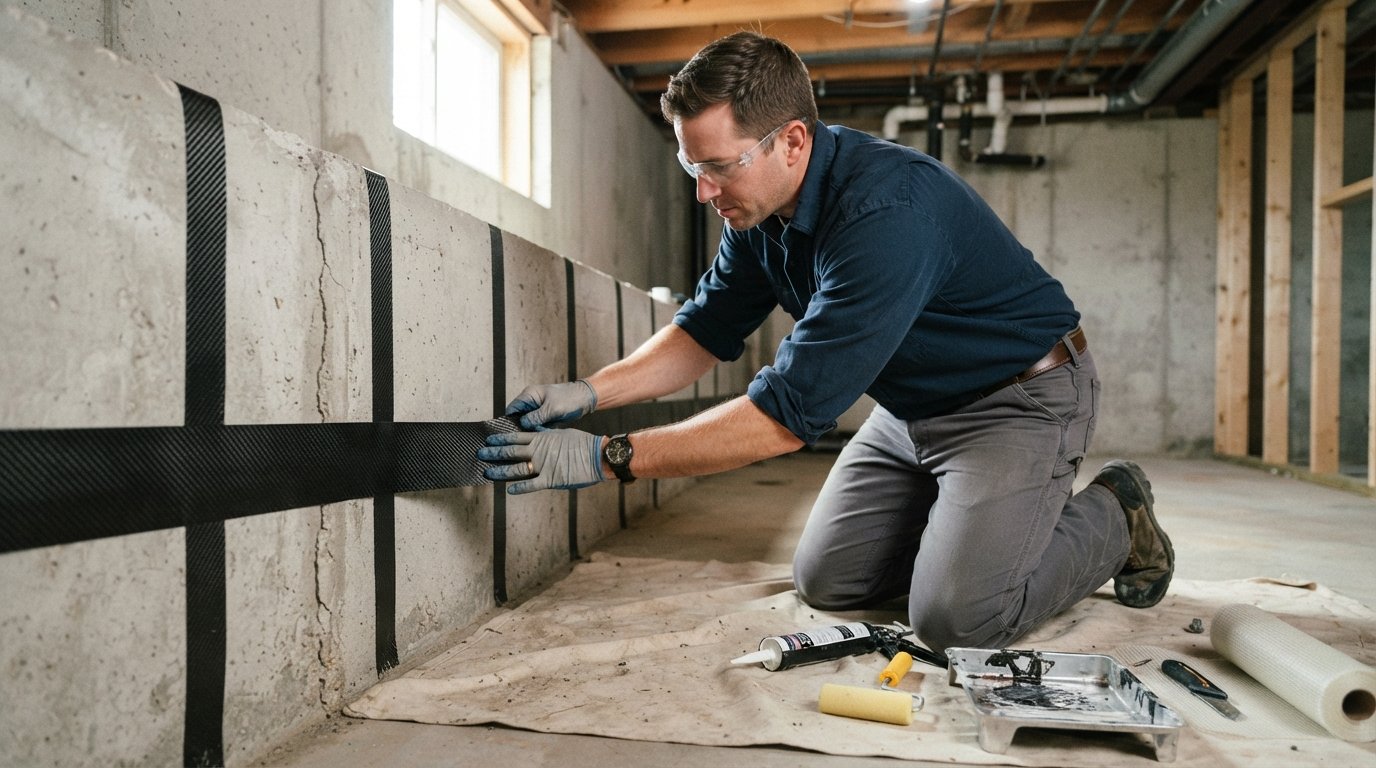
Carbon fiber repair works by mechanically reinforcing a foundation wall that has cracked or started to bow inward. The system relies on two main components: carbon fiber straps and carbon fiber staples. Straps are wide, flat strips of carbon fiber fabric that are bonded to the interior surface of the wall with a high-strength epoxy. They run vertically from the top of the wall to the footing and are anchored at both ends. When the wall tries to move inward, the strap resists the tension and holds the wall in place. Staples, on the other hand, are shorter strips used to stitch cracks together, preventing further separation.
The key advantage of carbon fiber is its incredible tensile strength, which is several times greater than steel on a per-weight basis. Because the material is bonded directly to the wall, it distributes the load across the entire surface rather than concentrating stress at a few anchor points. This makes it an excellent choice for stabilizing masonry and concrete walls without the need for massive excavation or heavy equipment. Unlike steel I-beams or piers, carbon fiber straps do not require digging up the basement floor or excavating outside, which means less disruption and often a lower total project cost.
However, carbon fiber is not a one-size-fits-all fix. It is most effective when the wall is still relatively straight and the movement is minimal to moderate. If the wall has already bowed significantly or the soil pressure is extreme, a more robust solution like helical piers or push piers may be necessary. A qualified foundation contractor can assess the severity of the problem and recommend the right approach. For a broader look at comparing repair bids, see our guide on understanding foundation repair quotes.
Which Crack and Bowing Scenarios Suit Carbon Fiber vs Piers
Determining whether carbon fiber is appropriate comes down to the type and extent of the damage. Carbon fiber excels at addressing horizontal cracks, stair-step cracks in block walls, and minor to moderate bowing (typically less than 2 inches of deflection). It is also a strong choice for preventing future movement in walls that have been stabilized but need added reinforcement. Because the straps are unobtrusive and can be painted over, they are popular in finished basements where aesthetics matter.
Piers, by contrast, are designed to address foundation settlement, where the entire footing has sunk or shifted. Piers are driven deep into stable soil or bedrock to lift and support the structure. They are the go-to solution for vertical cracks, wall rotation, and significant bowing that has compromised the wall's structural integrity. In some cases, a combination of carbon fiber and piers may be recommended. For example, if a wall is bowing and the footing is also settling, carbon fiber alone will not correct the settlement; piers may be needed to stabilize the footing first.
Here are the key scenarios where carbon fiber is typically the preferred method:
- Horizontal cracks in poured concrete or block walls that have not yet caused significant bowing.
- Stair-step cracks in masonry walls with minimal displacement.
- Walls with moderate bowing (less than 2 inches) where the footing is stable.
- Preventative reinforcement for walls showing early signs of stress.
- Finished basements where minimal disruption is desired.
If the wall has bowed more than 2 inches, or if there are signs of soil movement or footing failure, piers are usually the safer bet. A professional evaluation is essential to make the right call. In our experience, homeowners who get multiple quotes often find that contractors disagree on the best method, which is why it pays to understand the trade-offs.
Typical Cost Range per Wall and What Drives Pricing
Carbon fiber foundation repair is generally more affordable than pier systems, but costs can vary widely depending on the number of straps, the height of the wall, accessibility, and regional labor rates. As a ballpark, most homeowners pay between $2,500 and $6,000 per wall for carbon fiber reinforcement. For a simple crack stitching with staples, costs can be as low as $500 to $1,500. For a full wall stabilization with multiple straps, expect $4,000 to $8,000 or more. These figures are national averages; your actual quote will depend on the specifics of your project.
Several factors drive the price. The number of straps required is the biggest variable: a typical 8-foot-high wall might need 4 to 6 straps spaced 4 to 6 feet apart. The length of the wall also matters, as longer walls require more material and labor. Accessibility plays a role too; if the area is cramped or requires moving stored items, labor costs increase. Finally, the extent of surface preparation and any additional crack injection or waterproofing will add to the total. It is important to get a detailed, written estimate that specifies the number of straps, the type of epoxy, and the warranty terms.
Compared to other methods, carbon fiber is often the middle ground: more expensive than simple crack injection but significantly less than pier installation, which can run $10,000 to $25,000 or more per wall. For a side-by-side comparison, you can use our cost estimation tools to get a better sense of what your project might cost. And if you are also considering renewable energy upgrades, you might find free solar power quotes helpful for planning a solar installation.
Warranties, Longevity, and Questions to Ask a Foundation Contractor
Carbon fiber systems, when installed correctly, can last for decades. The material itself is resistant to corrosion, rot, and UV damage (though it should be protected from sunlight in exposed applications). Most manufacturers offer warranties of 20 to 25 years, and some contractors provide a lifetime warranty on workmanship. However, the warranty is only as good as the contractor behind it. Before hiring, ask for the manufacturer's warranty documentation and confirm that the contractor is a certified installer. A proper installation requires surface preparation, proper epoxy mixing, and correct anchoring; cutting corners can lead to failure.
Here are essential questions to ask any foundation contractor before you commit:
- What is your experience with carbon fiber systems, and can you provide references from similar projects?
- Are you licensed and insured, and can you provide proof?
- What is the specific scope of work, including the number of straps and the type of epoxy?
- What warranty do you offer on both materials and labor?
- Will you obtain the necessary permits, and who handles inspections?
It is also wise to ask about the expected lifespan and any maintenance requirements. A reputable contractor will be transparent about the limitations of carbon fiber and will not oversell its capabilities. If the contractor recommends carbon fiber for a wall that clearly needs piers, get a second opinion. The foundation is not a place to gamble on the lowest bid.
Finally, consider the long-term value. Carbon fiber repair can often be completed in a day or two, with minimal disruption to your home. It does not require heavy equipment or major excavation, which means you can often stay in your home during the work. The cost, while not trivial, is an investment in the structural integrity of your property. By understanding the process and asking the right questions, you can make an informed decision and avoid costly mistakes down the road.
In summary, carbon fiber foundation repair is a proven, effective method for stabilizing cracked and bowing walls. It is less invasive and often more affordable than pier systems, making it a popular choice for many homeowners. Use this guide to evaluate your options and connect with qualified professionals who can provide accurate quotes for your specific situation.