
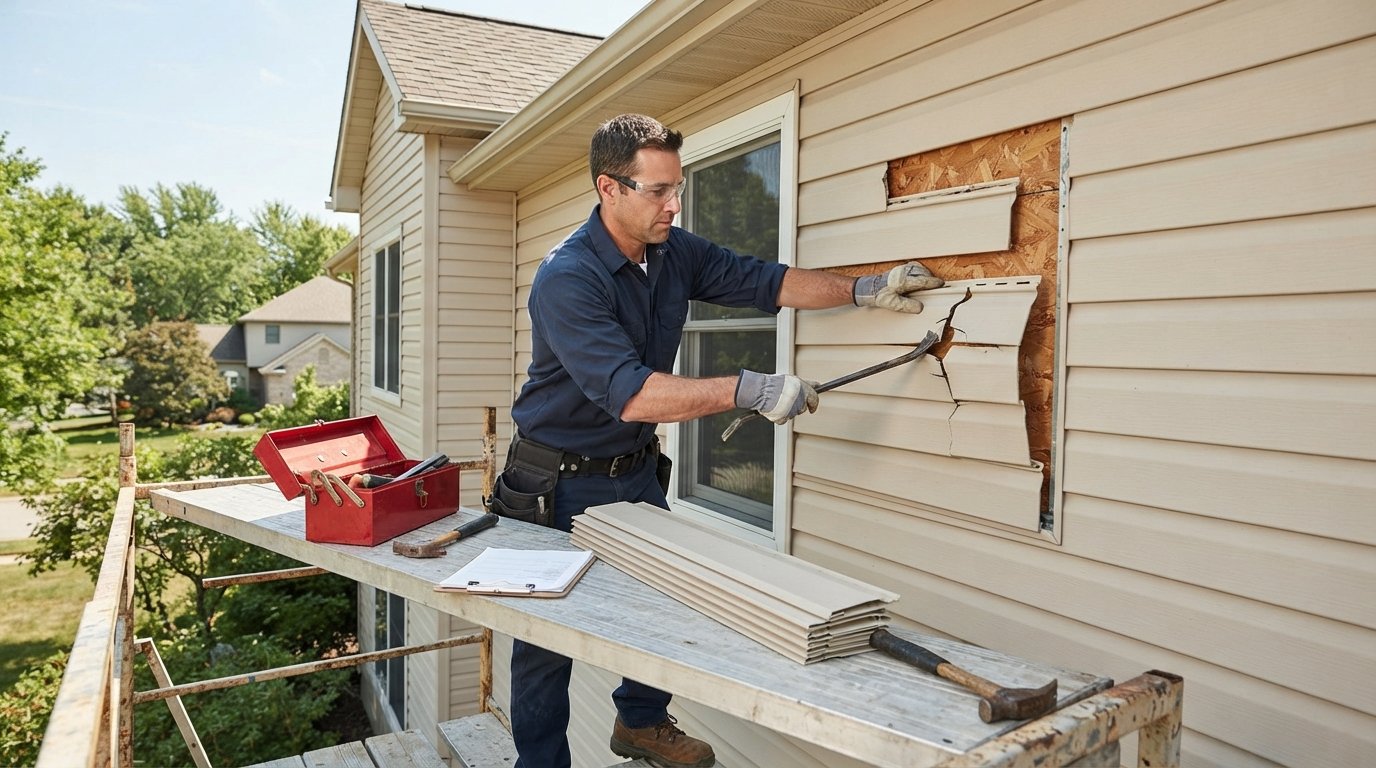
Repairing Siding Damage vs. Full Replacement: What to Know
Repairing siding damage instead of full replacement saves money when damage is localized. Call (833)-365-8755 for expert guidance on your repair.

By Jessica Reis
Learn more about Siding Repair for guides, costs, and what to expect.
Compare Siding Repair Pros Near You

Enter your ZIP code to compare top-rated local professionals and request free quotes.
Your home's siding takes a beating from sun, rain, wind, and hail, so it is no surprise when cracks, dents, or loose panels appear. The good news is that not every blemish means you need to re-side the entire house. In many cases, repairing siding damage instead of full replacement is the smarter financial move, especially when the problem is localized and caught early. This guide walks you through the types of damage that are repairable, how to match materials for a seamless fix, when repair costs start to rival replacement, and whether to tackle the job yourself or bring in a pro.
Common Siding Damage Types and Which Are Repairable
Siding problems range from cosmetic to structural, and the right approach depends on what you are dealing with. Vinyl siding might crack after a cold snap, wood siding can rot near the foundation, and fiber cement can chip from impact. Knowing which issues are fixable and which signal a larger problem is the first step in deciding between repair and replacement.
Here are the most frequent types of siding damage and their typical repairability:
- Cracks and holes: Often repairable, especially in vinyl and wood, with patching or panel replacement.
- Rot and moisture damage: Repairable if isolated; widespread rot may require replacement.
- Loose or missing panels: Usually a simple reattachment or single-panel swap.
- Fading and discoloration: Can sometimes be painted or cleaned, but severe fading across all sides may point to replacement.
- Hail dents and impact marks: Repairable in some materials, but extensive damage may justify a claim and partial replacement.
Localized damage, such as a single cracked panel from a stray baseball or a small area of rot around a window, is almost always a candidate for repair. The key is to assess whether the damage is contained or if it signals a systemic issue like poor ventilation or chronic water intrusion. If you spot soft spots, mold, or peeling paint in multiple areas, it may be time to consider a larger scope. For a deeper look at how to evaluate replacement options when repair is not enough, see our guide to siding replacement quotes.
Matching Materials and Color for Invisible Repairs
One of the biggest concerns homeowners have about repairing siding damage instead of full replacement is whether the repaired area will blend in. The good news is that modern siding materials and color-matching techniques make it possible to achieve a nearly invisible repair, especially if you have spare materials or can source a close match.
For vinyl siding, manufacturers often discontinue colors after a few years, but you may still find matching panels through specialty suppliers or by salvaging from an inconspicuous area (like behind a shrub). If an exact match is impossible, a professional can often blend a replacement panel by positioning it in a less visible spot or by painting the entire wall section to ensure uniformity. Wood siding can be patched with similar species and then painted or stained to match, though achieving a perfect grain match is challenging. Fiber cement and engineered wood can be patched with compatible materials and painted, and because these products are often painted on-site, color matching is more straightforward.
Here is a quick framework for matching materials:
- Identify the exact siding material and manufacturer (check the back of a loose panel or your home's original paperwork).
- Look for leftover materials in your garage or attic; builders often leave extras.
- Contact local siding suppliers with a sample for color and texture matching.
- If a perfect match is not available, consider painting the entire wall or a larger section to create a uniform look.
Keep in mind that even with careful matching, some materials fade over time, so a new panel may stand out slightly until the rest of the siding weathers. In many cases, a professional can use blending techniques, such as overlapping seams or strategic placement, to minimize visibility.
When Repair Costs Approach Replacement Costs
Repairing siding damage instead of full replacement makes financial sense when the damage is limited and the repair cost is a fraction of a full re-side. But there is a tipping point: if repairs become extensive or recurring, the cumulative cost can approach or exceed the price of new siding. Knowing where that line falls helps you make a sound decision.
As a rule of thumb, if the repair estimate is more than 30 to 40 percent of the cost of a full replacement, it is worth getting quotes for both options. For example, if a full siding replacement on your home would cost $12,000 and the repair quote comes in at $5,000, replacement may offer better long-term value, especially if the existing siding is older or showing wear in other areas. On the other hand, a $500 patch for a single cracked panel is a clear win for repair.
Several factors can push repair costs higher:
- Hard-to-match materials that require custom fabrication.
- Damage that extends into sheathing or framing, requiring carpentry work.
- Multiple areas of damage scattered across the house.
- Labor-intensive repairs on upper stories or complex rooflines.
It is also important to consider the age and condition of the rest of the siding. If your siding is nearing the end of its expected lifespan (typically 20 to 40 years depending on material), a repair might be a short-term fix before a full replacement becomes necessary. In that case, you might choose a minimal repair to buy time while you save for a replacement. For a detailed breakdown of replacement costs and what to expect, our guide on siding replacement quotes can help you compare.
DIY Patch Options vs. Hiring a Siding Professional
For handy homeowners, small siding repairs can be a manageable DIY project. Patching a small hole in vinyl siding with a color-matched patch kit, reattaching a loose panel with siding clips, or filling cracks in wood siding with exterior-grade epoxy are all tasks within reach for someone comfortable with basic tools. However, there are limits to what DIY can achieve, and some repairs are best left to professionals to avoid causing further damage or voiding warranties.
DIY is a good option when the damage is small, accessible, and on a material you understand. For instance, replacing a single vinyl panel on a ground-floor wall is often straightforward: you unlock the panels above and below, slide out the damaged piece, and snap in a new one. Wood siding repairs, like patching a small area of rot, can also be DIY-friendly if you are comfortable with carpentry and painting.
Hiring a professional makes sense in these situations:
- The damage is on a second story or hard-to-reach area.
- You need to match discontinued materials or colors.
- The damage involves underlying sheathing, framing, or insulation.
- You are dealing with fiber cement or engineered wood, which require specialized tools and techniques.
- You want a warranty on the workmanship.
Professionals also bring expertise in identifying hidden damage, such as water infiltration behind the siding, which can be more extensive than it appears. They can advise whether a repair is truly sufficient or if a larger intervention is needed. When interviewing contractors, ask about their experience with your specific siding material and request references for similar repair jobs. For more tips on vetting professionals, you can explore resources like PlanRemodel, which offers a directory of pre-vetted contractors and educational content.
Making the Decision: Repair or Replace?
Deciding between repairing siding damage instead of full replacement comes down to a few key questions: How extensive is the damage? How old is the siding? What is the cost difference? And how long do you plan to stay in the home? If the damage is isolated, the siding is otherwise in good shape, and the repair cost is well below replacement, repair is usually the clear winner. It preserves your budget for other projects and keeps waste out of landfills.
On the other hand, if the siding is aging, damaged in multiple areas, or you are planning to sell soon, a full replacement might offer better curb appeal and ROI. A professional assessment can help you weigh the options objectively. Many contractors offer free inspections and quotes, so you can gather the data you need without pressure. Remember that repairing siding damage instead of full replacement is often a smart, cost-effective strategy, but it is not the right call for every situation. By understanding the types of damage, matching techniques, cost thresholds, and DIY limits, you can make an informed choice that protects your home and your wallet.