
Stucco Siding Cost, Durability, and Maintenance Guide
Compare stucco siding installation cost durability and maintenance needs, then call (833)-365-8755 to explore your project options.

Learn more about Stucco Application for guides, costs, and what to expect.
Compare Stucco Application Pros Near You

Enter your ZIP code to compare independent local professionals and request free quotes.
Stucco siding is one of the oldest and most recognizable exterior finishes in North American construction, prized for its masonry-like appearance and long service life. Yet many homeowners hesitate because they have heard about cracking, moisture problems, or unexpected repair bills. The truth is that stucco performs exceptionally well when it is installed correctly, detailed for the local climate, and maintained on a reasonable schedule. This guide breaks down what stucco siding installation really costs, how long it lasts in different environments, and what upkeep you should plan for so you can budget with confidence.
Stucco Siding Installation Cost: What Drives the Price
Stucco is not a single product. The term covers several systems that look similar from the curb but differ significantly in cost, performance, and maintenance needs. The three most common options for residential exteriors are traditional three-coat stucco, one-coat stucco, and exterior insulation and finish systems (EIFS). Understanding these categories is the first step toward an accurate budget.
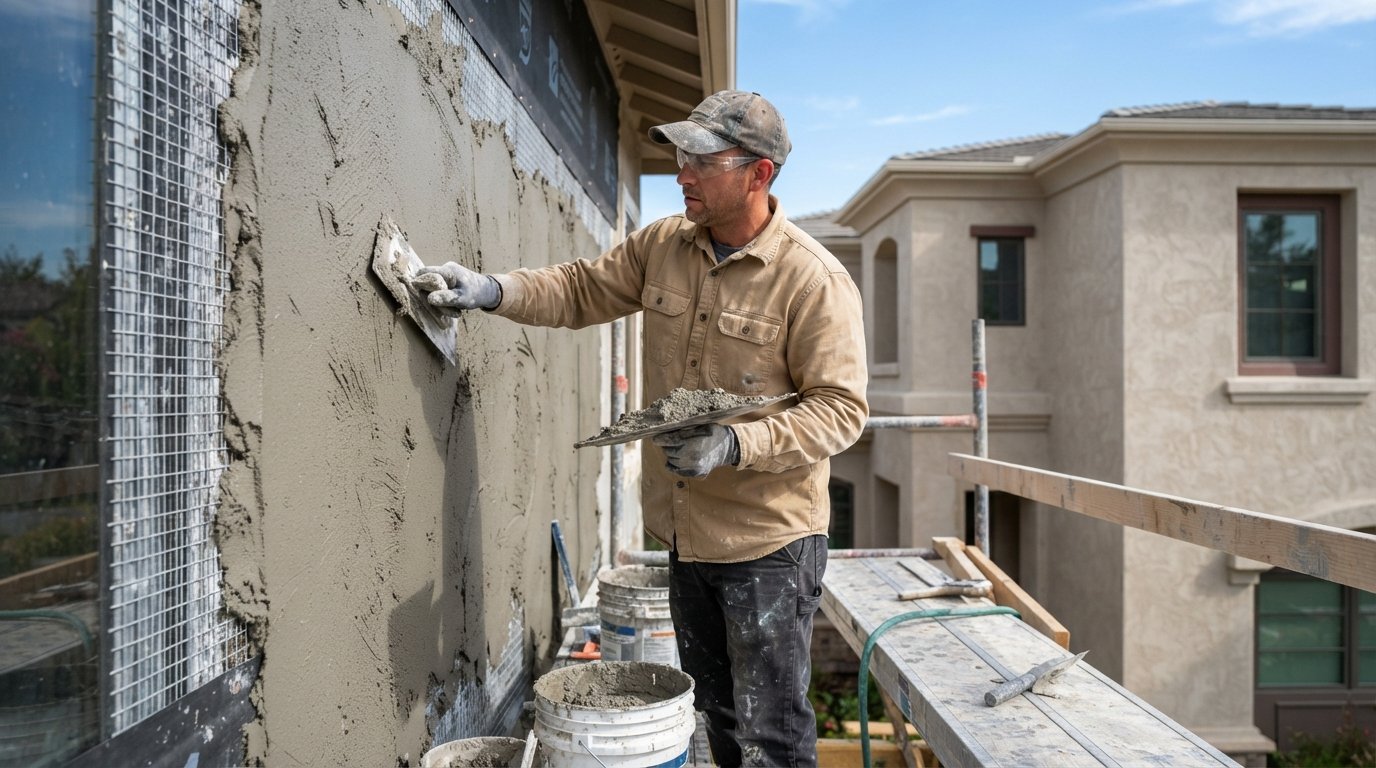
Traditional three-coat stucco is a cement-based mixture applied over metal lath and a weather-resistive barrier. It is built up in three distinct layers: a scratch coat, a brown coat, and a finish coat. This method is labor-intensive, requires skilled craftspeople, and takes longer to complete because each coat must cure. One-coat stucco uses a proprietary pre-blended product applied over a special drainage mat or lath, reducing labor and drying time. EIFS, often called synthetic stucco, consists of a foam insulation board covered with a reinforcing mesh and a polymer-based finish. Each system has a different price profile.
For budgeting purposes, most homeowners in the United States can expect the following installed cost ranges, though regional labor rates and material availability will move these numbers up or down:
- Traditional three-coat stucco: roughly $9 to $14 per square foot installed, reflecting the high labor and material input.
- One-coat stucco: roughly $7 to $11 per square foot installed, with savings coming from faster application.
- EIFS (synthetic stucco): roughly $6 to $10 per square foot installed, depending on insulation thickness and finish type.
These figures typically include the weather barrier, lath or drainage mat, and finish coat, but they may not include removal of existing siding, sheathing repairs, or scaffolding. On a typical 1,500 square foot exterior wall area, a three-coat job could land between $13,500 and $21,000, while a one-coat or EIFS job might fall between $9,000 and $16,500. Because stucco is a site-mixed or pre-blended product rather than a panel system, small changes in wall complexity, window count, and trim detailing can shift the final number by several thousand dollars.
If you are comparing exterior cladding options side by side, it helps to look at total cost of ownership rather than just the bid price. In our guide on composite decking versus wood durability and maintenance, we explain how upfront price and long-term upkeep interact for outdoor surfaces. The same logic applies to stucco: a lower installation bid can be outweighed by higher repair or recoating costs later if the system is not detailed correctly.
Durability: How Long Stucco Lasts and What Affects It
A properly installed traditional stucco wall can last 50 years or more, and many mid-century stucco homes are still performing well today. One-coat and EIFS systems have shorter track records but generally carry manufacturer expectations of 25 to 40 years when installed and maintained correctly. The variables that matter most are substrate preparation, drainage detailing, and climate-specific design.
Moisture management is the single biggest factor in stucco durability. Stucco is a reservoir cladding: it absorbs some moisture and releases it slowly. For that reason, the assembly behind the stucco must include a weather-resistive barrier and, in most modern installations, a drainage plane that allows water to escape. The weep screed at the base of the wall is a critical detail. It creates a gap that lets moisture drain out and gives the stucco a proper termination point above the foundation. Missing or blocked weep screeds are a leading cause of hidden water damage, rot, and mold in stucco walls.
Cracking is another durability topic homeowners ask about constantly. Hairline cracks are normal and expected as stucco cures and as the building moves seasonally. They are usually cosmetic and can be filled during routine maintenance. Structural or map cracking, however, can signal a substrate problem, missing control joints, or poor mixing. The repair expectation should be realistic: minor crack filling every few years is normal, but large or widening cracks warrant a professional assessment before they allow water intrusion.
Climate plays a decisive role in how stucco ages. In humid climates, the priority is drainage and ventilation so walls can dry. In hot-dry climates, stucco performs very well because low humidity reduces moisture loads, though intense sun can degrade elastomeric finishes faster. In freeze-thaw climates, water that enters cracks can freeze, expand, and spall the surface, so crack maintenance and proper flashing become even more important. Stucco can succeed in all three environments, but the detailing must match the climate.
Regional Suitability: Humid, Hot-Dry, and Freeze-Thaw Climates
In humid regions such as the Southeast and Gulf Coast, stucco walls face constant moisture pressure from rain and high humidity. The key defenses are a continuous weather barrier, a drainage plane, corrosion-resistant lath, and careful flashing at windows and roofs. Homes in these areas should be inspected after heavy storm seasons for cracks and sealant failures around penetrations. EIFS systems in humid climates must be installed with drainage and should be kept clear of soil contact at the base.
In hot-dry climates like the Southwest, stucco is a natural fit. Low humidity reduces the risk of trapped moisture, and the material's thermal mass can help moderate temperature swings. The main maintenance concern is sun exposure, which can chalk or fade the finish coat over time. Elastomeric or acrylic finish coats with good UV resistance are worth the modest upgrade. Cracking still occurs from daily thermal expansion, so a flexible sealant at joints and penetrations is part of a sound maintenance plan.
In freeze-thaw climates across the Midwest and Northeast, stucco must be detailed to shed water quickly and resist frost damage. Weep screeds, kick-out flashings, and proper roof-to-wall transitions are non-negotiable. Homeowners should inspect the base of walls and around windows each spring for spalling or cracked sealant. Traditional three-coat stucco with a proper drainage plane generally handles freeze-thaw well, but any system will struggle if water is allowed to sit against the wall.
Maintenance Schedule: Sealing, Painting, and Repairs
Stucco is a low-maintenance cladding, but it is not maintenance-free. A simple schedule keeps it looking good and prevents small issues from becoming expensive repairs. The two main upkeep tasks are sealing or painting the finish coat and repairing cracks and sealant joints.
Most stucco finishes benefit from a new coat of breathable masonry paint or an elastomeric coating every 8 to 12 years, depending on climate and sun exposure. Elastomeric coatings bridge small cracks and add a layer of water resistance, but they must be vapor-permeable so the wall can still dry. Sealing with a penetrating silane or siloxane water repellent every 5 to 7 years is another option in rainy climates, though it should not be used on walls that already have an elastomeric coating without manufacturer guidance. Always confirm the product is compatible with the existing finish.
Crack repair and joint maintenance should be part of an annual or biennial routine. Small hairline cracks can be filled with a compatible patching compound and touched up with finish coat. Sealant joints around windows, doors, and penetrations should be inspected yearly and replaced when they pull away or crack. The following checklist captures the core maintenance cadence for most homes:
- Inspect the exterior each spring for new cracks, spalling, or staining, especially below windows and at wall bases.
- Check weep screeds and drainage paths to confirm they are clear of soil, mulch, and debris.
- Replace failed sealant joints around openings and penetrations as soon as they are found.
- Clean the walls with a gentle wash every few years to remove dirt and biological growth.
- Plan for recoating with breathable paint or elastomeric finish every 8 to 12 years, and re-sealing every 5 to 7 years if your climate warrants it.
Budgeting for maintenance is easier when you set aside a small annual reserve. A common rule of thumb is to allocate 1 to 2 percent of the stucco installation cost per year for upkeep and minor repairs. On a $15,000 job, that is $150 to $300 per year, which comfortably covers sealant, patching, and periodic cleaning. Major repairs, such as re-stuccoing a section of wall or correcting drainage defects, should be quoted by a qualified professional before work begins.
Getting Accurate Quotes and Choosing an Installer
Because stucco performance depends so heavily on installation details, the contractor you choose matters as much as the material. Ask for a written scope that names the system being installed, the weather barrier and drainage components, the number of coats, and the finish type. Confirm that the proposal includes flashing at all openings and a proper weep screed at the base. Compare at least three bids and make sure each one describes the same system so you are comparing apples to apples.
Always verify that any contractor holds the required licenses and insurance for your project, and ask for references from similar homes in your climate. A referral and matching service can simplify this step: 180Remodel connects homeowners with independent local providers for a range of exterior and interior projects, and ContractorHomeQuotes offers a similar free matching service that lets you compare quotes from independent local providers with no obligation. Neither service performs the work itself; pricing, scheduling, and service terms are set by the independent providers.
Finally, keep expectations grounded. Stucco is a durable, attractive cladding with a long service life, but it rewards homeowners who plan for moisture management and routine maintenance. A realistic budget includes both the installation cost and an annual reserve for upkeep.
Whether you are building new or replacing old siding, the smartest approach is to gather several written estimates, ask detailed questions about drainage and flashing, and schedule maintenance before small cracks become big problems. With the right system and a modest upkeep plan, stucco can protect your home for decades.