
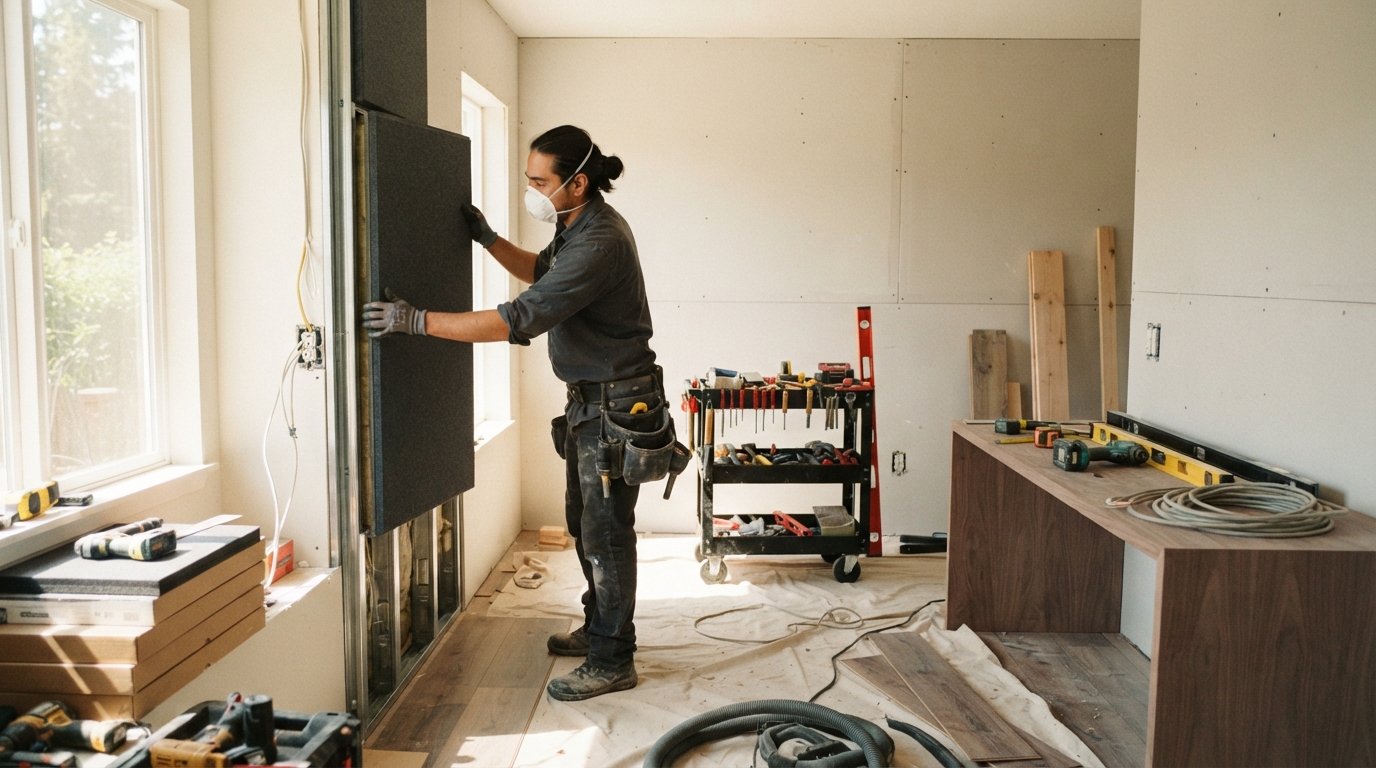
Home Office Renovation Cost for Remote Work: A 2026 Budget Guide
Plan your home office renovation cost for remote work with real 2026 numbers for electrical, soundproofing, and HVAC. Call (833)-365-8755 for vetted local quotes.

By Jessica Reis
Learn more about Room Remodel for guides, costs, and what to expect.
Compare Room Remodel Pros Near You

Enter your ZIP code to compare top-rated local professionals and request free quotes.
Converting a spare bedroom or basement corner into a dedicated home office is one of the highest-return projects a remote worker can tackle, but the price tag swings wildly depending on electrical work, soundproofing, and built-ins. A basic cosmetic refresh might cost $2,000, while a fully wired, acoustically treated, custom-milled workspace can run past $25,000. This guide breaks down real numbers so you can plan a home office renovation cost for remote work that matches your actual needs, not a contractor's wish list.
What Drives Home Office Renovation Cost for Remote Work
Three variables dominate every home office budget: the condition of the existing space, the amount of new infrastructure you add, and whether you choose custom millwork or freestanding furniture. A clean, square bedroom with adequate outlets is a cosmetic project. A damp basement corner with one dangling bulb is a construction project. Remote workers also carry requirements that traditional spare bedrooms do not: reliable power for monitors and network gear, acoustic control for calls, and ventilation for small enclosed rooms.
Labor typically accounts for 40 to 60 percent of a home office renovation cost for remote work, and that share climbs in high-cost metros. Material choices move the needle just as much. A $300 laminate desk and a $4,500 built-in walnut desk occupy the same square footage but produce very different invoices. Before requesting bids, list your non-negotiables (a door that closes, a dedicated circuit, one acoustic wall) and your nice-to-haves (custom shelving, recessed lighting). That list keeps estimates comparable and prevents scope creep.
It also helps to benchmark against broader renovation data. Our average home project cost estimates guide shows how office conversions stack up against kitchen and bath remodels, which is useful context when you are deciding whether to bundle projects or phase the work.
Room-by-Room Cost to Convert a Space Into a Dedicated Office
The starting point matters more than any other factor. Converting a bedroom is mostly finish work. Converting a basement or garage corner introduces moisture control, insulation, and egress considerations. The table below summarizes typical ranges for a 100 to 150 square foot office, assuming mid-grade materials and professional labor.
- Spare bedroom conversion: $2,500 to $8,000. Paint, flooring, outlet additions, lighting, and a door upgrade. No structural work.
- Basement corner conversion: $8,000 to $22,000. Framing, insulation, vapor barrier, drywall, ceiling, flooring, electrical, and HVAC extension. Moisture remediation is extra.
- Garage corner conversion: $6,000 to $18,000. Insulated walls, raised floor or slab treatment, heating and cooling, electrical, and a separating wall. Garage door insulation and weather sealing often needed.
Bedroom conversions are the most popular because they preserve resale value and require the least permitting. Expect to spend $1,500 to $3,500 on electrical alone if the room has only two outlets and a switched ceiling fixture; adding a dedicated 20-amp circuit, four to six receptacles, and recessed lighting is standard for a modern workstation. Basement conversions carry the widest range because water management is non-negotiable. If the space smells musty or shows efflorescence, budget $2,000 to $6,000 for drainage or encapsulation before finishes go in.
Garage corners are tempting for remote workers who want separation from the house, but they demand real thermal work. An insulated, heated garage office in a cold climate can cost $15,000 or more once you add a minisplit, insulated overhead door, and a sealed separation wall. In mild climates, the same project may land near $8,000. Get at least three itemized bids and insist that each one lists permits, disposal, and finish allowances separately so you can compare apples to apples.
Electrical Upgrades: Outlets, UPS Backup, and Dedicated Circuits
Remote work runs on clean, continuous power. A single 15-amp circuit shared with a bedroom TV and space heater will trip the moment you add a monitor, dock, and printer. Most electricians recommend one dedicated 20-amp circuit for the office, which costs $400 to $900 installed depending on panel capacity and wire run length. If your electrical panel is full or outdated, a panel upgrade adds $1,500 to $3,500 but may be required before any new circuits are permitted.
Outlet placement deserves more thought than most homeowners give it. Plan for four to six duplex receptacles, including at least one behind the desk and one on each adjacent wall. USB-C integrated outlets cost $25 to $50 each and reduce wall-wart clutter. For network gear, a dedicated circuit with a whole-home surge protector ($200 to $500 installed) protects expensive equipment better than a power strip alone.
Uninterruptible power supply (UPS) backup is the unsung hero of home office electrical planning. A 1500VA UPS costs $150 to $250 and keeps your router, modem, and computer running through short outages. Hardwired surge protection at the panel plus a quality UPS gives you layered defense. If you run a home server or NAS, ask the electrician about a transfer switch for a portable generator; that adds $500 to $1,200 but pays for itself during storm season. All electrical work should be permitted and inspected, both for safety and for insurance compliance. For a broader look at how project costs break down by trade, see our average home project cost estimates guide.
Soundproofing and Acoustic Treatment for Calls and Video Meetings
Acoustics separate a professional home office from a desk in the corner. Clients forgive a bookshelf backdrop; they do not forgive echo, keyboard clatter, or a barking dog. The good news is that effective acoustic treatment costs far less than full soundproofing, and most remote workers need a mix of both.
Start with the door. A solid-core door ($300 to $800 installed) plus weatherstripping and a door sweep ($50 to $150) blocks more conversation leakage than any wall treatment. If the office shares a wall with a TV room or bedroom, adding a second layer of drywall with Green Glue compound runs $1,200 to $2,500 for a 100-square-foot wall and measurably reduces mid-frequency noise. Full room-within-a-room construction is rarely worth it for a home office; reserve that for music studios.
Inside the room, acoustic panels absorb reflections that make video calls sound hollow. A pack of six 2-inch panels costs $150 to $400 and covers the first reflection points behind the desk and on side walls. Bass traps in corners add $100 to $300. Avoid foam mattress toppers and egg-crate products; they underperform and look unprofessional on camera. A rug, heavy curtains, and upholstered furniture contribute free absorption. If you take frequent calls, budget $500 to $1,500 total for door sealing, panels, and soft furnishings. That is a fraction of full soundproofing and delivers most of the perceived benefit.
Built-In Shelving, Desk, and Lighting vs. Freestanding Furniture
The millwork decision is where home office renovation cost for remote work diverges most dramatically. Freestanding furniture is fast, flexible, and renter-friendly. Built-ins are permanent, increase home value, and create a polished backdrop for video calls. Neither is universally better; the right choice depends on how long you plan to stay and how much storage you need.
Freestanding options are surprisingly capable. A quality standing desk runs $500 to $1,200, a bookcase $200 to $600, and a task chair $300 to $1,000. Total furniture outlay of $1,500 to $3,000 outfits a professional office without touching the walls. Built-ins cost more but solve problems furniture cannot: floor-to-ceiling storage, a concealed printer cabinet, cable management, and a desk that matches the room's trim. Custom built-in desk and shelving for a 10-foot wall typically runs $4,000 to $9,000 installed, with premium hardwoods and integrated lighting pushing toward $12,000.
Lighting deserves its own line item. Overhead recessed lighting costs $150 to $300 per fixture installed, and four fixtures plus a dimmer runs $800 to $1,500. Layered lighting (overhead plus a desk lamp plus bias lighting behind the monitor) reduces eye strain during long days. Bias lighting kits cost $30 to $80. If you appear on video frequently, a key light on a boom arm ($100 to $250) improves how you look more than any paint color. Budget $1,000 to $2,500 for a professionally lit office, or $300 to $600 if you layer plug-in fixtures yourself.
HVAC Balancing and Ventilation for Small Enclosed Workrooms
A closed office door traps heat, CO2, and stale air. A 100-square-foot room with a closed door and a running computer can climb five to eight degrees above the rest of the house within an hour. Remote workers often mistake this for poor insulation when the real issue is air balance.
The cheapest fix is a return-air path: a transfer grille or undercut door that lets conditioned air escape back to the central system. A transfer grille costs $50 to $150 installed and solves most overheating in rooms with a supply vent but no return. If the room has no ductwork at all, a ductless minisplit costs $3,000 to $6,000 installed and provides both heating and cooling with quiet operation, which matters on calls. A simpler alternative is a window or portable heat pump ($500 to $1,200), though portable units are noisy and consume floor space.
Ventilation is separate from temperature. Small enclosed rooms benefit from a dedicated exhaust fan or an energy recovery ventilator (ERV). A quiet bath-style exhaust fan on a timer costs $250 to $600 installed and clears stale air during breaks. ERVs, which exchange heat while bringing in fresh air, run $1,500 to $3,500 installed and are worth considering if you work eight or more hours daily in a tight room. For most homeowners, a transfer grille plus a $150 air quality monitor that tracks CO2 gives adequate feedback and costs far less. If you are also planning larger system work, ask your HVAC contractor to evaluate static pressure; adding a small office to an undersized system can degrade comfort everywhere.
Permits, Contingency, and Hidden Costs
Permit requirements vary by jurisdiction, but most electrical, plumbing, and structural work requires one. Budget $200 to $800 for permits on a typical office conversion, plus the time cost of inspections. Skipping permits can void insurance claims and complicate resale, so verify requirements with your local building department before work begins. Homeowners association rules may also govern exterior changes, garage conversions, and even visible window treatments.
Contingency is not optional. Set aside 15 to 20 percent of the project budget for surprises: knob-and-tube wiring, asbestos in old floor tile, a failing subfloor, or a discovery that the basement wall needs drainage work. On a $12,000 office renovation, a 20 percent contingency is $2,400, and it is far easier to release unused contingency than to find extra cash mid-project. If you are relocating and setting up a home office at the same time, resources like Moving.Homes offer checklists and planning guides that help you sequence the move and the renovation without paying for overlapping rent and storage.
Finally, get multiple bids. Three itemized estimates reveal whether a contractor is padding labor, underestimating electrical, or missing permit costs. A quote that is 30 percent below the others usually means something is excluded, not that you found a bargain. Use a consistent scope sheet when requesting bids so every contractor prices the same work. If you need help comparing proposals, our guide to average home project cost estimates explains how to read line items and spot red flags.
Plan the budget around the work that is hard to change later: electrical, insulation, and air sealing. Those items deliver comfort and safety every day, while finishes can be upgraded over time. A disciplined scope, three competitive bids, and a healthy contingency turn a stressful renovation into a workspace that supports your career for years.