
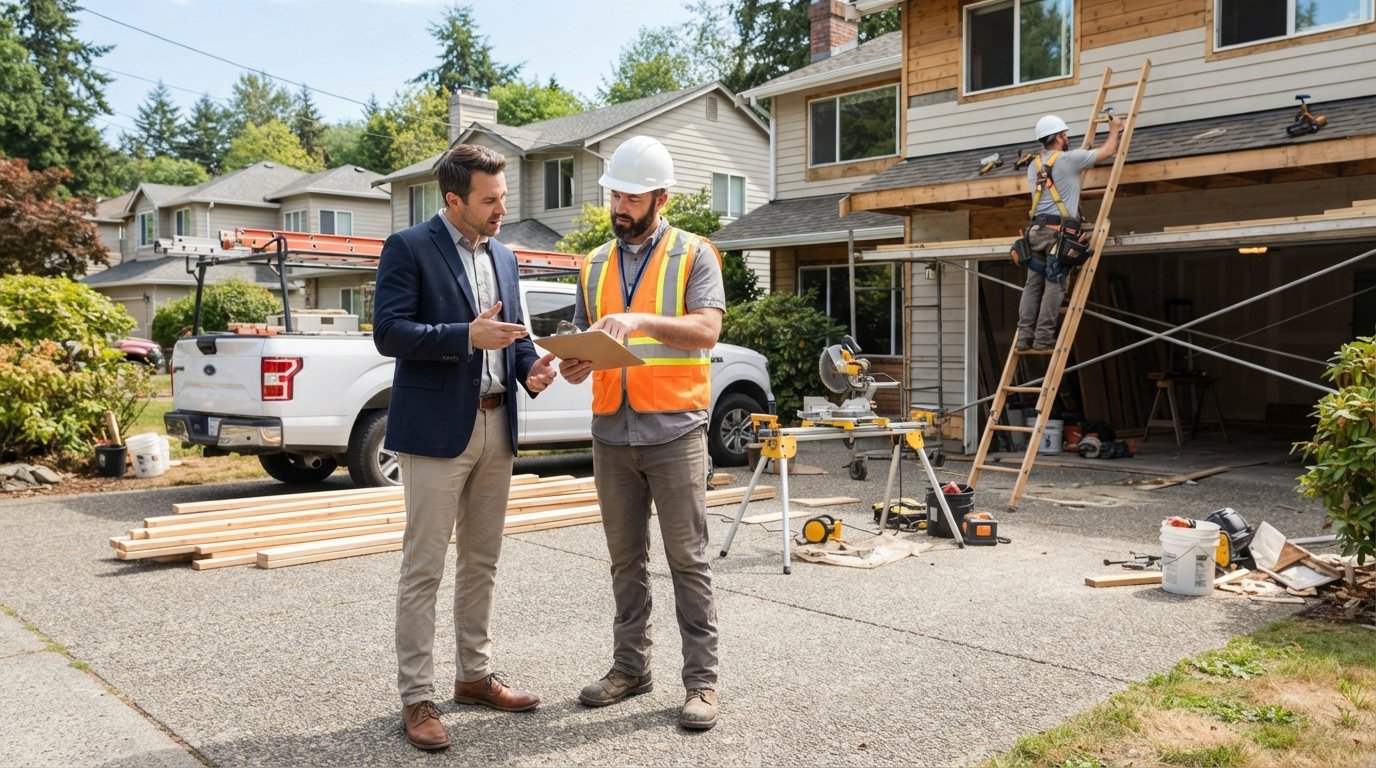
Verifying Subcontractor Licenses and Insurance: Homeowner Guide
Verify subcontractor licenses and insurance for homeowners to avoid liens and denied claims. Call (833)-365-8755 for vetted contractor quotes.

By Justin Blake
Learn more about General Contracting for guides, costs, and what to expect.
Compare General Contracting Pros Near You

Enter your ZIP code to compare top-rated local professionals and request free quotes.
You hired a licensed general contractor, signed a detailed contract, and watched the crew arrive on schedule. Everything feels under control until a worker falls from a ladder and the hospital calls, or a materials supplier slaps a lien on your house because a subcontractor was never paid. In that moment, the question that matters is simple: did anyone verify that the people swinging hammers and running wire were properly licensed and insured? Most homeowners never ask, and that single omission can turn a dream renovation into a financial and legal nightmare. Verifying subcontractor licenses and insurance for homeowners is not an optional box to check; it is the quiet safeguard that protects your property, your wallet, and your family.
Why Subcontractor Credentials Matter Even When the General Contractor Is Licensed
Many homeowners assume that hiring a licensed general contractor is enough. The GC holds the permit, carries the insurance, and answers to the state licensing board, so why worry about the electrician, plumber, or roofer they bring along? The reality is that a general contractor's license covers the GC's own scope of work and business operations. It does not automatically extend to every specialty trade on the job site. In most states, electrical, plumbing, roofing, and HVAC work require separate trade licenses, and those licenses belong to the individual or company performing the work, not to the GC who hired them.
This distinction matters because liability flows in unexpected directions. If an unlicensed electrician causes a fire, your homeowner's insurance may deny the claim on the grounds that the work was performed by an unlicensed party. If a roofer without workers' compensation coverage is injured on your property, you could face a lawsuit that your own policy may not fully cover. Even the GC's liability policy often contains exclusions for uninsured subcontractors, which means the GC's insurer could refuse to pay for damage caused by a sub who lacked proper coverage. In practical terms, the credentials of every worker on your property become your problem the moment something goes wrong.
There is also a consumer protection angle. Many states require that any person performing work on a residential property hold a license, and homeowners who knowingly hire unlicensed workers can lose access to state recovery funds, warranty protections, and the ability to file complaints with licensing boards. Some municipalities will not issue a certificate of occupancy if inspections reveal that unlicensed tradespeople performed the work, forcing you to tear out and redo completed projects at your own expense. Verifying subcontractor licenses and insurance for homeowners is therefore not about distrusting the GC; it is about closing gaps in a system where each party's credentials only cover their own piece of the puzzle.
How to Request and Verify Certificates of Insurance
Every legitimate subcontractor should be able to produce a certificate of insurance, often called a COI, before setting foot on your property. This document is issued by the subcontractor's insurance carrier and summarizes the types and limits of coverage in force. A typical COI shows general liability insurance, workers' compensation insurance, and sometimes commercial auto coverage, along with policy numbers, effective dates, and the name of the insured. Asking for this document is not rude or excessive; it is standard practice in professional construction, and a reputable subcontractor will expect the request.
The critical step is not simply collecting the certificate but verifying it directly with the insurance carrier. Certificates are easy to fabricate or alter, and a policy can be canceled the day after the certificate is issued. Call the phone number listed for the carrier, reference the policy number, and confirm that coverage is active and that the named insured matches the subcontractor's legal business name. Pay attention to the policy expiration date and the coverage limits, because a policy with a low limit may not be enough to cover a serious injury or a major structural error. For larger projects, you may also want to be named as an additional insured on the policy, which gives you direct protection under the subcontractor's coverage.
Here is a practical sequence for requesting and confirming coverage before work begins:
- Ask the general contractor for a list of every subcontractor scheduled to work on your project, including company names and license numbers.
- Request a current certificate of insurance from each subcontractor, either through the GC or directly from the sub's office.
- Call the insurance carrier to confirm active coverage, policy limits, and the exact legal name of the insured business.
- Check the expiration date against your project timeline and request updated certificates if the policy renews mid-project.
- Keep copies of every certificate and verification note in your project file for future reference or insurance claims.
Beyond insurance, license verification deserves its own check. Most states maintain an online license lookup tool through the contractor licensing board or the department of consumer affairs. Search by the subcontractor's business name or license number, confirm that the license is active, and review any disciplinary actions or complaints. Some states also require that the license be classified for the specific type of work being performed, so a general handyman license may not cover electrical or plumbing tasks. If a subcontractor cannot provide a license number or the number does not appear in the state database, treat that as a serious red flag and ask the GC to explain.
Lien Risk When Subcontractors Go Unpaid
One of the most overlooked risks in any renovation is the mechanics lien. When a subcontractor or materials supplier is not paid, they may file a lien against the property where the work was performed, even if the homeowner paid the general contractor in full. This legal tool exists to protect tradespeople and suppliers from nonpayment, but it can leave homeowners holding the bag for debts they never agreed to. The lien attaches to your property title, which means you may be unable to sell or refinance until the dispute is resolved, and in some cases you could be forced to pay twice for the same work.
Lien risk is directly tied to the credential and payment practices of subcontractors. Unlicensed and uninsured subs are more likely to operate informally, skip written contracts, and disappear when payment disputes arise, which increases the odds that a lien will be filed. Even licensed subs can file liens if the GC mishandles funds or delays payment. Homeowners can reduce this risk by requiring lien waivers as part of the payment process. A conditional lien waiver states that the subcontractor relinquishes lien rights once payment clears, while an unconditional waiver releases rights immediately upon signing. Collecting these waivers from every sub and supplier at each payment milestone creates a paper trail that protects your title.
Another protective step is to request a preliminary notice or lien release clause in your contract with the GC. Some states allow subcontractors to file a notice of lien rights early in the project, which gives homeowners visibility into who has lien rights and for how much. If your state does not require preliminary notices, ask the GC to provide a sworn statement listing all subcontractors and suppliers along with their payment status at each draw. This practice, common on larger projects, is equally valuable for a kitchen remodel or a roof replacement. Verifying subcontractor licenses and insurance for homeowners goes hand in hand with managing lien exposure, because credentialed subs are more likely to follow formal payment and waiver procedures.
Questions to Ask the General Contractor About Their Subs
The general contractor is your primary point of contact and the party responsible for managing the team, so the conversation about subcontractor credentials should start there. A professional GC will welcome these questions and have clear answers ready. If a GC becomes defensive, evasive, or dismissive when asked about sub licensing and insurance, that reaction itself is valuable information. The goal is not to interrogate but to establish a shared understanding of how the project will be staffed and protected.
Use the following questions as a framework for that conversation:
- Will you provide a written list of every subcontractor and supplier on this project, including license numbers and insurance contacts?
- Do your subcontractors carry their own general liability and workers' compensation coverage, or do they rely on your policy?
- How do you verify that a subcontractor's license is active and appropriate for the trade before hiring them?
- What is your process for collecting lien waivers from subs and suppliers at each payment milestone?
- Are you willing to include a clause in our contract requiring licensed and insured subs and allowing me to request certificates at any time?
The answers to these questions reveal a great deal about how the GC operates. A GC who says all subs are covered under the company policy may be describing a legitimate arrangement, but you should still confirm that the policy actually covers uninsured subs and that the coverage limits are adequate. A GC who cannot produce a sub list or who brushes off lien waivers is signaling that your project may lack basic protections. For a deeper look at how modern bidding platforms handle credentials and documentation, see our guide on digital contractor bidding for homeowners, which explains how digital tools can streamline verification and comparison.
It also helps to put these expectations in writing. Add a clause to your contract stating that all subcontractors must be properly licensed and insured, that certificates must be provided before work begins, and that the GC will indemnify you against claims arising from uninsured subs. This language shifts the burden of proof to the GC and gives you a contractual remedy if problems arise. If the GC resists adding such a clause, consider whether that resistance is a warning sign about the company's practices.
Building a Verification Habit for Every Project
Verifying subcontractor licenses and insurance for homeowners is not a one-time task; it is a habit that should carry through every phase of a project. New subs may join midway through a renovation, especially on larger jobs where schedules overlap. A roofer might finish before the electrician arrives, and a finish carpenter might appear only in the final weeks. Each new arrival represents a new set of credentials to check. Build a simple project file that includes a sub list, copies of certificates, license lookup notes, and lien waivers, and update it as the project progresses.
Homeowners who want a broader directory of vetted professionals and service guides can use Repairmen, a nationwide platform that connects homeowners with licensed, reviewed local service professionals for appliance repair, remodeling, maintenance, and emergency repairs. Such platforms can complement your own verification efforts by providing an additional layer of screening, but they do not replace the step of confirming certificates and license numbers directly. The most reliable approach combines platform vetting with your own due diligence, especially for high-value projects where the stakes are highest.
Finally, remember that the cost of verification is almost nothing compared to the cost of a claim, a lien, or a failed inspection. A few phone calls and a folder of documents take an afternoon, while an uninsured injury or a mechanics lien can take months or years to resolve. The next time you plan a renovation, make subcontractor credentials part of the first conversation, not an afterthought. Your home, your finances, and your peace of mind are worth the extra effort.