
Historic Window Restoration vs Replacement Cost: 2026 Guide
Compare historic window restoration vs replacement cost, energy savings, and preservation rules. Get free quotes at (833)-365-8755.
By Adnan Nazir
Learn more about Window Repair for guides, costs, and what to expect.
Compare Window Repair Pros Near You

Enter your ZIP code to compare top-rated local professionals and request free quotes.
Your 1920s craftsman has original wood windows that stick, rattle, and leak air. Your contractor says replacement vinyl units will cut your energy bills and save you money. The preservationist down the street says tearing out historic windows destroys the character that gives your home its value. Both are making claims about cost, and both might be wrong. The real answer to the historic window restoration vs replacement cost question is more nuanced than either side admits, and getting it wrong can cost you thousands in either direction. This guide breaks down the actual numbers, the hidden variables, and the decision framework that experienced contractors use when advising owners of older and historic homes.
What Historic Window Restoration Actually Involves
Restoration is not a single task. It is a collection of repairs that bring an original window back to functional condition while preserving its historic fabric. The scope varies dramatically based on the window's condition, but most projects include several of the following steps.
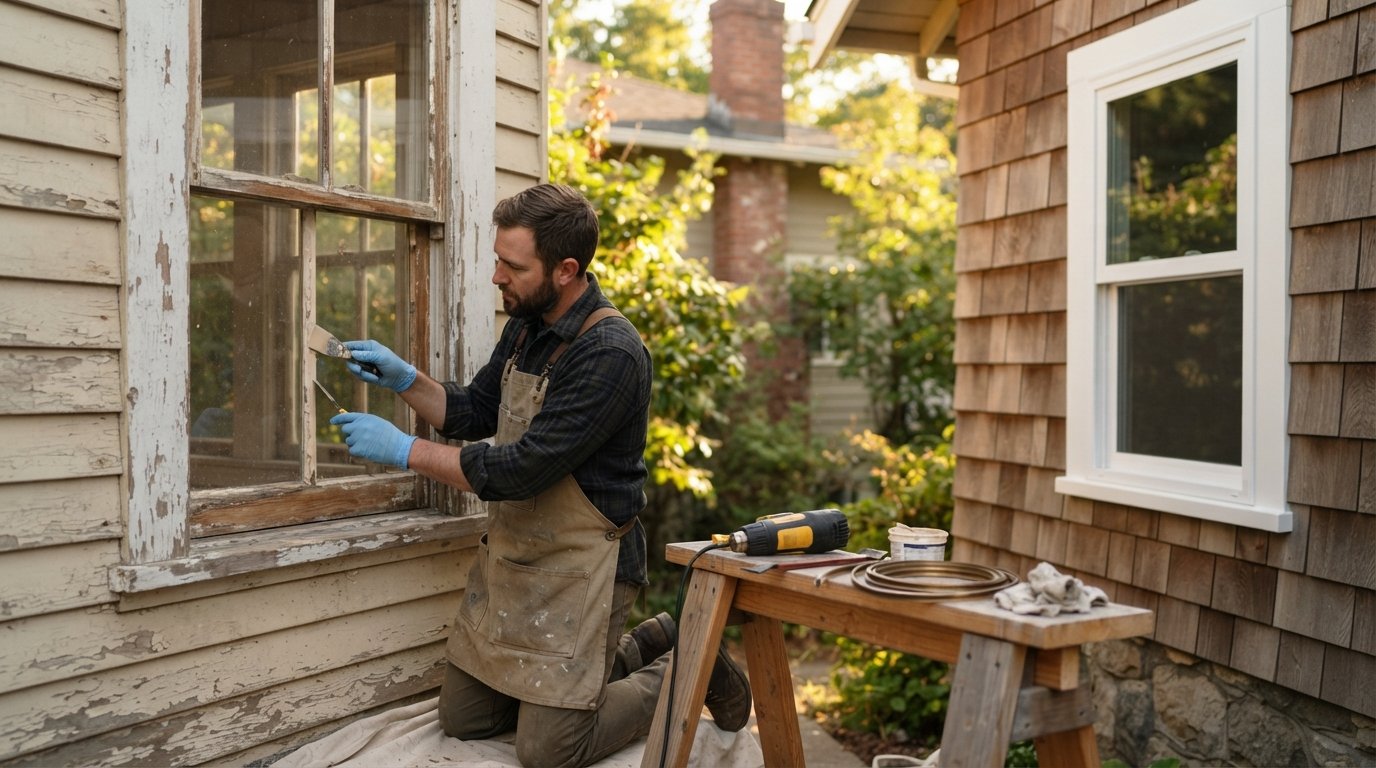
Reglazing is often the first line item. Old glazing putty cracks and falls away, allowing moisture to rot the sash. A restorer removes the old putty, repairs any soft wood, and re-glazes the window with fresh putty. Weatherstripping follows: bronze or copper interlocking strips, spring-loaded metal, or silicone gaskets create a seal between the sash and frame. Repairing or replacing sash weights and cords, freeing painted-shut sashes, and repairing rotted sill ends round out the typical scope. Many restorers also add a storm window, either exterior or interior, to improve efficiency without altering the historic window itself.
The cost of this work depends on how many windows you have, their condition, and whether you hire a specialist or a general carpenter. A full restoration of a single double-hung window, including reglazing, weatherstripping, sash repair, and painting, typically runs between $400 and $900 per window. If the window needs extensive wood repair or sash replacement, the price can climb to $1,200 or more. For a house with 15 windows, that puts the total project in the $6,000 to $13,500 range, though larger or more ornate windows push the number higher.
The Real Cost of Replacement Windows
Replacement windows appear cheaper on the surface. A basic vinyl double-hung unit might cost $300 to $600 per window, installed. For 15 windows, that is $4,500 to $9,000. But the comparison is not that simple. Historic homes often have non-standard window sizes, which means custom units that cost 30 to 50 percent more than stock sizes. If your home is in a historic district, you may be required to use wood windows that match the original profile, and those units can run $1,000 to $2,500 per window installed.
There is also the question of what you lose. Original wood windows are made from old-growth lumber that is denser and more rot-resistant than modern wood. Their wavy glass and divided lites are part of the home's character. Replacement units, even high-quality ones, have a shorter lifespan. Vinyl windows typically last 20 to 25 years, while a well-maintained original window can last a century or more. When you factor in the cost of replacing a replacement window in 20 years, the long-term math shifts.
Energy savings are another point of confusion. The U.S. Department of Energy notes that windows account for 25 to 30 percent of residential heating and cooling energy use, but the savings from replacement are often overstated. A study by the National Trust for Historic Preservation found that the energy performance of a restored wood window with a good storm window is nearly identical to a replacement vinyl window, and the payback period for replacement can exceed 50 years in many climates.
Side-by-Side Cost Comparison
To make the historic window restoration vs replacement cost decision clearer, here is how the numbers stack up for a typical 15-window project in a historic home.
- Full restoration with storm windows: $8,000 to $15,000 total ($530 to $1,000 per window), including reglazing, weatherstripping, sash repair, painting, and storm window installation.
- Basic vinyl replacement: $5,000 to $9,000 total ($330 to $600 per window) for stock sizes, but custom sizes and historic district requirements can push this to $15,000 to $30,000.
- Wood replacement (historically appropriate): $15,000 to $37,500 total ($1,000 to $2,500 per window), installed.
- Restoration plus interior storm windows: $10,000 to $18,000 total, with better performance than exterior storms in some cases.
These ranges are national averages. Your local labor market, the condition of your windows, and whether you need to meet historic preservation guidelines will move the numbers. For a broader look at how repair versus replacement decisions play out across other home systems, see our roof repair vs replace cost comparison guide, which follows a similar decision framework.
Energy Efficiency and Historic Preservation Rules
Energy performance is the most common reason homeowners consider replacement. It is true that a single-pane wood window with no storm is leaky. But restoration addresses the leaks directly. Weatherstripping seals the gaps, reglazing stops air infiltration through the sash, and a storm window creates a dead air space that insulates nearly as well as a double-pane unit. The key is doing all three, not just one.
Historic preservation rules add another layer. If your home is in a locally designated historic district or listed on the National Register, exterior changes may require approval from a preservation commission. Many commissions require that replacement windows match the original in material, profile, and divided-lite configuration. Vinyl windows are often rejected outright. In those cases, restoration is not just the better aesthetic choice; it may be the only compliant one. Before you plan any window project, check with your local preservation office. The rules vary widely by city and state, and ignoring them can result in stop-work orders or fines.
For homeowners interested in broader energy upgrades, platforms like SolarEnergy.ai offer tools and guides on solar adoption and efficiency incentives that can complement a window restoration project. Pairing restored windows with solar panels or other efficiency measures can reduce overall energy costs without sacrificing historic character.
How to Find a Contractor Experienced with Historic Windows
Not every window contractor knows how to work on historic windows. Many are trained to sell and install replacement units, and some will steer you toward replacement because that is what they know. Finding a contractor with restoration experience requires asking specific questions and checking references carefully.
Start by asking whether the contractor has completed restoration work on homes of similar age and style. Ask for addresses or photos of past projects, and follow up with the homeowners. Inquire about their approach to reglazing, weatherstripping, and sash repair. A knowledgeable restorer will talk about bronze weatherstripping, sash weight repair, and glazing putty, not just "new windows." Check whether they have worked with your local preservation commission before, as that experience can smooth the approval process.
Get at least three quotes and compare the scope, not just the price. One contractor might quote restoration of the sashes only, while another includes storm windows and painting. Make sure you are comparing equivalent work. Also ask about lead times and whether the contractor will remove and reinstall the windows or work in place. Working in place is often cheaper and preserves more of the original fabric.
If you are unsure where to start, a contractor matching service can connect you with local professionals who have experience with historic properties. ContractorHomeQuotes offers free, no-obligation quotes from pre-screened contractors in your area, which can save you hours of research and vetting.
Making the Decision: A Framework for Your Home
The right choice depends on four factors: the condition of your windows, your local preservation rules, your budget and timeline, and your long-term plans for the home. If your windows are structurally sound and the main issues are paint, glazing, and air leaks, restoration is almost always the better investment. It preserves character, lasts longer, and often costs less than historically appropriate replacement. If the sashes are rotted beyond repair or the windows are missing entirely, replacement with wood units that match the original profile may be the only option.
Consider your timeline as well. Restoration can be done incrementally, a few windows at a time, which spreads the cost. Replacement is usually a single large project. If you plan to sell within a few years, restoration may offer a better return because buyers in historic neighborhoods often value original details. If you plan to stay long-term, the durability of restored wood windows can outperform vinyl replacements.
Finally, get professional advice before committing. A contractor who specializes in historic windows can assess your specific situation and give you a realistic scope and price. The historic window restoration vs replacement cost question does not have a one-size-fits-all answer, but with the right information and the right contractor, you can make a decision that balances cost, performance, and preservation.
Learn more about Window Repair for guides, costs, and what to expect.
Compare Window Repair Pros Near You
Enter your ZIP code to compare top-rated local professionals and request free quotes.