
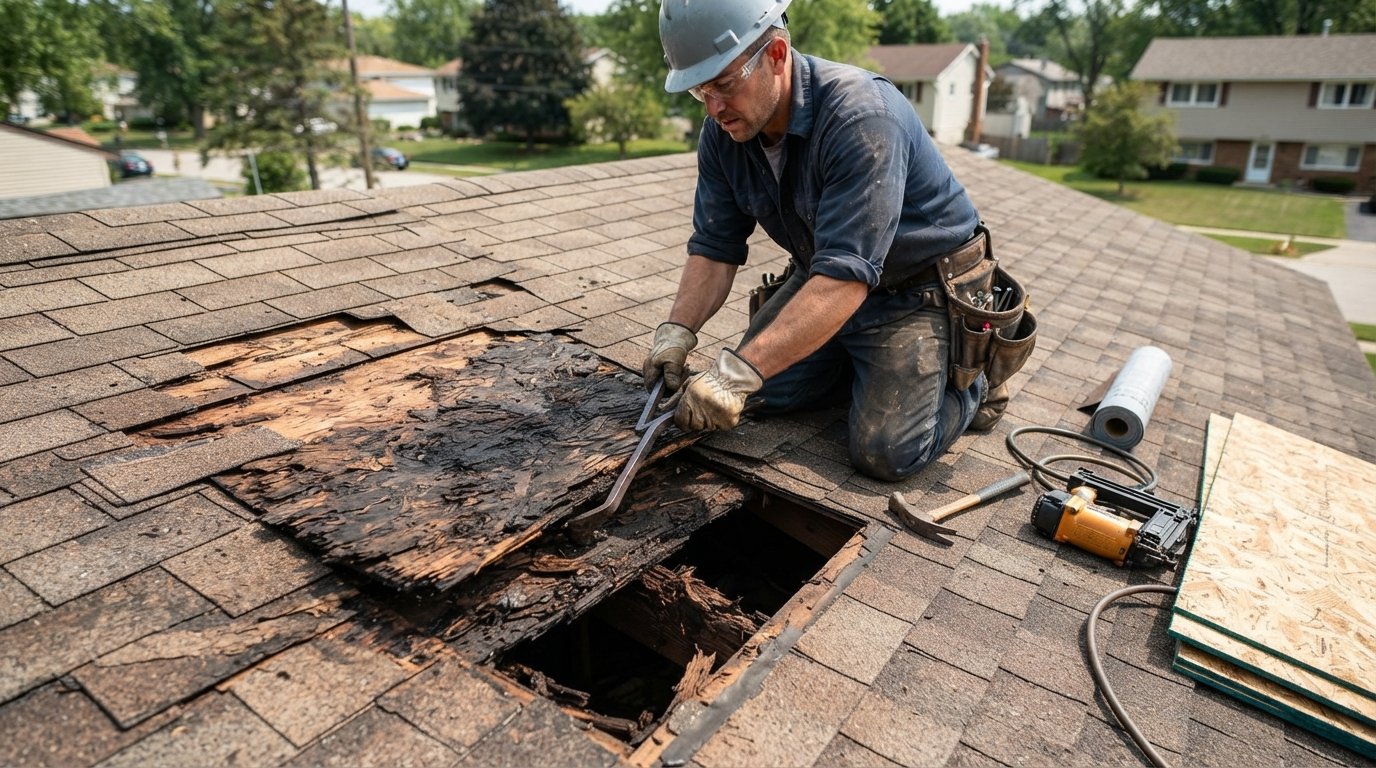
Roof Sheathing Replacement Cost When Decking Is Rotted
Roof sheathing replacement cost when decking is rotted runs $400 to $20,000+ depending on scope. Call 8333658755 for a free local quote.

By Justin Blake
Learn more about Roof Repair or Maintenance for guides, costs, and what to expect.
Compare Roof Repair or Maintenance Pros Near You

Enter your ZIP code to compare top-rated local professionals and request free quotes.
You noticed a soft spot under your shingles. Maybe a roofer peeled back a few courses and found black, crumbly wood instead of solid decking. Now you are facing a repair that goes deeper than shingles, and you want to know what roof sheathing replacement costs when the decking underneath is rotted. The short answer: most homeowners pay between $1,500 and $6,000 for partial sheathing replacement, while a full tear-off and redeck can run $8,000 to $20,000 or more depending on roof size, material, and how much hidden damage the tear-off reveals. The long answer involves understanding why wood rots, how contractors price the work, and how to avoid surprise charges once the old roof is off.
Why Rotted Roof Decking Matters More Than You Think
Roof sheathing, also called roof decking or simply the deck, is the layer of plywood or oriented strand board (OSB) nailed to your roof trusses. It gives the shingles a solid surface and helps transfer wind and snow loads to the framing. When that wood stays wet long enough, it loses structural integrity. A small leak around a chimney flashing or a nail pop can soak the sheathing for months before you see a water stain on the ceiling.
Once rot sets in, the problem compounds. Soft decking cannot hold roofing nails, so shingles lift in the wind. Sagging panels create low spots where water pools. In severe cases, the rot spreads to fascia, soffit, and even truss ends. That is why a roofer who finds rotted decking during a tear-off will not simply shingle over it. Most building codes and manufacturer warranties require solid, sound decking before new roofing goes down.
The tricky part is that rotted decking is often invisible from the outside. A home inspection or roofing estimate may catch a few soft spots by walking the roof and feeling for give, but the full extent usually becomes clear only after the old shingles are removed. This uncertainty is the single biggest reason sheathing replacement costs vary so widely from one project to the next.
What Drives Roof Sheathing Replacement Cost When Decking Is Rotted
When contractors price roof sheathing replacement, they are not just charging for wood. The cost reflects labor, disposal, materials, and the added complexity of working around an already disruptive roof replacement. Here are the main cost drivers you should understand before you sign anything.
- Square footage of damaged decking: Most roofers price sheathing by the sheet (typically 4x8 feet, or 32 square feet). Partial replacement of a few sheets costs far less than replacing the entire roof deck.
- Material choice: Standard 7/16 inch OSB is the cheapest option. Plywood costs more but holds up better to repeated moisture exposure. Some homeowners upgrade to thicker panels or treated wood in high-humidity areas.
- Labor and access: Steep roofs, multiple stories, and complex roof lines slow the crew down and increase labor costs. Removing old shingles and underlayment before sheathing work adds time.
- Disposal fees: Rotted wood, old shingles, and underlayment all go to the landfill. Dumpster rental and tipping fees are real line items in most estimates.
- Hidden damage: Fascia, drip edge, flashing, and even truss repairs can be needed once the deck is exposed.
Understanding these drivers helps you read a roofing estimate with a critical eye. A bid that seems too low may exclude sheathing replacement entirely, leaving you with a change order once the tear-off begins. A bid that seems high may include full redecking when only a few panels are actually soft.
If you are also planning other exterior upgrades, such as a new front door, the same logic applies: material choice and hidden damage drive the final number. Our guide on the best material for door replacement in Cost Haven walks through how to compare upfront cost against long-term durability, which is a useful framework for roofing decisions too.
Average Costs: Partial vs. Full Sheathing Replacement
To give you a realistic budget range, it helps to separate partial sheathing replacement from a full redeck. Partial replacement happens when a roofer finds isolated soft spots, maybe around a chimney, a valley, or a skylight. Full replacement means every sheet of decking comes off, usually because the roof has been leaking for years or the existing decking is too thin or too damaged to reuse.
For partial sheathing replacement, most homeowners pay $75 to $150 per sheet installed, including labor and disposal. If five to ten sheets are rotted, you are looking at roughly $400 to $1,500 on top of the shingle replacement. For full redecking, expect $1.50 to $3.50 per square foot for the sheathing alone, plus the cost of the new roof itself. On a 1,500 square foot roof, that is $2,250 to $5,250 just for the decking.
When you combine a full tear-off, new underlayment, new shingles, and full sheathing replacement, total project costs commonly land between $8,000 and $20,000 for an average suburban home. Larger roofs, steep pitches, and premium shingles can push the number higher. The table below summarizes typical ranges, but keep in mind that local labor rates and material prices vary by region.
| Scope of Work | Typical Cost Range |
|---|---|
| Partial sheathing replacement (5 to 10 sheets) | $400 to $1,500 |
| Full sheathing replacement (1,500 sq ft roof) | $2,250 to $5,250 |
| Full roof replacement with partial redeck | $8,000 to $14,000 |
| Full roof replacement with full redeck | $12,000 to $20,000+ |
These numbers are guidelines, not quotes. Your actual cost depends on where you live, how many layers of old roofing must be removed, and whether the rot has spread into framing. Always get at least three written estimates and ask each contractor to specify how they handle unexpected sheathing damage.
How Contractors Price Sheathing Work: What to Look For in an Estimate
Roofing estimates come in many formats, and the way a contractor prices sheathing tells you a lot about how the project will go. Some contractors include a per-sheet price for sheathing replacement as a contingency line item. Others exclude it entirely and present a change order once the roof is open. Neither approach is automatically wrong, but you need to know which one you are signing.
A transparent estimate will usually include the base cost of the tear-off and re-roof, a stated price per sheet for any decking that needs replacement, and a clear description of what counts as damaged. It should also note whether the price includes disposal, new underlayment, and any required permits. If a contractor refuses to put a per-sheet price in writing, that is a red flag.
Here is a simple framework for comparing bids that include sheathing work:
- Ask each contractor for a per-sheet price for 7/16 inch OSB and for plywood, installed.
- Confirm whether the price includes removal and disposal of the old decking.
- Ask how they handle rot that extends into fascia, soffit, or truss ends.
- Check whether the estimate includes a allowance for a certain number of sheets, and what happens if that number is exceeded.
- Verify that the contractor will document damage with photos before replacing anything.
Following this process keeps you in control of the budget and reduces the chance of a nasty surprise when the roof is open. It also gives you leverage to negotiate if one bid is significantly higher than the others without a clear explanation.
Signs Your Roof Decking Is Rotted and Needs Replacement
Not every soft spot means full replacement, but some signs are clear indicators that the decking is compromised. Catching them early can save you thousands by limiting the repair to a few sheets instead of the entire roof.
- Spongy or springy spots underfoot: If the roof feels soft when walked on, the wood has lost strength.
- Sagging rooflines: Visible dips or waves in the roof plane often mean the decking or framing is failing.
- Dark stains or mold in the attic: Black or green growth on the underside of the decking points to long-term moisture.
- Shingles that lift or crack: Nails cannot hold in rotten wood, so shingles come loose in wind.
- Water stains on ceilings: Brown rings or peeling paint below the roof often trace back to decking damage.
If you notice any of these signs, get a professional roof inspection before the next storm season. A roofer can probe the decking with a screwdriver or awl to test for softness and give you a realistic scope of work. In some cases, a moisture meter can confirm whether the wood is wet enough to rot further.
Keep in mind that attic ventilation plays a huge role in preventing rot. Poor ventilation traps warm, moist air against the underside of the decking, especially in winter. If your attic is poorly vented, fixing the roof without improving ventilation may lead to repeat rot in a few years.
Repair or Replace: Making the Right Call for Rotted Decking
When rotted decking is found, you have three basic options: patch the damaged areas, replace the entire roof deck, or replace the deck and the roofing at the same time. The right choice depends on the extent of the rot, the age of your existing roof, and your long-term plans for the home.
Patching makes sense when the damage is isolated and the rest of the decking is sound. If your roof is relatively new and only a few sheets are soft around a leak source, a targeted repair is cost-effective. However, patching a roof that is already 15 to 20 years old often does not make financial sense, because you will pay for another tear-off soon when the shingles fail.
Full replacement is the better choice when the roof is near the end of its life, when multiple areas are soft, or when the decking is thin or sagging. Yes, the upfront cost is higher, but you avoid paying twice for labor and disposal. You also get the chance to upgrade underlayment, flashing, and ventilation, which can extend the life of the new roof.
If you are unsure which path fits your situation, a free quote request can connect you with local roofing pros who will inspect the decking and give you a written scope. Platforms like FreeQuotes.Contractors let you compare multiple estimates side by side, which is the fastest way to see how different contractors price sheathing replacement and whether they include it in the base bid or as a contingency.
How to Save Money on Roof Sheathing Replacement
Roof sheathing replacement is rarely a project you can DIY safely, but there are legitimate ways to keep costs under control. The key is to plan ahead and avoid emergency pricing.
First, address leaks as soon as you notice them. A $300 flashing repair today can prevent $3,000 in decking replacement later. Second, schedule your roof replacement in the off-season if your climate allows. Spring and fall are often slower for roofers, which can mean more competitive bids. Third, bundle work. If you need new gutters, attic insulation, or ventilation upgrades, doing them during the roof replacement can save on labor and disposal.
Fourth, ask about material options. OSB is cheaper than plywood, but plywood handles moisture better. In dry climates, OSB may be perfectly adequate. In humid or coastal areas, the extra cost for plywood or treated panels may be worth it. Finally, get multiple quotes. The difference between the highest and lowest bid for the same scope can be 30 percent or more, and the cheapest bid is not always the best value if it excludes sheathing replacement or uses inferior materials.
What to Ask Before You Hire a Roofing Contractor
Before you sign a contract, ask these questions to protect yourself from surprise sheathing charges:
- What is your per-sheet price for sheathing replacement, installed?
- Does that price include removal and disposal of the old decking?
- How will you document rotted decking before replacing it?
- Is there a cap on sheathing costs, or is it open-ended?
- Are you licensed and insured in my state, and can you provide proof?
A professional contractor will answer these questions without hesitation and put the answers in writing. If a roofer pressures you to sign before the roof is inspected, or refuses to provide a written per-sheet price, keep looking. The best roofing contractors want you to understand the scope of work, because it reduces disputes later.
It also helps to check references from recent jobs where sheathing replacement was part of the scope. Ask those homeowners whether the final cost matched the estimate and how the contractor handled unexpected damage. Their answers will tell you more than any sales pitch.
Roof sheathing replacement cost when decking is rotted is not a number you can pin down without an inspection, but you can control the process. Get several written estimates, insist on a per-sheet price for decking, and choose a contractor who documents damage with photos before replacing anything. That approach keeps your budget predictable and your new roof on solid ground.