
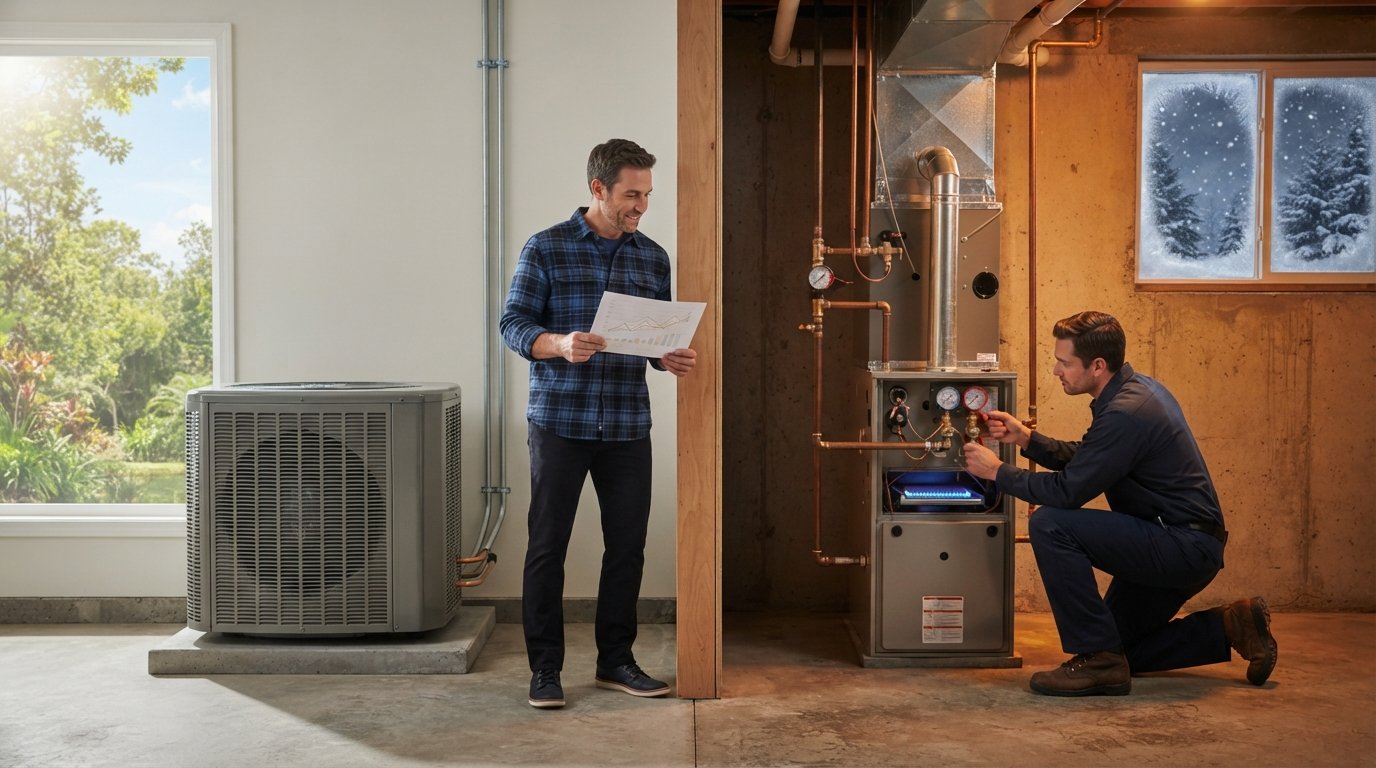
Heat Pump vs Furnace Operating Cost by Climate
Compare heat pump vs furnace operating cost by climate. See which system costs less to run in mild, moderate, and cold regions before you upgrade.

By Margaret Sheridan
Learn more about Heating System Installation or Replacement for guides, costs, and what to expect.
Compare Heating System Installation or Replacement Pros Near You

Enter your ZIP code to compare top-rated local professionals and request free quotes.
Your heating bill is not just a number. It is a signal that tells you whether your current system is right for your climate, your home, and your budget. If you live in a region with mild winters, a heat pump can cut your annual heating costs by hundreds of dollars compared to a gas furnace. In a bitterly cold climate, the math flips, and a high-efficiency furnace often wins on pure operating cost. Understanding this split is the key to choosing the right system for your home.
The decision between a heat pump and a furnace is not about which technology is universally better. It is about which one operates more efficiently where you live. Climate determines how hard your system works, how often it runs, and how much energy it consumes. That is why the same heat pump that saves a homeowner in Atlanta thousands over a decade might struggle to keep up in Minneapolis without a backup heat source.
This guide breaks down the operating costs of heat pumps versus furnaces across different climate zones. You will see how efficiency ratings, fuel prices, and temperature extremes interact to shape your monthly bills. By the end, you will have a clear framework for estimating which system costs less to run in your specific region, and how to plan for the upfront investment.
How Climate Shapes Heating System Efficiency
Heating systems do not operate in a vacuum. Their efficiency is directly tied to outdoor temperatures. A furnace generates heat by burning fuel, and its efficiency is largely stable regardless of how cold it is outside. A heat pump, however, moves heat from the outdoor air into your home. As the outdoor temperature drops, there is less heat available to move, so the system has to work harder and consumes more electricity. This is why heat pump performance is rated at different temperature points.
In mild climates, where winter temperatures rarely drop below freezing, a heat pump operates in its sweet spot. It can deliver two to three units of heat for every unit of electricity it consumes. A furnace, even a high-efficiency model, can only deliver slightly less than one unit of heat per unit of fuel. This efficiency gap translates directly into lower operating costs for heat pumps in mild regions. The same heat pump in a colder climate will see its efficiency drop as temperatures fall, narrowing the gap and sometimes reversing the advantage.
Furnaces also have an edge in extremely cold climates because they can produce consistent, high-temperature heat regardless of outdoor conditions. Heat pumps may need a supplemental electric resistance heater when temperatures plunge below their operating range, which drives up electricity consumption. This is why climate is the single most important factor in the heat pump versus furnace operating cost comparison.
Understanding Efficiency Ratings: HSPF, SEER, and AFUE
Before comparing costs, you need to understand the numbers on the spec sheet. Heat pumps are rated using Heating Seasonal Performance Factor (HSPF) for heating and Seasonal Energy Efficiency Ratio (SEER) for cooling. Furnaces use Annual Fuel Utilization Efficiency (AFUE). These ratings tell you how efficiently a system converts energy into heat, but they do not tell you the whole story. You also need to factor in local energy prices.
HSPF measures the total heat output in British thermal units (BTUs) divided by the total electricity consumed in watt-hours over a typical heating season. A higher HSPF means greater efficiency. Modern heat pumps range from HSPF 8 to HSPF 13 or higher. AFUE measures the percentage of fuel converted to usable heat. An AFUE of 90 means 90 percent of the fuel becomes heat, and 10 percent is lost through exhaust. High-efficiency furnaces can reach AFUE 98.
To compare operating costs, you convert these ratings into a cost per million BTUs of delivered heat. The formula varies by fuel type, but the principle is simple: divide the cost of your fuel by the system efficiency. For example, if electricity costs $0.15 per kilowatt-hour and your heat pump has an HSPF of 10, your cost per million BTUs is roughly $14.70. If natural gas costs $1.20 per therm and your furnace has an AFUE of 95, your cost per million BTUs is about $12.60. This calculation reveals why fuel prices and local climate matter so much.
These calculations are the foundation of any real cost comparison. They also explain why a heat pump that looks expensive to run in one state can be the cheapest option in another. The same equipment, placed in different climates with different fuel costs, produces dramatically different operating expenses.
Heat Pump vs Furnace Operating Cost by Climate Zone
Climate zones in the United States range from hot-humid in the South to very cold in the North. The Department of Energy divides the country into eight climate zones based on heating and cooling degree days. For heating cost comparisons, the key metric is heating degree days: the higher the number, the colder the climate and the more energy you need to stay warm. Let us break this down by region.
Mild Climates (Zones 1-3: Southeast, South Central, Coastal West)
In these regions, winter temperatures are mild, and heating seasons are short. A heat pump is almost always the cheaper option to operate. Because the outdoor air stays relatively warm, the heat pump maintains high efficiency. It also provides cooling in summer, eliminating the need for a separate air conditioner and reducing total HVAC costs. A gas furnace in these climates is often oversized for the few cold days, and the fixed monthly gas connection fee can make it more expensive even when it is not running.
For example, in Atlanta, a homeowner with a 3-ton heat pump might spend $600 to $800 per year on heating. The same home with a 90 percent AFUE gas furnace could spend $900 to $1,100, depending on gas prices. Over a 15-year lifespan, that difference can exceed $4,000, not counting the savings from not needing a separate AC unit. This is why heat pumps dominate new construction in the Southeast.
Moderate Climates (Zones 4-5: Mid-Atlantic, Midwest, Pacific Northwest)
In these regions, winters are real but not extreme. Temperatures often hover around freezing, and heat pumps still perform well, though their efficiency drops. A dual-fuel system, which pairs a heat pump with a gas furnace, is often the most cost-effective choice. The heat pump handles mild days, and the furnace takes over when temperatures drop below the heat pump's economic balance point, typically around 30 to 35 degrees Fahrenheit.
Operating costs in these zones can swing based on local energy prices. In areas with cheap natural gas, a high-efficiency furnace may cost slightly less to run during the coldest months. But when you factor in the heat pump's cooling efficiency, the dual-fuel approach often wins on total annual cost. A homeowner in Philadelphia might pay $1,100 per year for a dual-fuel system, compared to $1,300 for a furnace and separate AC. The savings come from using the most efficient equipment for each season.
Cold Climates (Zones 6-7: Northeast, Upper Midwest, Mountain West)
In these regions, winter is long and harsh. Temperatures regularly drop below 20 degrees Fahrenheit, and heat pumps lose efficiency rapidly. A standard air-source heat pump may struggle to keep up, relying on electric resistance backup heat, which is expensive. A high-efficiency gas furnace, or a cold-climate heat pump designed for low temperatures, becomes the better choice. Cold-climate heat pumps use variable-speed compressors and enhanced vapor injection to maintain capacity at low temperatures, but they still cost more to operate than a furnace in the deepest cold.
For a home in Minneapolis, a 95 percent AFUE furnace might cost $1,400 per year to run, while a standard heat pump with electric backup could cost $2,000 or more. A cold-climate heat pump might bring that down to $1,600, but it still lags behind natural gas in pure operating cost. However, if the home uses propane or oil, the heat pump becomes competitive because those fuels are much more expensive per BTU than natural gas.
Very Cold Climates (Zone 8: Parts of Alaska, Northern Canada)
In the most extreme climates, furnaces burning natural gas or heating oil remain the dominant choice for operating cost. Heat pumps can work, but they require significant backup and may not be practical for all homes. The cost per BTU of delivered heat from a heat pump in these regions is often double that of a high-efficiency furnace. Homeowners here should prioritize furnace efficiency and home insulation to control costs.
It is important to note that these are general guidelines. Actual costs depend on your home's insulation, air sealing, thermostat settings, and local utility rates. A well-insulated home in a cold climate may cost less to heat with a heat pump than a drafty home in a moderate climate heated by a furnace. The building envelope is as important as the equipment.
Fuel Prices and Their Impact on Operating Costs
Climate sets the stage, but fuel prices determine the final bill. The cost of electricity, natural gas, propane, and heating oil varies widely by region and over time. A heat pump's operating cost is tied to electricity rates, which have been rising in many parts of the country. A furnace's operating cost depends on the price of its fuel, which can be volatile.
In regions with low electricity rates, such as the Pacific Northwest where hydropower is abundant, heat pumps are extremely cheap to run. In regions with high electricity rates, such as parts of the Northeast, the advantage shifts toward natural gas furnaces if gas is available. Propane and oil are almost always more expensive per BTU than natural gas, which makes heat pumps more attractive in rural areas where gas is not available.
To estimate your own costs, gather your utility rates and use the efficiency ratings of the systems you are considering. A simple formula can give you a reliable estimate. For a heat pump, multiply your electricity rate by 293 divided by the HSPF. For a furnace, multiply your fuel rate by 100 divided by the AFUE. The result is your cost per million BTUs. Compare these numbers to see which system costs less to operate in your climate.
For a more detailed look at how project costs break down, including how to plan for replacement or installation, see our guide on average home repair project costs. It covers the financial side of major home systems and can help you budget for a heating upgrade.
Installation and Upfront Costs
Operating costs are only part of the equation. The upfront cost of a heat pump is often higher than a furnace, especially if you need to add ductwork or upgrade your electrical panel. However, heat pumps also provide cooling, which can offset the cost of a separate air conditioner. Furnaces are generally cheaper to install, but you still need a cooling system in most climates.
When comparing total cost of ownership, you must factor in installation, maintenance, and lifespan. Heat pumps and furnaces both last 15 to 20 years with proper maintenance. Heat pumps may require more frequent filter changes and coil cleaning, but they do not have a combustion chamber to inspect. Furnaces require annual tune-ups to ensure safe operation and efficiency. These maintenance costs are relatively small compared to energy savings.
Rebates and tax credits can significantly reduce the upfront cost of a heat pump. The federal government offers tax credits for high-efficiency heat pumps, and many states and utilities offer additional rebates. These incentives can make a heat pump cheaper to install than a furnace in some cases. Always check local programs before making a decision. To find qualified installers and compare quotes for your specific project, you can use a service like FreeQuotes.Contractors to connect with local HVAC professionals.
Making the Right Choice for Your Climate and Budget
The best heating system for your home depends on a combination of climate, fuel availability, and your budget. There is no one-size-fits-all answer. In mild climates, a heat pump is almost always the most cost-effective choice for both heating and cooling. In moderate climates, a dual-fuel system offers the best of both worlds. In cold climates, a high-efficiency furnace or a cold-climate heat pump paired with a furnace provides reliable, affordable heat.
Before you decide, gather the following information:
- Your local climate zone and heating degree days.
- Your current energy rates for electricity, natural gas, propane, or oil.
- The efficiency ratings of the systems you are considering.
- Available rebates and tax credits for high-efficiency equipment.
- Quotes from multiple licensed contractors.
With these details, you can calculate the estimated operating cost for each option and make an informed decision. Remember that a higher upfront cost can be offset by lower monthly bills over time. A heat pump that costs $2,000 more to install but saves $300 per year will pay for itself in less than seven years. After that, the savings go straight to your pocket.
Finally, do not overlook the importance of proper installation and sizing. A system that is too large or too small will waste energy and cost more to operate. A qualified contractor can perform a load calculation to determine the right size for your home. They can also advise you on the best system type for your climate and help you navigate available incentives. Getting multiple quotes is the best way to ensure you get a fair price and a quality installation.
Your heating and cooling system is one of the largest energy consumers in your home. Choosing the right one for your climate can save you thousands of dollars over its lifespan. By understanding how climate affects efficiency and how fuel prices influence operating costs, you can make a choice that keeps your home comfortable and your budget in check.
Learn more about Heating System Installation or Replacement for guides, costs, and what to expect.
Compare Heating System Installation or Replacement Pros Near You
Enter your ZIP code to compare top-rated local professionals and request free quotes.