
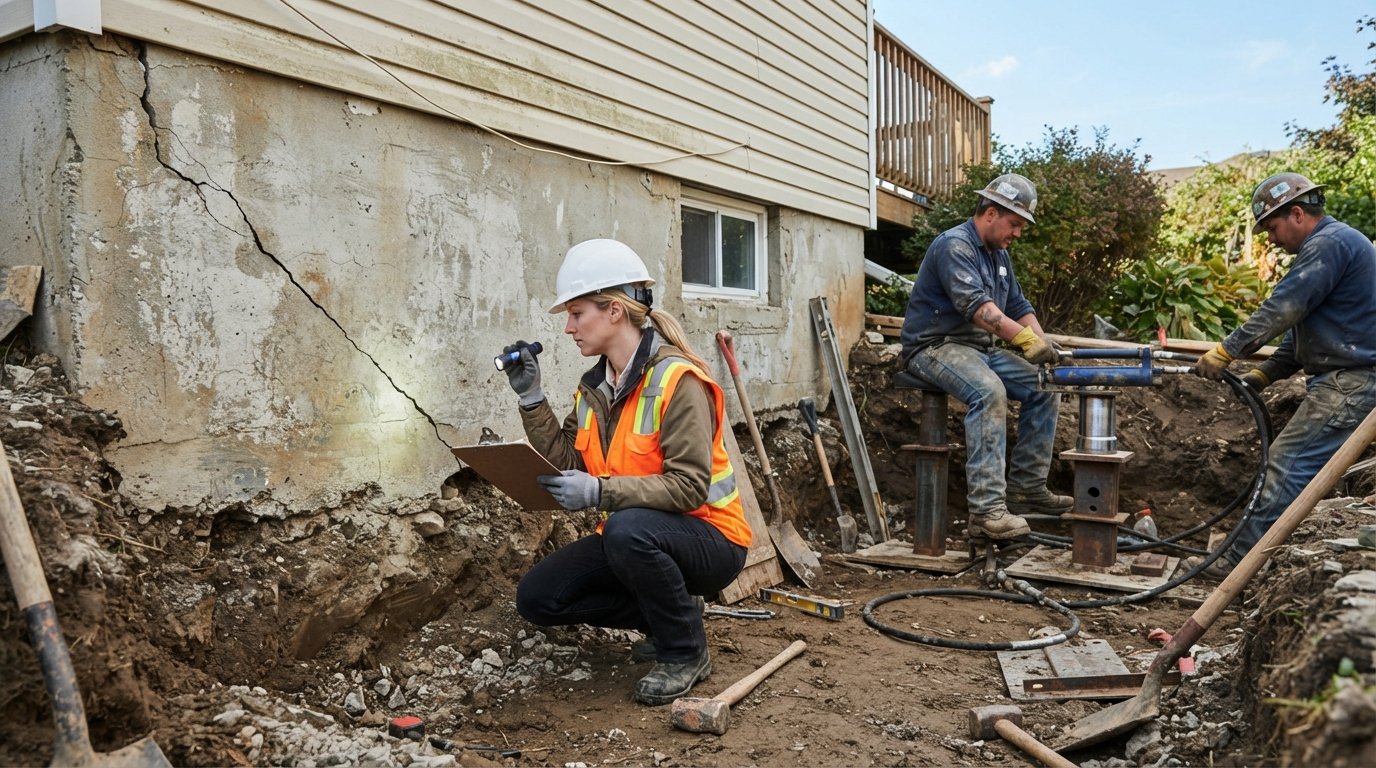
Foundation Underpinning Cost for Structural Repair
Foundation underpinning for structural repair typically runs $8,000 to $40,000. Learn what drives the cost of foundation underpinning before you compare quotes.

By Joshua Benson
Learn more about Foundation Repair for guides, costs, and what to expect.
Compare Foundation Repair Pros Near You

Enter your ZIP code to compare top-rated local professionals and request free quotes.
A crack running diagonally across your living room wall. A door that sticks no matter how many times you plane it. A floor that feels like it is sloping toward the street. These are the quiet signals that a foundation has begun to fail, and they rarely fix themselves. When a structural engineer confirms that underpinning is necessary, the first question almost every homeowner asks is simple: what will this actually cost? The answer depends on far more than square footage. Soil conditions, access, depth, and the chosen method all move the number, sometimes by tens of thousands of dollars. Understanding the cost of foundation underpinning for structural repair before you call a contractor puts you in a position to compare bids intelligently, spot outliers, and avoid the panic pricing that often follows a scary inspection report.
What Foundation Underpinning Actually Involves
Underpinning is the process of strengthening or stabilizing the foundation of an existing structure by extending its support to deeper, more competent soil or bedrock. It is different from a simple crack injection or cosmetic patching. Those repairs address symptoms. Underpinning addresses the load path itself. When soil beneath a footing has settled, eroded, or lost bearing capacity, the foundation above it moves. Underpinning transfers that load to a stratum that will not move.
The work typically begins with a geotechnical evaluation and a structural engineer's report. That report determines whether underpinning is the right solution or whether drainage correction, soil grouting, or a less invasive repair will suffice. Assuming underpinning is required, the contractor will excavate or drive supports to a specified depth, then connect those supports to the existing footing through brackets, pins, or a new concrete extension. The connection detail matters as much as the depth. A poorly engineered bracket can transfer load unevenly and create new cracking elsewhere.
Because underpinning is invasive and often performed in tight spaces, labor dominates the cost. Equipment access, excavation volume, and the need for temporary shoring all drive the final price. A project in an open suburban yard is a different financial animal from one in a zero-lot-line home with a finished basement and mature landscaping.
The Main Underpinning Methods and Their Price Ranges
There is no single price for underpinning because there is no single method. Each approach solves a different problem, and each carries its own cost profile. The table below reflects typical U.S. ranges as guidelines; actual quotes vary by region, soil, and project scope.
- Resistance piers (push piers): $1,200 to $2,500 per pier installed. Best for homes where bedrock or dense strata sit within reach and the structure needs lifting.
- Helical piers: $1,500 to $3,000 per pier. Ideal for lighter structures, tension loads, and sites where vibration must be minimized.
- Concrete piers or pads: $1,000 to $2,000 per pier. Traditional and effective in stable, well-drained soils but slower and more excavation-heavy.
- Mudjacking or slabjacking: $500 to $1,500 per project area. Cheaper but only suitable for void filling and minor slab lifting, not deep structural failure.
- Chemical grouting: $1,000 to $3,000 per zone. Useful for compacting loose, sandy soils before or instead of piering.
Most residential underpinning projects require between four and twelve piers, though larger homes or severe settlement patterns can require twenty or more. A typical single-family home with moderate settlement often lands between $8,000 and $25,000. Severe cases, deep piers, or difficult access can push past $40,000. The per-pier price is only one input; engineering, permits, excavation, restoration, and drainage corrections frequently add 20 to 40 percent to the base pier cost.
Homeowners should also distinguish between stabilization and lift. Stabilizing a foundation stops further movement. Lifting it attempts to return the structure to level. Lifting is riskier, slower, and more expensive, and not every home is a candidate. A structural engineer will specify a target lift, often measured in fractions of an inch, and the contractor will work toward that target over multiple visits.
What Drives the Cost of Foundation Underpinning for Structural Repair
Two homes on the same street can receive underpinning quotes that differ by $15,000. That gap is rarely arbitrary. It reflects real differences in site conditions, engineering requirements, and contractor overhead. Understanding the variables helps you read a bid instead of just comparing the bottom line.
Soil and geology sit at the top of the list. Expansive clay, organic fill, and high water tables force deeper piers and more conservative designs. Bedrock near the surface reduces depth and cost. A geotechnical report is not optional; it is the document that prevents a contractor from guessing. If a bid omits soil investigation, treat it as incomplete.
Access and excavation follow closely. A pier installed in an open yard with a skid steer is a different job from one installed inside a finished basement where the contractor must cut concrete, hand-dig, and haul spoils through a window. Interior work adds labor hours, dust control, and restoration. Landscaping, decks, porches, and driveways that must be removed and rebuilt add cost that is easy to overlook until the quote arrives.
Engineering, permits, and inspections are non-negotiable line items in most jurisdictions. A stamped structural drawing, a geotechnical report, and municipal permits can add $1,500 to $5,000 before a single pier is installed. Skipping permits to save money is a false economy that can complicate resale and insurance claims.
Finally, contractor credentials and warranty terms influence price. A licensed, insured contractor with a transferable warranty charges more than a fly-by-night operator, and for good reason. The warranty is often the most valuable part of the contract. When comparing bids, read the warranty language as carefully as the price. For a deeper walkthrough of how to read these documents, see our guide on understanding foundation repair quotes.
Regional Price Variation and What Homeowners Should Expect
Underpinning costs vary significantly by region because labor rates, soil conditions, and permitting requirements differ. In broad terms, homeowners in high-cost coastal metros should expect quotes at the upper end of national ranges, while homeowners in the Midwest and South often see lower labor rates but may face deeper piers due to expansive clay.
It is also worth noting that underpinning is rarely a standalone project. Drainage correction, downspout extensions, grading, and sometimes root removal are often required to prevent the same settlement from recurring. A responsible contractor will include these items or flag them explicitly. A bid that ignores water management is a bid that may lead to a second repair in five years.
Homeowners should obtain at least three quotes and compare them line by line: number of piers, depth, method, engineering, permits, restoration, and warranty. The cheapest bid is frequently the one that omits the most. The most expensive bid is not automatically the best. The goal is a complete, comparable scope from a contractor you can verify.
If you are still in the early research stage and want to compare vetted local professionals without obligation, FreeQuotes.Contractors connects homeowners with pre-screened contractors for foundation and structural work. Getting multiple quotes is the single most effective way to pressure-test pricing and scope.
How to Budget and Avoid Surprise Bills
A foundation repair is rarely a planned expense. It arrives after an inspection, a storm, or a crack that suddenly looks worse. That makes budgeting difficult, but not impossible. The key is to separate the known costs from the contingent ones and to build a contingency into your plan from the start.
Start with the engineer's report. It should specify the method, the number of piers, the target depth, and any ancillary work. Use that report as the basis for every bid you request. Contractors bidding on the same scope produce comparable numbers. Contractors bidding on vague descriptions produce chaos.
Then build a budget that includes the following categories:
- Engineering and geotechnical investigation: $1,000 to $4,000.
- Permits and inspections: $300 to $1,500.
- Underpinning installation: $8,000 to $40,000 depending on method and count.
- Restoration (concrete, landscaping, basement finishes): $1,000 to $10,000.
- Drainage corrections and preventive work: $500 to $5,000.
Add a contingency of 10 to 15 percent for conditions discovered during excavation. Contractors cannot always know what is beneath a footing until they open it. A contingency is not a sign of a bad plan; it is a sign of a realistic one.
Financing options matter too. Some contractors offer payment plans, and some lenders specialize in home improvement financing. If the repair is tied to an insurance claim, document everything and keep the engineer's report, photos, and invoices together. Insurance coverage for foundation failure varies widely and often depends on whether the cause was a covered peril or long-term settlement.
Choosing the Right Contractor for Structural Work
Underpinning is not a job for a general handyman. It requires engineering knowledge, specialized equipment, and experience with the specific soil conditions in your area. The contractor you choose will determine whether the repair lasts decades or fails within a few years.
Verify licensing and insurance first. Ask for the license number and confirm it with your state or provincial authority. Request a certificate of insurance and call the insurer to confirm active coverage. Then ask for references from projects similar to yours, ideally completed at least three to five years ago so you can assess long-term performance.
Review the contract carefully. It should include the engineer's specification, the number and depth of piers, the method, the warranty terms, the payment schedule, and the restoration scope. Avoid contracts that require large upfront payments. A reasonable deposit is typically 10 to 30 percent, with the balance tied to milestones.
Finally, trust your instincts. A contractor who pressures you to sign immediately, discourages a second opinion, or cannot explain the engineering behind the repair is not the contractor you want holding up your house. The right professional will welcome questions and provide documentation without hesitation.
Foundation underpinning is a significant investment, but it is also an investment in the safety and value of your home. Understanding the cost of foundation underpinning for structural repair, from per-pier pricing to the hidden line items that drive the final invoice, lets you approach the project with clarity. Get the engineering done, gather multiple quotes, compare scopes rather than just totals, and choose a contractor who can explain exactly what will happen beneath your foundation. Do that, and you will be in a far stronger position than most homeowners facing the same repair.