
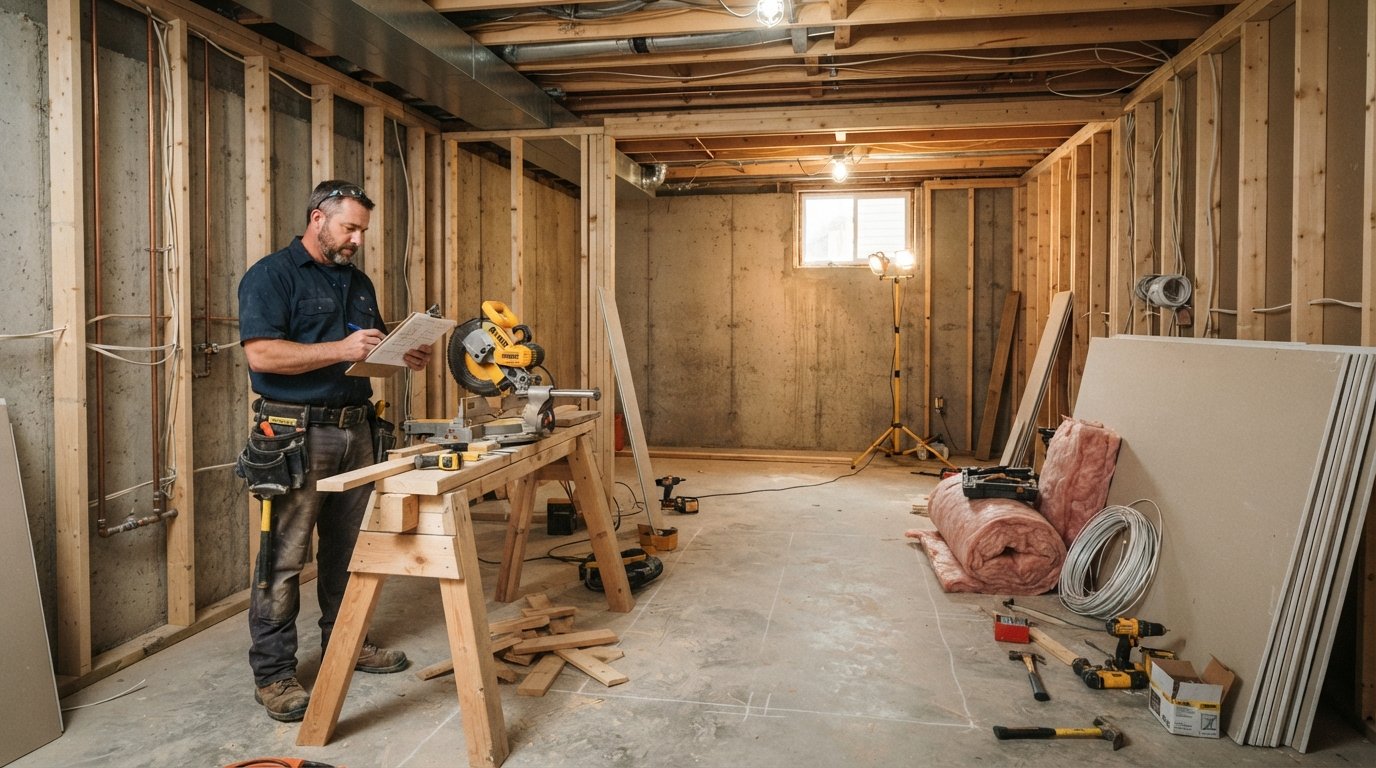
Basement Finishing Cost Per Square Foot Breakdown
Get a clear basement finishing cost per square foot breakdown, from framing to flooring. Call 8333658755 for expert help planning your budget.

By Peter Hubert
Learn more about Basement Finishing or Remodeling for guides, costs, and what to expect.
Compare Basement Finishing or Remodeling Pros Near You

Enter your ZIP code to compare top-rated local professionals and request free quotes.
Finishing a basement is one of the most reliable ways to add usable living space without expanding your home's footprint. Yet the single biggest question homeowners ask is simple: what will it actually cost? The answer rarely comes as one clean number, because basement finishing is really a collection of separate projects, framing, electrical, plumbing, insulation, drywall, flooring, and trim, each with its own price tag. Understanding how those pieces stack up per square foot is the fastest way to build a realistic budget and avoid the shock of a bid that lands far above your expectations.
This guide breaks down the basement finishing cost per square foot by category, explains what pushes your project toward the low or high end, and shows how to compare contractor quotes with confidence. Whether you are planning a simple rec room or a full suite with a bathroom and wet bar, the figures below give you a working framework, not a guarantee, since local labor rates and material choices always move the final number.
National Basement Finishing Cost Per Square Foot at a Glance
Across the United States, most finished basements land somewhere between $30 and $75 per square foot, with the national average hovering near $50 per square foot. That spread is wide because the scope of work varies enormously. A basic open room with painted ceilings and vinyl plank flooring sits at the bottom of the range, while a fully built-out space with a bathroom, kitchenette, egress windows, and custom built-ins climbs toward the top or beyond.
It helps to think in tiers. A minimal finish, sometimes called a partial finish, typically runs $30 to $50 per square foot and covers framing, insulation, drywall, basic electrical, and budget flooring. A mid-range finish runs $50 to $75 per square foot and adds better materials, recessed lighting, a dropped ceiling or drywall ceiling, and perhaps a simple bathroom rough-in. A high-end finish can exceed $75 to $100 or more per square foot once you add full bathrooms, wet bars, home theaters, custom cabinetry, and premium flooring.
For a concrete example, a 700 square foot basement finished at $50 per square foot comes to roughly $35,000. The same space at $80 per square foot reaches $56,000. That difference usually comes down to wet areas, ceiling height, and how much custom work you request. Our companion guide on basement remodeling costs and ideas explores how design choices shift these totals even further.
Line-Item Breakdown of Basement Finishing Costs
Contractors rarely quote a single blended rate. Instead, they price each trade, then add overhead and profit. Seeing those line items per square foot helps you spot where your money goes and where you can trim without sacrificing quality. The ranges below reflect national averages for a typical 600 to 1,000 square foot basement and assume the space is already dry and structurally sound.
- Framing and structural prep: $3 to $8 per square foot for steel studs, furring strips, and soffits around ducts and beams.
- Insulation and vapor barrier: $1.50 to $4 per square foot, with rigid foam or spray foam costing more than batts.
- Electrical and lighting: $4 to $10 per square foot for outlets, switches, recessed lights, and a subpanel upgrade if needed.
- Plumbing rough-in (if adding a bath or bar): $3 to $12 per square foot, heavily dependent on whether a bathroom exists above.
- Drywall, taping, and ceiling: $4 to $9 per square foot, with dropped ceilings cheaper than drywall ceilings.
- Flooring: $3 to $12 per square foot installed, from luxury vinyl plank to engineered hardwood or tile.
- Doors, trim, and paint: $3 to $7 per square foot for interior doors, baseboards, casing, and finish coats.
- Permits, design, and cleanup: $2 to $5 per square foot, higher in metro areas with strict inspections.
Add those categories together and you land squarely in the $30 to $75 per square foot zone, which is why the blended rate is a useful shortcut but a poor planning tool on its own. If your contractor hands you one lump sum with no line items, ask for the breakdown. A transparent bid protects you from surprise change orders later.
What Drives Your Cost Up or Down
Two basements of identical square footage can differ by tens of thousands of dollars, and the reasons are predictable. Moisture is the first factor. A basement with a history of seepage needs waterproofing, a sump pump, or interior drainage before any finishing begins, and that work can add $5,000 to $15,000 before a single stud goes up. Skipping it invites mold and ruined drywall within a year or two.
Ceiling height matters almost as much. Standard eight-foot ceilings are simple to finish. Anything below seven feet requires soffits, bulkheads, or careful planning around ducts, and very low ceilings may need excavation, which is a major expense. Adding a bathroom is the other big swing factor, since breaking concrete for drains and venting can run $5,000 to $20,000 depending on access to existing plumbing.
Egress windows deserve special mention. Bedrooms require a code-compliant escape window, and cutting a foundation wall plus installing the window and well typically costs $3,000 to $7,000 each. Local labor rates, permit fees, and material availability also shift the final number, which is why the same project in a rural area can cost far less than in a major coastal city.
How to Compare Basement Finishing Quotes
Once you have three or more bids in hand, the lowest number is not automatically the best value. Compare what each contractor includes, because a cheap quote often excludes permits, insulation, or ceiling finishes that the others price in. A useful approach is to line up the bids against the same checklist so differences jump out immediately.
- Verify that each bid lists labor and materials separately for every trade.
- Confirm who pulls the permits and whether inspection fees are included.
- Check the scope for moisture control, insulation type, and ceiling treatment.
- Ask how change orders are priced and whether there is a written cap.
- Review the payment schedule and warranty terms before signing.
It also helps to request quotes from pre-screened professionals rather than cold-calling random listings. Platforms such as FreeQuotes.Contractors connect homeowners with vetted local contractors and provide free, no-obligation estimates, which makes it easier to gather several comparable bids in one place. Just remember that any estimate is a guideline, and actual pricing depends on your region, market conditions, and the specific details of your project.
Where to Save Money Without Cutting Corners
Budget-conscious homeowners can trim costs in several places without sacrificing durability. Handling demolition and cleanup yourself can save $1 to $3 per square foot, provided you dispose of debris properly. Choosing luxury vinyl plank over engineered hardwood, or a dropped ceiling over drywall, reduces material and labor costs while still looking polished. Reusing existing lighting layouts and keeping plumbing fixtures on shared walls also avoids expensive rough-in work.
What you should not cut is moisture protection, proper insulation, or licensed electrical work. These are the items that protect your investment and keep your family safe. A finished basement done right can return 70 percent or more of its cost at resale, while a rushed job that traps damp air can become a liability you have to tear out and redo.
Before you commit, gather at least three written estimates, ask each contractor for references from similar projects, and confirm licensing and insurance. With a clear per-square-foot framework in hand, you can walk into those conversations knowing exactly which numbers are reasonable and which ones deserve a second look.